(To locate specific authors, consult the index.)
1. Four trenches lie beyond this area shown in Figure 1: the Peru-Chile Trench, the Middle America Trench, the South Sandwich Trench, and the Puerto Rico Trench. (The latter may simply be a submarine canyon.)
Why are a few trenches not in the concentrated trench region in the western Pacific? After studying this entire chapter, especially “Magma Production and Movement” on page 166, you will see that major faulting (shearing) deep inside the Earth would not always have been under the western Pacific. On rare occasions it would have occurred elsewhere, such as along continent-plate boundaries where the Peru-Chile Trench and the Middle America Trench are today.
2. “[At least 19 studies have shown] that silicate liquids are more compressible than silicate crystals,” Carl B. Agee, “Crystal-Liquid Density Inversions in Terrestrial and Lunar Magmas,” Physics of the Earth and Planetary Interiors, Vol. 107, 1998, p. 63.
3. “It is perhaps especially remarkable that some material was recovered from the depths exceeding 7000 m in the trenches, even right down to the bottom of the Philippine Trench. ... plant remnants, making them fossils [that are] rather surprising in the deep sea.” Anton F. Bruun, “General Introduction to the Reports and List of Deep-Sea Stations,” Galathea Report: Scientific Results of the Danish Deep-Sea Expedition Round the World 1950–1952, editors Anton F. Bruun, S. Greve, and R. Spärck (Copenhagen: Nordlundes Bogtrykkeri, 1957), p. 15.
4. Robert L. Fisher and Roger Revelle, “The Trenches of the Pacific,” Continents Adrift (San Francisco: W. H. Freeman and Co., 1972), p. 15.
5. Gordon A. Macdonald et al., Volcanoes in the Sea, 2nd edition (Honolulu: University of Hawaii Press, 1983), p. 330.
6. Fisher and Revelle, p. 12.
7. Jane Qiu, “Expedition Probes Ocean Trench’s Deepest Secrets,” Science, Vol. 355, 13 January, 2017, p. 115.
8. “... earthquakes do indeed serve to make the Earth more compact, thus decreasing its moment of inertia and, because they leave total angular momentum unchanged, increasing the rotation speed and thus decreasing the length of the day, which is what would be expected.” John Maddox, “Earthquakes and the Earth’s Rotation,” Nature, Vol. 332, 3 March 1988, p. 11.
While each major earthquake suddenly causes the Earth to spin slightly faster, continuous tidal effects steadily slow the Earth’s spin. The latter effect, detected by atomic clocks, dominates over long time periods. [See pages 593– 596.]
“Meanwhile, the questions remain of why the effect of earthquakes on the Earth’s rotation should have the effect of predominantly decreasing the polar moment of inertia ...” Ibid.
Answer: Gravity always tries to squeeze the Earth into a more spherical, compact shape. During the early stages of the global flood, the fountains of the great deep redistributed massive amounts of rock, making the Earth less spherical. The imbalance grew even more toward the end of the flood, as gravity suddenly shifted material within the inner Earth, caused rapid continental drift, and formed Earth’s three major oceans: the Atlantic, Pacific, and Indian Oceans.
Today, aftershocks follow each major earthquake, as the inner Earth adjusts locally to the earthquake’s sudden redistribution of mass near the fault. Likewise, today’s earthquakes are simply aftershocks caused by major shifts of mass during the flood.
9. “... seismic waves passing beneath continents traveled faster than those passing beneath ocean basins.” Richard A. Kerr, “The Continental Plates Are Getting Thicker,” Science, Vol. 232, 23 May 1986, pp. 933–934.
u “Seismic models of global-scale lateral heterogeneity in the mantle show systematic differences below continents and oceans that are too large to be purely thermal in origin.” Alessandro M. Forte et al., “Continent-Ocean Chemical Heterogeneity in the Mantle Based on Seismic Tomography,” Science, Vol. 268, 21 April 1995, p. 386.
10. On 25 March 1998, the largest earthquake in 4 years and one of the largest ever recorded on the ocean floor struck inside the Antarctic plate, 350 kilometers from the nearest plate boundary. [See Richard Monastersky, “Great Earthquake Shakes Off Theories,” Science News, Vol. 154, 5 September 1998, p. 155.] Powerful intraplate earthquakes have also occurred near Lisbon, Portugal (1755), New Madrid, Missouri (1811, 1812), and Charleston, South Carolina (1886).
11. “It has long been known that impoundment of reservoirs, surface and underground mining, withdrawal of fluids and gas from the subsurface, and injection of fluids into underground formations are capable of inducing earthquakes.” William L. Ellsworth, “Injection-Induced Earthquakes,” Science, Vol. 341, 12 July 2013, p. 142.
12. “Now changes in local gravity resulting from large earthquakes can be detected.” Fred F. Pollitz, “A New Class of Earthquake Observations,” Science, Vol. 313, 4 August 2006, p. 619.
u Shin-Chan Han et al., “Crustal Dilation Observed by GRACE After the 2004 Sumatra-Andaman Earthquake,” Science, Vol. 313, 4 August 2006, pp. 658–661.
13. “The available seismic data show that the primary stress field results from more or less horizontal tension—at right angles to the axis of the trench—at most depths.” William F. Tanner, “Deep-Sea Trenches and the Compression Assumption,” The American Association of Petroleum Geologists Bulletin, Vol. 57, November 1973, p. 2195.
14. Maya Tolstoy et al., “Breathing of the Seafloor: Tidal Correlations of Seismicity at Axial Volcano,” Geology, Vol. 30, June 2002, pp. 503–506.
u “... tidal effects on earthquakes were not accepted until recently. ... The records showed high seismic activity at or just after low tide. The earthquake frequency nearly doubled at the lowest tides ...” Junzo Kasahara, “Tides, Earthquakes, and Volcanoes,” Science, Vol. 297, 19 July 2002, pp. 348–349.
15. The volume of the liquid outer core is 1.7 × 10¹¹ km3, the area of the Pacific Ocean is 7.3 × 10⁷ km2, and the densities of the lower mantle and outer core are 5.5 and 10.1 gm/cm3, respectively. The Pacific plate began subsiding within hours after the continental plates started moving away from the rising Mid-Atlantic Ridge. After the first 1% of the magma in the outer core had formed, the Pacific plate had subsided about 30 miles (48 km), enough to prevent any interference with the sliding hydroplates.

 Along with this subsidence, Earth’s surface water shifted violently from above the upward bulging chamber floor on the Atlantic side of the Earth onto the subsiding Pacific plate. That massive shift in weight could have pushed the inclining hydroplates past their tipping point.
u “Elsewhere, such as around the borders of the Pacific, most of the subsidence appears to have taken place by faulting.” Kenneth K. Landes, “Our Shrinking Globe,” Bulletin of the Geological Society of America, Vol. 63, March 1952, p. 227.
16. “Here we present support for a response of the El Niño/Southern Oscillation (ENSO) phenomenon to forcing from explosive volcanism ... The results imply roughly a doubling of the probability of an El Niño event occurring in the winter following a volcanic eruption.” J. Brad Adams et al., “Proxy Evidence for an El Niño-Like Response to Volcanic Forcing,” Nature, Vol. 426, 20 November 2003, p. 274.
17. “Tremor often happens along with slow slip, although sometimes it crops up before or after slow slip, or not at all. Occasionally tremor reverses direction for a little while. Why that happens remains a mystery.” Alexandra Witze, “Quakes in Slo-Mo,” Science News, Vol. 183, 23 March 2013, p. 28.
u Garry Rogers and Herb Dragert, “Episodic Tremor and Slip on the Cascadia Subduction Zone: The Chatter of Silent Slip,” Science, Vol. 300, 20 June 2003, pp. 1942–1943.
u “But so far, no one can explain why these slow earthquakes happen or what they portend.” Carrie Arnold, “Let’s Take It Slow,” Discover, April 2014, p. 16.
18. Mark D. Zoback, “State of Stress and Crustal Deformation Along Weak Transform Faults,” Philosophical Transactions of the Royal Society of London, Vol. 337, 15 October 1991, pp. 141–150.
19. “The basaltic magma could not ascend from a position deeper than 200 km in the Earth’s interior.” Satoru Urakawa et al., “Anomalous Compression of Basaltic Magma,” Research Frontiers 2006, p. 114. Also available at www.spring8.or.jp/pdf/en/res_fro/06/113-114.pdf.
u “Magmas are normally less dense than coexisting crystals at atmospheric pressure, but they are more compressible than crystals. More than two decades of experimental studies have shown that the density of magmas can be higher than that of coexisting crystals at high pressure.” Ibid, p. 113.
u When the mineral perovskite (Mg,Fe)SiO3 melts at high (mid-mantle) pressures, the mineral’s iron and magnesium preferentially leave the solid and enter the melt, making the magma denser. [See Ryuichi Nomura et al., “Spin Crossover and Iron-Rich Silicate Melt in the Earth’s Deep Mantle,” Nature, Vol. 473, 12 May 2011, pp. 199–202.]
u These experimental results, by themselves, should kill the idea that the mantle as a whole circulates as a convecting fluid.
u Magma will dissolve certain material as it rises or sinks. If denser material is dissolved, its rise will be slowed or stopped. If volatiles or lighter material is dissolved, the magma rise will increase or maybe rise explosively.
20. Thanks to Kevin S. Elam, Nuclear Engineer, for pointing this out to me on 10 January 2018.
21. A concentrated load on a thick solid (such as the Earth) produces s154tresses inside the solid. The stresses spread out laterally, in proportion to their depth below the surface.
22. Rocks deep inside the Earth are under high and fairly uniform compressive stresses. As explained on page 166, such solids, if they fail (break), will fail by shearing. At each point inside the Earth, the maximum shearing stress occurs on a plane oriented 45° to the planes of principal stress. The principal stresses produced by the rising of the Atlantic floor and the downward pull on the Pacific plate are approximately vertical and horizontal. Therefore, maximum shearing stress—and Benioff zones—will occur at about a 45° angle to the horizontal. For more information, consult any introductory textbook on “strength of materials”; look for the subject of “Mohr’s Circle.”
One can also conclude that the principal stresses that produced Benioff zones had to be applied suddenly. Had they been applied over many years, slow deformations, called creep, would have removed the shearing stresses.
23. Movements within the mantle during and soon after the flood would have generated much heat and melting. Denser elements (such as nickel and iron) would have settled gravitationally, releasing even more heat which, in turn, melted other parts of the mantle, allowing more gravitational settling. This would explain why (a) temperatures inside the Earth increase with depth, (b) the Earth has a core, (c) the outer core is a liquid while the inner core is a solid, (d) denser elements are concentrated nearer the center of the Earth, (e) the inner core spins faster than the rest of the Earth, (f) many early cultures thought the Earth had a 360-day year (Endnote 35), and (g) Earth’s density almost doubles as one passes down through the core-mantle boundary. [See the highlighted red cells on page 604.]
Evolutionists say the Earth formed by meteoritic bombardment. While meteoritic bombardment might explain (a)–(d) above, it is contradicted by (e)–(g). Also, meteoritic bombardment would melt the entire Earth several times over and create other problems. [See “Consequences of Evolving Earth by Meteoritic Bombardment” on page 626.]
Had that occurred, we would not find dense, nonreactive elements, such as gold, at the Earth’s surface. But we do! Besides, granite rocks have never melted. [See “Geothermal Heat” on page 123.] A molten Earth, after billions of years of cooling, would not produce the temperature patterns we see inside the Earth. [See “Rapid Cooling” on page 44.] Meteoritic bombardment would also add too much xenon to the Earth’s atmosphere. [See “Molten Earth?” on page 33 and page 91.] And finally, meteoritic bombardment presupposes the prior existence of meteoroids, whose origin, as currently taught, has many problems. [See pages 349– 375.] Belief in a once-molten Earth has led many to believe that the Earth is billions of years old.
24. “Two deep holes, drilled on opposite sides of Eniwetok Atoll, reached the basement below the cap of Recent to Eocene limestone at depths of 4,610 and 4,158 feet.” Seymour O. Schlanger, Subsurface Geology of Eniwetok Atoll, Geological Survey Professional Paper 260–BB (Washington, D.C.: United States Government Printing Office, 1963), p. 991.
u Harry S. Ladd, “Drilling of Eniwetok Atoll, Marshall Islands,” American Association of Petroleum Geologists Bulletin, Vol. 37, October 1953, pp. 2257–2280.
25. See “Volcanic Gases” on page 269.
26. “Our main conclusion is that abyssal-hill-like topography may result from continuous stretching of a brittle layer.” W. Roger Buck and Alexei N. B. Poliakov, “Abyssal Hills Formed by Stretching Oceanic Lithosphere,” Nature, Vol. 392, 19 March 1998, p. 275.
27. S. P. Kelley and J-A. Wartho, “Rapid Kimberlite Ascent and the Significance of Ar-Ar Ages in Xenolith Phlogopites,” Science, Vol. 289, 28 July 2000, pp. 609–611.
u Sylvie Demouchy et al., “Rapid Magma Ascent Recorded by Water Diffusion Profiles in Mantle Olivine,” Geology, Vol. 34, June 2006, pp. 429–432.
28. Jesse F. Lawrence and Michael E. Wysession, “Seismic Evidence for Subducted-Transported Water in the Lower Mantle,” Earth’s Deep Water Cycle, editors Steven Jacobsen and Suzan van der Lee (Washington, D.C.: American Geophysical Union Monograph, 2006), pp. 251–261.
29. See “Highly Compressed Solids” on page 625.
30. We sometimes see this on a small scale when soil below a concrete slab settles or becomes more compact. Without support, the slab cracks vertically, and one side of the slab settles below the other. If the slab were also compressed horizontally, as was the subsiding Pacific hydroplate, the crack would depart from the vertical, at angles comparable to those of Benioff zones. Sediments blanketing the crack would take the shape of a trench.
31. “... strong evidence that seismic waves traveling through the inner core along the axis of the magnetic poles complete their trip through Earth about four seconds more quickly than do waves traveling from one side of the equator to the other.” Susan Kruglinski, “Journey to the Center of the Earth,” Discover, June 2007, p. 55.
32. Jeff Hecht, “The Giant Crystal at the Heart of the Earth,” New Scientist, 22 January 1994, p. 17.
u “In the mid-1980s, scientists from Harvard University first noticed an unusual feature of Earth’s core: Seismic waves tended to travel fastest when they paralleled Earth’s axis of rotation. Their speed dropped by as much as 3 percent when the waves moved perpendicular to the rotation axis. The seismologists who discovered this asymmetry explained it by suggesting that the iron crystals in the core point toward the poles and thus transmit seismic waves fastest when they travel that way. This pattern may develop from the way Earth’s magnetic field orients the crystals that solidify on [or that settle on] the surface of the inner core.” Richard Monastersky, “Earth’s Core Out of Kilter,” Science News, Vol. 145, 16 April, 1994, p. 250.
Regardless of how the solid crystals arrived at the surface of the inner core, they are aligned with Earth’s magnetic field. Therefore, those crystals must have had their own magnetic field, which means that each crystal added to Earth’s magnetic field despite the high temperatures. [See “The Origin of Earth’s Powerful Magnetic Field” on page 194.
33. Xiaodong Song and Paul G. Richards, “Seismological Evidence for Differential Rotation of the Earth’s Inner Core,” Nature, Vol. 382, 18 July 1996, pp. 221–224.
34. For the reasons explained in Figure 2 on page 163, the growing inner core had more angular momentum per unit volume than the same volume of the inner Earth had before the core began to form. Because angular momentum is conserved, the rest of the Earth had to loose a like amount of angular momentum. That means that as the inner core was forming after the flood, the outer Earth’s spin rate slowed for some unknown period(s) of time. Days would have been slightly longer for one or more short time intervals.
u “Two years ago, a pair of seismologists discovered evidence that the inner core is dancing to its own beat, spinning measurably faster than the rest of the planet. ... Since then, two other studies have bolstered the concept of an independently rotating inner core ...” Richard Monastersky, “The Globe Inside Our Planet: Earth’s Inner Core Is Turning Out To Be an Alien World,” Science News, Vol. 154, 25 July 1998, p. 58.
u John E. Vidale et al., “Slow Differential Rotation of the Earth’s Inner Core Indicated by Temporal Changes in Scattering,” Nature, Vol. 405, 25 May 2000, pp. 445–447.
u “Our results confirm that Earth’s inner core is rotating faster than the mantle and crust at about 0.3° to 0.5° per year.” Jian Zhang et al., “Inner Core Differential Motion Confirmed by Earthquake Waveform Doublets,” Science, Vol. 309, 26 August 2005, p. 1357.
u The inner core’s spin should be slowing relative to the rest of the Earth—but very slowly, because the resisting outer core is a liquid and the inner core is so massive.

PREDICTION 12: When greater precision is achieved in measuring the inner core’s rotational speed, it will be found to be slowing relative to the rest of the Earth.
Because the inner core is still spinning slightly faster than the rest of the Earth, friction must be slowing the spin of the inner core. If the Earth were billions of years old, why hasn’t the inner core stopped spinning relative to the rest of the Earth? Clearly, the Earth is not billions of years old, and events of the flood that formed the inner and outer core happened only about 5,000 years ago.
35. When the flood began, the year likely had 360 days.
u “Discovered calendars from civilizations around the world universally reckoned the year as consisting of 360 days, with 12 months of 30 days each.” Thomas Mitchell, preface to The Ancient 360 Day Year, by Dale W. Wong (Charleston, South Carolina: Advantage Media Group, 2006).
u Velikovsky showed—from writings of the Persians, Incas, Egyptians, Chinese, Chaldeans, Assyrians, Babylonians, Hebrews, Greeks, Hindus, Romans, Aztecs, Mayas, and Peruvians—that a 360-day calendar prevailed in much of the ancient world. [See Immanuel Velikovsky, “The Year of 360 Days,” in Worlds in Collision (Garden City, New York: Doubleday & Company, Inc., 1950), pp. 330 – 359.]
Velikovsky thought that gravitational encounters with Venus and Mars altered Earth’s orbit and produced our 365-day year. Those promoting this idea could have demonstrated its feasibility with a computer simulation. They have not. Besides, Carl Sagan demolished Velikovsky’s explanation in “An Analysis of Worlds in Collision.” [See Scientists Confront Velikovsky, editor Donald Goldsmith (Ithaca, New York: Cornell University Press, 1977), pp. 41–104.]
u Early Egyptians assumed a 360-day year, until they realized that the Nile was flooding later and later each year according to that calendar. Because Egypt’s earliest settlers probably would not have adopted a 360-day year while in Egypt, they presumably brought that outdated understanding with them. [See J. Norman Lockyer, The Dawn of Astronomy (Cambridge, Massachusetts: The M.I.T. Press, 1964), pp. 243–248.]
u Babylonian astronomers, thousands of years ago, divided a circle into 360 degrees. Why did they choose 360, instead of something easier, such as 100 or 1,000? Probably because a year had 360 days before the flood—one degree for each day of the year. This would have been the average daily motion of the Sun among the stars, a relatively easy measurement.
If so, either Earth’s spin rate or its orbital period around the Sun increased during the flood. Increasing Earth’s orbital period requires a large, unknown energy source; increasing the spin rate does not, so the spin rate probably increased.
u See paragraph 6 on page 487 for an insight from the most detailed record of a year in very ancient times.
36. “The kinetic energy (~5 x 10 38 ergs) released in the largest impacts (1.5 x 10 27 g at 9 km/sec) would be several times greater than that required to melt the entire Earth.” George W. Wetherill, “Occurrence of Giant Impacts during the Growth of the Terrestrial Planets,” Science, Vol. 228, 17 May 1985, p. 879.
37. “Using constraints from experiments, simulations, and theory, we show that spontaneous crystallization in a homogeneous liquid iron alloy at Earth’s core pressures requires a critical supercooling of order 1000 K, which is too large to be a plausible mechanism for the origin of the Earth’s inner core.” Ludovic Huguet et al. “Earth’s Inner Core Nucleation Paradox,” Earth and Planetary Science Letters, Vol. 487, 1 April, 2018, p. 9.
These authors, trying to solve this “Core Nucleation Paradox,” wonder if a large chunk of the relatively cold mantle, broke off, fell into the hot liquid core, sank, and began the solidification of the inner core. Because the mantle is less dense than the hot liquid in the core, a piece of the mantle would not sink, but could only float. Pieces of the mantle would remain pressed against the bottom of the mantle.
38. “Highly siderophile (iron-loving) elements (Re, Os, Ir, Ru, Rh, Pt, Pd, and Au) must have been added to the mantles of Earth, the Moon, and Mars after their iron cores formed; otherwise the mantles would be devoid of these elements, which tend to be segregated to the core.” Christopher W. Dale, “Coming Late to the Planetesimal,” Science, Vol. 336, 6 April 2012, p. 10.
39. “The shear-wave velocity (Vs) reveals a softer inner core composition than previously thought.” Jessica C. E. Irving, “Earth’s Soft Heart,” Science, Vol. 362, 19 October, 2018, p. 294.
u Hrvoje Tkalcic and Thanh-Son Pham, “Shear Properties of Earth’s Inner Core Constrained by a Detection of J Waves in Global Correlation Wavefield,” Science, Vol. 362, 19 October, 2018, p. 329.
40. Youjun Zang, et al.,”Fe Alloy Slurry and a Compacting Cumulate pile Across Earth’s Inner-core Boundary.” Journal of Geophysical research: Solid Earth, Vol. 124, pp. 1-30.
41. Exactly where on the 46,000-mile-long rupture this instability first occurred depended on several factors. It was the point where the forces acting in one direction overcame the shearing strength of the rock inside the Earth.
42. Cliff Frohlich, “Deep Earthquakes,” Scientific American, Vol. 260, January 1989, p. 52.
43. Shallow earthquakes may involve another phenomenon besides the mechanism explained in Figure 9. Trapped subterranean water, unable to escape during the flood, slowly seeps upward through cracks and faults formed during the crushing of the compression event. (Seismographs on the Pacific Ocean floor have measured tremors from such seepings.)14 The higher this water migrates through a crack, the more the water’s pressure exceeds that in the walls of the crack trying to contain it. Consequently, the crack spreads and lengthens. (So, before an earthquake, the ground often bulges slightly, water levels sometimes change in wells, and geyser eruptions may become more irregular.) Simultaneously, stresses build up in the crust, again driven ultimately by gravity and mass imbalances produced by the flood. Once compressive stresses have risen enough, the cracks have grown enough, and the frictional locking of cracked surfaces has diminished enough, sudden movement occurs. Water acts as a lubricant. (Therefore, large temperature increases are not found along the San Andreas Fault.) Sliding friction instantly heats the water, converts it to steam at an even higher pressure, and initiates a runaway process, one type of shallow earthquake.
44. “ [Deep earthquakes] have posed a fruitful puzzle since their discovery 60 years ago. How can rock fail at the temperatures and pressures that prevail hundreds of kilometers down?” Frohlich, p. 48.
45. Z. Altamimi et al., “A New Release of the International Terrestrial Reference Frame Based on Time Series of Station Positions and Earth Orientation Parameters,” Journal of Geophysical Research, Vol. 112, 2007, pp. 1–19.
u “The world is smaller than we thought - by five millimeters. That is the conclusion of an international project to measure the diameter of the Earth. The last such measurement was made in 2000.” Damian Carrington, “Honey, We Shrunk the Earth,” New Scientist, 6 July 2007, p. 15.
46. “I favor contraction because it can be adapted to explain so many puzzling features in geology that it becomes a veritable panacea.” Landes, p. 226.
47. Five measured points on the ocean floor moved 16–79 feet (5–24 meters) horizontally in the same general direction—toward the epicenter. Vertical movements on the ocean floor and on Japan were much smaller; some points rose and others dropped. [See Mariko Sato et al., “Displacement above the Hypocenter of the 2011 Tohoku-Oki Earthquake,” Science, Vol. 332 17 June 2011, p. 1395.]
Those points probably rose because magma droplets could escape from their tiny pockets before or during the earthquake and pool elsewhere, thereby lifting surfaces. Below 410-mile depths, where earthquakes do not occur, the solid encasement plastically deforms before magma droplets can escape. For more on this, see “Liquid Droplets in Hot Deep Rock” on page 174.
48. The heat required to melt a tiny piece of rock of mass m is m L, where L is the heat of fusion. After that mass drains along a fault down through the mantle from a high elevation h2 where the acceleration due to gravity is g2 to a low elevation h1 where the acceleration due to gravity is g1,
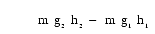
units of potential energy will be released as heat. That drainage occurs down vertical faults in the mantle, into the outer core. The ratio of heat released to heat expended in melting the mass is

If h2 is the height above the center of the Earth of a point halfway between the crossover depth and the top of the outer core, and h1 is the radius of the outer core, then using

(In Table 37 on page 620, L ª 4 × 10⁹ ergs/gm.) The ratio of heat released by draining magma to heat consumed in melting rock along a fault becomes

Even more heat is released throughout the mantle as the tiny pockets, that held the magma droplets, collapse.
49. Have earthquakes increased since the year 2000? The United States Geological Survey reports “As more and more seismographs are installed in the world, more earthquakes can be and have been located. However, the number of large earthquakes (magnitude 6.0 and greater) has stayed relatively constant.” [“Earthquake Facts and Statistics,” http://earthquake.usgs .gov/earthquakes/eqarchives/year/eqstats.php]
Better global communications have made us more aware of earthquakes and their destruction. This has led some to believe that earthquakes are increasing. Nevertheless, earthquakes will someday increase substantially, because heat is building up inside the Earth and the shrinkage of rock that melts below the crossover depth increases stresses in the crust and upper mantle. Also, these microscopic movements inside the Earth generate heat thousands of times faster than heat escapes at the Earth’s surface. This increasing heat melts rock, especially along the relatively hot walls of faults extending from trenches down to the liquid outer core. That melt then lubricates and facilitates further internal movements. [See Endnote 48.]
50. “In this paper we summarize and reassess a variety of geoscience data sets and show that a substantial part of the southwest Pacific Ocean consists of a continuous expanse of continental crust.” Nick Mortimer et al., “Zealandia: Earth’s Hidden Continent,” Geological Society of America Today, Vol. 27, March-April, 2017, p. 2.
51. “The presence of continental-type crust in the oceans where oceanic crust might be expected has been recognized from seismic information by a number of authors.” J. M. Dickins et al., “Past Distribution of Oceans and Continents,” New Concepts in Global Tectonics, editors S. Chatterjee and N. Hotton III (Lubbock, Texas: Texas Tech University Press, 1992), p. 193.
u “Much sialic [continental or granitic] material appears beneath the oceans and we remain skeptical as to the distinction between what is designated continental and oceanic crust. We are surprised and concerned for the objectivity and honesty of science that such data can be overlooked or ignored.” Dickins et al., p. 198.
“Miller (1970), on the basis of structural trends of pre-Mesozoic orogens [folded and faulted mountains], concluded a former sialic (continental) [granitelike] crust, which has now disappeared, was present west of the present coast of Chile.” Ibid., p. 195.
u “Possible presence of continental crust under the ocean has been postulated by Bullin (1980) and Orlenok (1983). They stated the idea that ‘the oceanic crust is thin and graniteless’ is a mistake.” D. R. Choi et al., “Paleoland, Crustal Structure, and Composition under the Northwestern Pacific Ocean,” New Concepts in Global Tectonics, editors S. Chatterjee and N. Hotton III (Lubbock, Texas: Texas Tech University Press, 1992), p. 187.
The unusual seismic characteristics of this layer in the northwestern Pacific have been noted earlier and called “Oceanic Layer 3.” Drilling has not been deep enough to reach it.
u “This 6.5- to 6.8-km/s layer [west of Sumatra] may be either lower continental (granitic) crust or thickened oceanic layer 3. ... Although the 6.5- to 6.8-km/s velocity is high for lower continental (granitic) crust, the large thickness of this layer suggests that it is continental crust, ...” R. M. Kieckhefer et al., “Seismic Refraction Studies of the Sunda Trench and Forearc Basin,” Journal of Geophysical Research, Vol. 85, No. B2, 10 February 1980, pp. 863, 873.
u “The presence of continental crust in the northwestern Pacific casts doubt over the validity of the use of magnetic anomalies for determination of spreading age and rate ... These anomalies are located within the area of continental crust. They appear to coincide with the major fracture patterns accompanied with intrusives ...” Choi et al., p. 188.
u “This provides unequivocal evidence of continental crust in Elan Bank. ... The garnet-biotite gneiss, in particular, indicates continental crust at this south Indian Ocean location.” Shipboard Scientific Party, “Leg 183 Summary, Kerguelen Plateau-Broken Ridge: A Large Igneous Province,” Proceedings, Ocean Drilling Program, Initial Reports, 183, editors M. F. Coffin et al. (College Station, Texas: ODP, 2000), pp. 1–101.
Three other papers describing this expedition’s amazing discoveries of traces of continental crust are in the Journal of Petrology, Vol. 43, July 2002, pp. 1105-1139.
u “Continental basement is known to outcrop at the base of the Rama ridge, the Lucipara ridge (site 304) and the Tukang Besi ridge (site 301).” [These ridges, between Australia and Asia, are typically two or more miles below sea level.] Christian Honthaas et al., “A Neogene Back-Arc Origin for the Banda Sea Basins: Geochemical and Geochronological Constraints from the Banda Ridges (East Indonesia),” Tectonophysics, Vol. 298, 10 December 1998, p. 311.
u “Bathymetry and seismic profiles suggest that continental crust forms the floor of the trenches all the way around the bend from Timor to Seram ...” Robert McCaffrey, “Active Tectonics of the Eastern Sunda and Banda Arcs,” Journal of Geophysical Research, Vol. 93, No. B12, 10 December 1988, pp. 15, 177.
52. L. Don Leet and Sheldon Judson, Physical Geology, 4th edition (Englewood Cliffs, New Jersey: Prentice-Hall, Inc., 1971), p. 420.
53. Macdonald et al., Volcanoes in the Sea, p. 328.
54. Earth’s spin makes the Earth slightly nonspherical. Taking that effect into account would not alter any conclusions in this chapter.
55. “... the tendency of earthquakes [is] to make the Earth rounder, and to pull in mass toward the centre of the Earth.” B. Fong Chao and Richard S. Gross, “Changes in the Earth’s Rotation and Low-Degree Gravitational Field Induced by Earthquakes,” Geophysical Journal of the Royal Astronomical Society, Vol. 91, 1987, p. 569.
“Why do earthquakes strive towards a rounder Earth? [Gravity strives for a rounder Earth. Gravity also drives earthquakes.] Or, conversely, does the Earth’s non-sphericity have any influence on the earthquake mechanism?” Ibid., p. 594. [It has everything to do with earthquakes and shifting continental plates. The next question one should ask is, “What caused the nonsphericity?” Answer: The flood.]
56. “Annual financial losses caused by earthquakes over the world are estimated at 150–250 billion US dollars. Strong earthquakes lead to hundreds of thousands of victims every year.” University College London, “Detection and Monitoring of Earthquake Precursors: TwinSat, a Russian-UK Satellite Project,” www.ucl.ac.uk/mssl/current-projects/formative-projects/twin-sat/twinsat-details.
57. Erik Vance, “Earthquakes in the Sky,” Scientific American, Vol. 319, pp.45–49.
58. “During the past 100 years, Earth’s slowdowns have matched surprisingly well with periods of global increases in the frequencies of magnitude-7 and larger earthquakes.” Paul Voosen, “Sloshing of Earth’s Core May spike Big Quakes, Science, Vol. 358, 3 November, 2017, p. 575.”
59. As more and more magma drains into the outer core, the blocks least anchored to adjacent blocks by friction are lifted, so the topography at the core-mantle boundary should be rough. Seismic studies have confirmed this.
Models with a root mean square core-mantle-boundary topography of 250 to 350 meters and correlation length of 7 to 10 kilometers explain the main features of the data. Paul S. Earle and Peter M. Shearer, “Observations of PKKP Precursors Used to Estimate Small-Scale Topography on the Core-Mantle Boundary,” Science, Vol. 277, 1 August 1997, p. 667.
Therefore, mantle blocks have horizontal dimensions of about 7 to 10 kilometers. This implies that Earth’s mantle may have millions of blocks, each separated by vertical faults.
If the liquid outer core played no role in earthquakes or had been circulating for billions of years, the core-mantle boundary should be quite smooth. It is not.
60. Two powerful earthquakes struck near Mexico City just 12 days apart: an 8.1 magnitude quake on 7 September 2017 that killed 95 people and a 7.1 earthquake on 19 September 2017 that killed 370 people.
Because those earthquakes were only 12 days apart and relatively near each other, most people suspected that the first earthquake trigger the second. However, the experts concluded that the two quakes were too far apart (650 kilometers or 400 miles) for theG163
stresses released by the first quake to cause the second quake, and the 12-day interval was too long for the shaking of the first to trigger the second. [See Alexandra Witze, “Deadly Mexico Quakes Not Linked,” Nature, Vol. 549, 28 September 2017.]
What these experts are missing is that the source of the stresses was not at the Earth’s surface but far below—in the expanding outer core that produces slips along the weakest vertical fault beneath both epicenters. The imbalance caused by each slip then produced earthquakes with a variety of movement directions.
The second quake was not an aftershock, because 32 years earlier that same region experienced an 8.0 earthquake that killed 10,000 people. What the three earthquakes have in common is their region which implicates a deep fault that periodically slips, and a common energy source—the slowly expanding outer core.
61. Seismologists have observed this repeating, almost periodic, pattern for centuries without knowing its underlying cause. Tragically, heat is continually building up inside the Earth, so earthquakes will increase. How fast is uncertain.
62. During these tiny implosions, not all solid points move inward with perfect spherical symmetry. If we visualize a hollow spherical shell collapsing, one side of the shell will begin the breakup. If the collapse begins at the 6 o’clock (bottom) position, the rock above could be lifted, producing a jolting uplift at the Earth’s surface.
63. The piezoelectric effect is explained in Figures 209– 212 on pages 391– 392.
64. “The epicentral distance [where electrical signals were detected days before an earthquake] was 120 km, and the earthquake magnitude was 4.5. ... the earthquake with magnitude 6.1 [had electrical anomalies] at the distance 130 km from the epicenter. ... for earthquakes close to 7.0 it is at least 1400 km.” Sergey Pulinets and Kirill Boyarchuk, Ionospheric Precursors of Earthquakes (New York: Springer-Verlag, 2004), pp. 14–15.
As we would expect, greater stresses appear to produce more powerful electrical effects and earthquakes.
65. See for example “Earthquakes and Electricity” on page 387.
66. Paul Rincon of the British Broadcasting Company reports:
One study looked at over 100 earthquakes with magnitudes of 5.0 or larger in Taiwan over several decades. The researchers found that almost all of the earthquakes down to a depth of about 35 km were preceded by distinct electrical disturbances in the ionosphere.
http://news.bbc.co.uk/2/hi/7435324.stm, 5 June 2008
67. Similar, but possibly less advanced efforts, are being undertaken in China, Mexico, Italy, Kazakhstan, and the United States (at Stanford University).
68. The French DEMETER satellite detected a significant change in electron concentration in the ionosphere 3 days before the Haitian 7.0 earthquake (2010) and 7 days before the Samoa 8.0 earthquake (2009). DEMETER was terminated in December 2010 after successfully completing its objectives. The French have no plans to continue the program.
69. University College London.
70. As has been frequently shown in this book, scientific errors often result from seeing a correlation and jumping to a conclusion that one of the correlated variables caused the other. Maybe it was the other way around, or perhaps a third (but unknown) variable caused the correlation—or the correlation is spurious. Unless one first understands the forces, energy, and mechanism, the imagined cause will often be wrong and will only produce an expensive “wild goose chase.”
The following earthquake precursors are prime examples that have wasted resources and spawned many false hypotheses: strange animal behaviors, changing water levels in wells, emissions of radon gas from the ground, changes in the velocity of certain seismic waves, ground uplift and tilt, a sharp increase in the number of tiny earthquakes, and electromagnetic effects in the Earth and atmosphere. Failure to identify the root cause of earthquakes has produced costly and embarrassing false alarms.
The hydroplate theory begins with one well-established cause: a large volume of water under the crust. [See “The Hydroplate Theory: Key Assumptions” on page 128.] From that starting point, 25 major mysteries of the Earth and solar system are explained. In Part II of this book, eight of those 25 features are explained in separate chapters that go into great detail and show hundreds of supporting evidences such as the origin of black smokers, radioactivity, crystalline material in comets, and dozens of tiny moons that were captured by planets (an astronomical puzzle).
Once one understands how the Earth was destroyed during the flood, one can see why stresses periodically build up inside the Earth and are the root cause of earthquakes (their various precursors) and volcanoes. Those stresses sometimes produce frictional heating, change water levels in wells, and generate piezoelectric effects. The piezoelectric effects, in turn, produce varying electrical signals which probably account for some strange animal behaviors. (Later you will see why powerful stresses during the flood produced radon gas that earthquake stresses sometimes release from deep rock.)
71. “Tiny 3-D Images from Stanford and SLAC Shed Light on Origin of Earth’s Core,” Stanford University News, 16 December 2010, p. 1.
u Will Hunt, “Creating a Piece of Middle Earth,” Discover, July/August 2011, p. 45.
72. Philip Campbell, “Gravity Changes before Quake Hits,” Nature, Vol. 540, 1 December 2016, p. 10.
u Changes in the gravity at the epicenter have been detected months before major earthquakes. [See “Gravity Tracking of a Great Earthquake,” Science, Vol. 361, 10 August 2018, p. 566.
73. N. Petford et al., “Granite Magma Formation, Transport and Emplacement in the Earth’s Crust,” Nature, Vol. 408, 7 December 2000, p. 669–673.
74. Shannon Hall, “The Molten Mechanics of Inner Earth,” Scientific American, December 2015, p.21.
75. Calculations are sometimes put forth in an attempt to show that plumes can rise through the mantle. Usually assumed are unrealistically low values for the mantle’s viscosity and density or unrealistically high values for the plume’s initial temperature and volume. These claims take the position, “We know flood basalts came from the outer core (where most magma resides), so here is how it must have happened.” Others, looking at the physics involved and using the most reasonable numbers, admit they don’t understand how enormous volumes of flood basalts could rise through the mantle. My calculations show that a magma plume rising buoyantly and melting its way up from the core-mantle boundary would initially have to exceed the Earth’s volume for just one drop of magma to reach the Earth’s surface. Others, cited below, have reached similar conclusions.
u “A simple calculation shows that if ascent is governed by Stoke’s law, then the great viscosity of the lithosphere (about 10 25 poise, if it is viscous at all) ensures that the ascent velocity will be about ten thousand times smaller than that necessary to prevent solidification. A successful ascent could be made only by unrealistically large bodies of magma.” Bruce D. Marsh, “Island-Arc Volcanism,” Earth’s History, Structure and Materials, editor Brian J. Skinner (Los Altos, California: William Kaufman, Inc., 1980), p. 108.
u “The question of where the magma comes from and how it is generated are the most speculative in all of volcanology.” Gordon A. Macdonald, Volcanoes (Englewood Cliffs, New Jersey: Prentice-Hall, Inc., 1972), p. 399.
u “All the evidence that has been used so far to support the plume model—geochemical, petrological, thermal, topographic—is equivocal at best, if indeed not contrary. The plume idea is ad hoc, artificial, unnecessary, inadequate, and in some cases even self-defeating, and should be abandoned.” H. C. Sheth, “Flood Basalts and Large Igneous Provinces from Deep Mantle Plumes: Fact, Fiction, and Fallacy,” Tectonophysics, Vol. 311, 30 September, 1999, p. 23.
u “There are no chemical or isotopic data that require deep-plume origins or anomalously high temperatures, and no reliable seismic-tomography results have ever revealed a plume.” Gillian R. Foulger and Warren B. Hamilton, “Plume Hypothesis Challenged,” Nature, Vol. 505, 30 January 2014, p. 618.
u “Deep narrow thermal plumes are unnecessary and are precluded by uplift and subsidence data. The locations and volumes of ‘midplate’ volcanism appear to be controlled by lithospheric architecture, stress and cracks.” Don L. Anderson, “The Thermal State of the Upper Mantle; No Role for Mantle Plumes,” Geophysical Research Letters, Vol. 27, 15 November 2000, p. 3623.
76. “The plume hypothesis survived largely as a belief system and had to be extensively modified to account for unexpected observations.” G. R. Foulger and J. H. Natland, “Is ‘Hotspot’ Volcanism a Consequence of Plate Tectonics?” Science, Vol. 300, 9 May 2003, p. 921.
u “The textbook explanation for intraplate volcanism by fixed hot spots is either entirely wrong or insufficient to explain these phenomena.” Anthony A. P. Koppers and Hubert Staudigel, “Asynchronous Bends in Pacific Seamount Trails: A Case for Extensional Volcanism?” Science, Vol. 307, 11 February 2005, p. 906.
77. Ian McDougall claimed scientific support for this idea in 1964. [See Ian McDougall, “Potassium-Argon Ages from Lavas of the Hawaiian Islands,” Geological Society of America Bulletin, Vol. 75, February 1964, pp. 107–128.] He dated volcanoes on seven Hawaiian islands and said that without exception they increase in age from southeast to northwest, just as would happen if the Pacific plate drifted toward the northwest at 10 –15 cm/year. Why then do other volcanic chains show no such age-distance relationship? [See William R. Corliss, Inner Earth (Glen Arm, Maryland: The Sourcebook Project, 1991), p. 28.]
McDougall did not subject his samples to blind testing, a standard procedure for any critical test in which an investigator’s biases could influence the results, knowingly or unknowingly. While geologists hardly ever consider blind testing, which is intended to ensure accuracy and objectivity, it is standard practice for critical tests within the applied sciences, such as medicine and engineering. (Blind testing is explained on page 103.) Someone should conduct a blind test to check McDougall’s results.
u “At the present time insufficient information is available on the ages of volcanoes within these chains to fully test this [hotspot] theory; however, what is known of the ages generally does not support a simple hot spot origin. It has been fairly well established that the age progression associated with hot spot volcanism is not present in either the Line Islands or the Marshall Islands.” Macdonald et al., Volcanoes in the Sea, p. 343.
PREDICTION 13: A well-designed blind test will not support McDougall’s age sequence for seven Hawaiian volcanoes.
78. “It seems that we must abandon the convenient concept of fixed hotspots as reference points for past plate motions.” Ulrich Christensen, “Fixed Hotspots Gone with the Wind,” Nature, Vol. 391, 19 February 1998, p. 740.
“It was later shown, however, that the Pacific hotspots move relative to those in the Atlantic at rates of 1–2 cm yr-1. This is less than the speed of fast-moving plates (10 cm yr-1), but enough to make the hotspot frame of reference suspect.” Ibid., p. 739.
79. “The two most difficult observations to explain in terms of hotspots are the lack of subsidence since the cessation of active volcanism 30 – 25-million years ago and the northeast orientation of the [Bermuda] rise, which is nearly at right angles to the predicted motion of the North American plate.” Randall M. Richardson, “Bermuda Stretches a Point,” Nature, Vol. 350, 25 April 1991, p. 655.
80. “Furthermore, a plate that drifts slowly with respect to the plume source should be more easily penetrated than one that quickly sweeps past it, allowing little time for transfer of heat and melt.” Marcia McNutt, “Deep Causes of Hotspots,” Nature, Vol. 346, 23 August 1990, pp. 701–702.
81. Don L. Anderson, “Hotspots, Basalts, and the Evolution of the Mantle,” Science, Vol. 213, 3 July 1981, pp. 82–89.
82. W. Roger Buck, “A Third Way to Rift Continents,” Nature, Vol. 499, 11 July 2013, pp. 157–159.
83. Ibid.
84. “In nearly all cases, seamount height, and thus seafloor depth, is less than expected of normal seafloor.” Jacqueline Caplan-Auerbach et al., “Origin of Intraplate Volcanoes from Guyot Heights and Oceanic Paleodepth,” Journal of Geophysical Research, Vol. 105, No. B2, 10 February 2000, p. 2679.
85. In about 1972, I met J. Tuzo Wilson, one of the developers of the plate tectonic theory and the author of the hotspot hypothesis. Wilson stated his belief that plates are driven by drag from a circulating mantle. I explained that plates would move steadily if that were true, not irregularly as happens today. In Iceland, astride the Mid-Atlantic Ridge, such movements could be easily measured with a laser beam and interferometer. Tourists would flock to see an instrument register continuous continental movement before their eyes. Wilson seemed slightly irritated and said, “Everyone talks about making those measurements, but no one does.” Wilson then said he had been considering a new mechanism that might move plates. If the Mid-Oceanic Ridge rose, plates would move away from the ridge crest by gravity sliding on a semi-molten mantle. He thought that a few feet of elevation might set plates in motion—very slowly, of course.
This is similar in several respects to the hydroplate theory: plates sliding downhill on water, away from the rising Mid-Atlantic Ridge. However, Wilson’s slowly sliding plates would not have the energy or momentum needed to form mountains. [See Endnote 45 on page 213.] His explanation also raises more questions than it answers. Why would the Mid-Atlantic Ridge rise, and why can we not detect it rising today? (Iceland, while seismically active, is not moving apart.) If other portions of the Mid-Oceanic Ridge were rising, their rise would stop continental movement. Wilson was proposing a cause that might produce a known effect, which is legitimate. However, he had no independent evidence of that cause, and his explanation solved no other problems. The hydroplate theory explains past and present plate movements and solves all 25 major mysteries listed on page 118.
86. “The oceanic crust has been generated almost entirely by outpourings of mafic [basaltic] lavas.” Nicholas M. Short, Planetary Geology (Englewood Cliffs, New Jersey: Prentice-Hall, Inc., 1975), p. 98.
u “The present ocean basins are characterized by the large-scale outpouring of basalt.” Dickins et al., p. 197.
u “Therefore, all the basalts recovered by DSDP [Deep Sea Drilling Project] in the northwestern Pacific are considered to be sills or lavas that are not necessarily indicative of real oceanic crust. Similar conclusions have also been reached by several authors [references given].” Choi et al., p. 187.
87. The deepest hole ever drilled into an ocean floor was Hole 504B which reached 2,111 meters (1.311 miles) below the bottom of the eastern Pacific, 250 miles west of Colombia.
u “There is a vast need for future Oceanic Drilling Program initiatives to drill below the base of the basaltic ocean floor crust to confirm the real composition of what is currently designated oceanic crust.” Dickins et al., p. 198.
88. Viscosity is a measure of flow resistance. Water has a lower viscosity than syrup. Syrup has a lower viscosity than warm tar. Warm tar has a lower viscosity than cold tar. Air has very low viscosity. Rock, having very high viscosity, will flow only if it is highly compressed in all directions and pressure differences within it are extreme.
89. Silicon, when present, readily bonds with four oxygen atoms, creating silica, a strong tetrahedron (pyramid) with silicon in the center and oxygen atoms at the four vertices. (Sand is basically silica, SiO2.) These tetrahedra often link together, producing long chains that would look like spaghetti if they could be seen. That “spaghetti” becomes entangled and gives silicon-rich magma its thick, viscous characteristics.
90. Harry Hammond Hess, “Drowned Ancient Islands of the Pacific Basin,” American Journal of Science, Vol. 244, November 1946, pp. 779–781, 790.
91. Most corals feed on photosynthesizing algae and therefore must live within the top 160 feet of the ocean.
92. Ariel A. Roth, “Coral Reef Growth,” Origins, Vol. 6, No. 2, 1979, pp. 88–95.
93. Hess, p. 784.
94. “It is quite common to find groups of guyots [tablemounts] in a relatively small area with flat tops varying several hundred fathoms from one to another among the group.” Hess, p. 777.
95. “It is rather surprising that the normal guyots are swept clean since water currents at such depths as these are thought to be slight.” Hess, p. 778.
96. J. R. Heirtzler et al., “A Visit to the New England Seamounts,” Earth’s History, Structure and Materials, editor Brian J. Skinner (Los Altos, California: William Kaufmann, Inc., 1980), pp. 153–159.
98. http: //en.wikipedia.cor/wiki/Andesite_line, last accessed 19 February 2008.
99. Granite, when heated and deformed, can appear to have solidified from a melt, even though it never came from a liquid.
100. J. P. Poirier et al., “Eutectoid Phase Transformation of Olivine and Spinel into Perovskite and Rock Salt Structures,” Nature, Vol. 321, 5 June 1986, pp. 603–605.
101. Richard G. Gordon and Seth Stein, “Global Tectonics and Space Geodesy,” Science, Vol. 256, 17 April 1992, pp. 333–341.
102. Bradford Clement et al., “Neotectonics: Watching the Earth Move,” Proceedings of the National Academy of Sciences, Vol. 96, 7 December 1999, p. 14205.
u Philip England and Peter Molnar, “Active Deformation of Asia,” Science, Vol. 278, 24 October 1997, pp. 647–650.
103. Naoki Uchida et al., “Periodic Slow Slip Triggers Megathrust Zone Earthquakes in Northeastern Japan,” Science, Vol. 351, 29 January 2016, pp. 488–492.
u “The team studied fault movements in the three months before and the nine months after the Magnitude 9.1 Tohoku Earthquake that occurred in March 2011 [and killed more than 18,000 people]. Well before that destructive event, the seafloor slipped in one direction during small quakes. But in the days before the big quake, the direction of slippage reversed.” Phillip Campbell, “Fault Reversal Hints at Coming Quake,” Nature, Vol. 557, 10 May 2018, p. 142.
104. “... the deepest quakes should be confined to a thin layer at the center of a descending slab—and the Bolivian quake was just too big [several times too big] to fit.” Richard A. Kerr, “Biggest Deep Quakes May Need Help,” Science, Vol. 267, 20 January 1995, pp. 329–330.
u “The problem is that large deep earthquakes seem to have occurred on faults larger than expected from the competing [plate tectonic] models of the process causing deep earthquakes.” Seth Stein, “Deep Earthquakes: A Fault Too Big?” Science, Vol. 268, 7 April 1995, p. 49.
105. Myron J. Block, “Surface Tension as the Cause of Benard Cells and Surface Deformation in a Liquid Film,” Nature, Vol. 178, 22 September 1956, pp. 650 – 651.
106. Klaus Regenauer-Lieb et al., “The Initiation of Subduction: Criticality by Addition of Water?” Science, Vol. 294, 19 October 2001, p. 578.
These authors propose that ocean water may have “softened” the Earth’s crust, breaking it along a narrow band all around the Earth.
Just by adding water, we obtain a narrow faultlike zone for lithosphere separation. ... but a sound quantitative description does not exist. Ibid., p. 580.
u “In spite of its importance, it is unclear how subduction is initiated.” Robert J. Stern, “Subduction Initiation: Spontaneous and Induced,” Earth and Planetary Science Letters, Vol. 226, 2004, p. 275.
Stern makes two proposals, then says that understanding subduction promises to be an exciting and fruitful area of research.
107. Dapeng Zhoa et al., “Depth Extent of the Lau Back-Arc Spreading Center and Its Relation to Subduction Processes,” Science, Vol. 278, 10 October 1997, pp. 245–257.
108. Julia Rosen, “Seismic Array Shifts to Alaska,” Science, Vol. 358, 6 October 2017, p. 22.
109. http://en.wikipedia.org/wiki/Plate_tectonics
110. N. Christian. Smoot, Tectonic Globaloney: Closing Arguments (Bloomington, Indiana: House Press, 2012), pp. 24, 37, 53, 83.
111. H. W. Menard, “The Deep-Ocean Floor,” Scientific American, Vol. 221, September 1969, pp. 126–142.
112. “Cloos and Saunders et al. have shown that large oceanic plateaus cannot be subducted. Such thick plateaus resist subduction, jam the trench and accrete to the arc.” Sheth, p. 16.
u “It is disturbing that the proposed, exceedingly large differential movements between continents and ocean basins (especially where much unconsolidated sediment is involved) are not obvious. ... The present simple continental-margin model diagrammed with essentially rigid slabs does not relate well to observational data, and its value as a framework for interpreting observed structures of the continental margin is diminished by the large gap between theory and observation.” Roland von Huene, “Structure of the Continental Margin and Tectonism at the Eastern Aleutian Trench,” Geological Society of America Bulletin, Vol. 83, December 1972, p. 3625.
u “... slippage of the oceanic crust beneath an overlying trench fill is unsupported by observational as well as theoretical data ...” D. W. Scholl, “Peru-Chile Trench Sediments and Sea-Floor Spreading,” Geological Society of America Bulletin, Vol. 81, 1970, pp. 1339–1360.
u A. A. Meyerhoff and Howard A. Meyerhoff, “The New Global Tectonics: Major Inconsistencies,” The American Association of Petroleum Geologists Bulletin, Vol. 56, February 1972, pp. 269–336.
u Warren Hamilton, Tectonics of the Indonesian Region, Geological Survey Professional Paper 1078 (Washington, D.C.: U.S. Government Printing Office, 1979), pp. 305–306.
u V. Ye. Khain, “Plate Tectonics: Achievements and Unsolved Problems,” International Geology Review, Vol. 27, January 1985, p. 5.
113. Fisher and Revelle, p. 15.
114. “[Various groups have attempted to produce a geodynamo], but they haven’t managed to generate self-sustaining dynamos.” Susan Young, “Dynamo Maker Ready to Roll,” Nature, Vol. 480, 8 December 2011, p. 163.
u “Given the role the planet’s magnetic field plays in guiding navigators and protecting Earth from solar storms, scientists know surprisingly little about it. Geophysicists don’t know exactly how the magnetic field got started billions of years ago or how it has managed to sustain itself for so long. It is even a mystery why Earth has a magnetic field in the first place.” Alexandra Witze, “Spinning the Core,” Science News, Vol. 183, p. 28.
After describing experiments that have tried to produce Earth’s magnetic field by a geodynamo, the author above simply states, “No dynamo yet ... .” Ibid.
115. A. V. Chekunov et al., “Difficulties of Plate Tectonics and Possible Alternative Mechanisms,” Critical Aspects of the Plate Tectonics Theory, Vol. II, editor A. Barto-Kyriakidis (Athens, Greece: Theophrastus Publishing & Proprietary Co., 1990), pp. 397–433.
116. In 1986, Robert S. Dietz, one of the developers of the plate tectonic theory, privately explained this problem to me. With a smile, he declined my suggestion that he publish that fact.
117. “But between 28° and 33°S the subducted Nazca plate appears to be anomalously buoyant, as it levels out at about 100 km depth and extends nearly horizontally under the continent.” John R. Booker et al., “Low Electrical Resistivity Associated with Plunging of the Nazca Flat Slab beneath Argentina,” Nature, Vol. 429, 27 May 2004, p. 400.
118. Peter Molnar, “Continental Tectonics in the Aftermath of Plate Tectonics,” Nature, Vol. 335, 8 September 1988, p. 133.
119. Ibid.
120. Thomas Chrowder Chamberlin, “The Method of Multiple Working Hypotheses,” Journal of Geology, Vol. 5, 1897, pp. 837–848. This famous paper was also reprinted in Journal of Geology, Vol. 31, 1931, pp. 155–165 and in A Source Book in Geology: 1400 –1900, editors Kirtley F. Mather and Shirley L. Mason (Cambridge, Massachusetts: Harvard University Press, 1967), pp. 604–630.
121. “But conventional ideas about how such a dramatic breakup might progress could be wrong. Resent results have spilled unexpected discoveries onto the pages of prominent journals, implying that the rift has diverged from expectations.” Shannon Hall, “Africa’s Big Breakup,” Vol. 39, May 2018, p. 52.
122. Earth’s preflood magnetic field could easily have been less than one hundredth of today’s magnetic field and still have helped shield the Earth from harmful radiation. Here’s why.
Our atmosphere substantially shields Earth’s surface from solar and cosmic rays. At sea level, the atmosphere provides the same shielding as 3 feet of lead. Some of the preflood atmosphere was expelled by the fountains of the great deep. Therefore, atmospheric shielding before the flood would have been somewhat greater than today.
Earth’s magnetic field provides some shielding from charged particles, except near the magnetic poles. Although the moon has no atmosphere, astronauts on the moon were shielded from harmful radiation by their space suits and the moon’s weak magnetic field, which is less than one hundredth that of the Earth. Astronauts were on the moon in 1969, when solar radiation was at its 11-year solar maximum.
123. Within the inner Earth, high-pressure friction heated the walls of thousands of sliding faults. Minerals in those walls with melting temperatures below those of magnetite melted, freeing the denser magnetite. As magnetite crystals fell toward the center of the Earth, pressures increased, phase changes occurred, and magnetite’s melting temperature increased. Magnetite’s high-pressure phase is stable at pressures of 75 GPa and temperatures of 2,000 K.
A high-pressure phase of magnetite (Fe3O4) (orthorhombic) and iron hydride (double hcp) were found to exist stably under these conditions.
[See Surendra Saxena et al., “Formation of Iron Hydride and High-Magnetite at High Pressure and Temperature,” Physics of the Earth and Planetary Interiors, Vol. 146, August 2004, p. 313.]
Saxena et al. observed a high-pressure phase of magnetite forming as follows:
4H2O 4H2 + 2O2
3Fe + 2O2 Fe3O4 (high-pressure magnetite)
In their experiments, heating the hydrated mineral (brucite) released the water on the left side of the first equation.
Water molecules locked in mantle minerals were probably released in a similar way as the inner Earth melted. [See “Water in the Upper Mantle” on page 180.] Oxygen then combined with iron at high pressure and temperature to produce huge amounts of magnetite with high melting temperatures. The magnetite then settled onto the inner core to form Earth’s gigantic magnetic field.
124. On 22 April 2007, Rod Nance, an electrical engineer, suggested to me that Earth’s magnetic field somehow originates in the inner core, not the outer core, as I and most others had commonly believed. Nance was familiar with the problems associated with the view that a dynamo, operating in the outer core, produced Earth’s magnetic field. Evolutionists have tried in vain to patch up those problems for decades. Once my focus shifted from the outer core to the inner core, I saw how gravitational settling resulting from the melting of the inner Earth produced Earth’s magnetic field. [See “Melting the Inner Earth” on page 620.]
125. Recall in our explanation of the Earth’s roll (Endnote 84, page 154) that during the Earth roll, the inner core rolled wildly, because its moment of inertia was more than a thousand times less than that of the slowly rolling and precessing outer Earth and the total angular momentum of the Earth had to be conserved. Therefore, as magnetic crystals settled onto and aligned with the magnetic field of the tumbling inner core, they formed sedimentary layers with crystal orientations that were not parallel with adjacent layers. These strangely oriented layers within the inner core have recently been discovered by seismic techniques.
In 2002, scientists discovered that the 2,440-kilometer wide inner core had layers of its own. The orientation of the iron in the core depends on what conditions were like when the iron solidified. Scientists can measure that orientation by seeing how quickly earthquake waves move at different angles: They move faster when they’re aligned with the iron’s orientation. Earthquake waves revealed that the center of the inner core, a region about 1,200 kilometers across, has a different orientation compared with that of the rest of the inner core. The cause of this off-kilter core became an unsolved mystery in the geophysics community. Thomas Sumner, “Earlier Origin for Earth’s Center,” Science News, Vol. 189, 23 January 2016, p. 8.
126. “... the cycle is remarkably regular, with the maximum change in day length occurring once every 5.9 years.” Cristy Gelling, “Day Length Changes Every Six Years,” Science News, Vol. 184, 24 August 2013, p. 11.
127. “... jerks might, for example, not be observed in Europe, but instead be observed in the region antipodal to Europe.” Jeremy Bloxham et al., “The Origin of Geomagnetic Jerks,” Nature, Vol. 420, 7 November 2002, p. 67.
128. “[There is] a striking correspondence between the occurrence of strong earthquakes and the magnetic field singularities.” Fabio Florindo and Laura Alfonsi, “Strong Earthquakes and Geomagnetic Jerks: A Cause-Effect Relationship?” Annili di Geofisica, Vol. 38, September-October 1995, p. 457.
u Fabio Florindo et al., “Could the Mw=9.3 Sumatra Earthquake Trigger a Geomagnetic Jerk?” Eos, Transactions American Geophysical Union, Vol. 86, 22 March 2005, p. 123.
129. R. Holme and O. de Viron, “Characterization and Implications of Intradecadal Variations in Length of Day,” Nature, Vol. 499, 11 July 2013, pp. 202–204.
u “But no one knows what causes geomagnetic jerks. ‘I have no clue,” said Holme.” http://www.livescience.com/38083-earth-core-day-length-pattern.html
130. One geomagnetic jerk in 1969-1970, was accompanied by a sudden shifting ahead of the inner core’s rotation by 50 degrees. This shift was discovered in 1971 by Professor Adam Dziewonski of Harvard University and his research associate Wei-jia Su.
The coincidence in time between the geomagnetic jerk of 1969–1970 and the rapid change in the inner core orientation [was 50 degrees]. Wei-jia Su, et al., “Planet Within a Planet: Rotation of the Inner Core of Earth,” Science, Vol. 274, 13 December 1996, p. 1886.
u “Around 1971, the axis of anisotropy, and presumably the inner core, shifted ahead some 50 degrees. ... At nearly the same time, the magnetic field at the surface [of the Earth] underwent an abrupt change known as a ‘magnetic jerk.’” William J. Cromie, “Putting a New Spin on Earth’s Core,” The Harvard University Gazette, 15 August 1996.
131. “Any successful account of geomagnetism must explain what caused the pole reversals at various times in history. ... No one has developed an explanation of why the sign reversals take place. The apparently random reversals of the Earth’s dipolar field have remained inscrutable.” Charles R. Carrigan and David Gubbins, “The Source of the Earth’s Magnetic Field,” Scientific American, Vol. 240, February 1979, p. 125.
132. “New calculations show that the electrical resistance of Earth’s liquid-iron core is lower than had been thought. The results prompt a reassessment of how the planet’s magnetic field has been generated and maintained over time. ... the thermal conductivity of liquid iron under the conditions in Earth’s core is several times higher than previous estimates. ... Such large thermal conductivities allow a substantial amount of heat to be carried by conduction, leaving less heat to drive convection. Convection may even cease in parts of the core. ... the properties of liquid iron make the operation of magnetic dynamos in terrestrial planets even more precarious than was previously believed. We are left with the challenge of understanding how Earth has succeeded in maintaining its magnetic field over most of geological time.” Bruce Buffett, “Geomagnetism under Scrutiny,” Nature, Vol. 485, 17 May 2012, pp. 319–320.
u “But here is the fundamental problem with our understanding of the geodynamo: It can’t work in the way geophysicists have long believed.” Tim Folger, “Journeys to the Center of the Earth,” Discover, July/August 2014, p. 40.
133. At the Earth’s surface, relative motion is seen on opposite sides of faults. Therefore, some lubricant must be present somewhere below to allow slippage. The founders of the plate tectonic theory assumed that the crust slipped relative to the mantle, but at the same time, they knew that the crust today should be frictionally locked to the mantle.
Almost since plate tectonics was discovered, there has been debate over the nature of the uppermost asthenosphere, particularly whether a lubricating mechanism is required to weaken it and facilitate plate motion. ... some mechanism that lowers the viscosity of a boundary layer beneath the plates is indeed necessary. Rob L. Evans, “Making the Earth Move,” Nature, Vol. 509, 1 May 2014, p. 40.
The search continues to find some mechanism, but students (and their teachers) are not told about this problem. As you will see, the slippage occurs in the liquid outer core.
134. Tremors are concentrated in areas where the fault slips most rapidly. [See Witze, p. 28.] Therefore, I believe tremors are probably caused by stiction, a term derived from the words “static friction.” Consider two mantle blocks pressing against each other on either side of a vertical fault. A greater force is required to initiate horizontal sliding (to overcome static friction) than to maintain sliding once movement has begun. If the pressing force is great, as it would be deep in the mantle, sliding will stop and start many times per second, creating a low-frequency tremor.