Below is the online edition of In the Beginning: Compelling Evidence for Creation and the Flood,
by Dr. Walt Brown. Copyright © Center for Scientific Creation. All rights reserved.
Click here to order the hardbound 8th edition (2008) and other materials.
We loosely refer to crustal “plates,” but that terminology conveys the false idea that plates are rigid and move like rafts on the mantle. (Figure 90 on page 167 shows that plates do move, but they are not rigid.) Thought is rarely given to the role of the mantle and core, because they are unseen—“out of sight, out of mind.” Some mistakenly teach that the mantle, almost entirely a solid, circulates like a hot, convecting liquid. (The first paragraph on page 154 gives one of many reasons that cannot happen.) Plate tectonics cannot explain why the plates move, and it ignores the key role of the liquid outer core. Frequently, earthquakes produce new crustal movements that define new plates—some very small plates. Contrast the vague and incomplete plate-tectonic view with the following:
The flood produced a terribly fractured earth. As the Mid-Atlantic Ridge and Atlantic floor rose during the flood, shearing produced thousands of faults through the crust and mantle, all the way to the liquid outer core. Since then, the great pressure within the earth has frictionally locked most of those fractures, preventing their slippage.
However, gravity, acting on the unbalanced earth since the flood, causes slippage along a few of the weakest faults. Frictional heating then produces thin films of magma along those faults. Above the crossover depth, that magma expands and tries to rise to the earth’s surface to form volcanoes or flood basalts; below the crossover depth, the magma shrinks because it is so compressible and under such high pressure.18 That magma then drains, increasing its density as it falls to the core. This is how much of the core formed. What slippage does occur along deep faults has been misinterpreted as a plate (30–60 miles thick) somehow diving into the mantle—an impossibility as explained in Table 4 on page 171.
Magma that leaves the mantle, by flowing up or down faults, allows blocks on either side of the fault to move laterally. That movement stops when enough protruding points on the flanks of the irregular blocks make solid-to-solid contact with each other. Those protrusions keep thin channels open, so magma can still flow between those blocks. Most magma drains into the outer core.
As the outer core’s volume grows and the mantle’s volume diminishes, the forces change on the thousands of mantle blocks. Eventually, the least anchored block is pushed upward with a jerk42—another type of earthquake. That movement scrapes protrusions over each other, and generates more heat and magma.
This ongoing cycle occurs primarily under the Pacific, where the greatest fracturing occurred during the flood as the Atlantic floor—centered directly opposite the western Pacific—rose. Blocks generally move toward the western Pacific where most drainage occurs, but a block can shift in the opposite direction as magma drains from a fault in that direction. Therefore, slow-slip earthquakes periodically reverse and produce tremors.102 Reverse slip is more rapid, because earlier movements of the block removed protruding obstacles from adjacent blocks. Rock is removed just as sandpaper, sliding across wood, removes a thin layer of protruding wood, but at the great pressures deep in the earth, the heat generated by slippage is enough to instantly melt the removed rock.
Lateral movements of blocks—generally toward the Pacific—experience no resistance at their base, because each block rests on a liquid—the outer core. Magma remains in the outer core, because it is twice as dense as the mantle resting on it.
So we can see that plates are not moving like rafts on the earth’s surface; thousands of blocks, each containing both mantle and crust, are moving on the essentially frictionless, liquid outer core by horizontal compression, usually toward the Pacific where drainage is greatest. The energy for all this movement is coming from the gravitational settling of magma that lined the faults and is now draining into the outer core. For every unit of heat that is consumed in melting a tiny but typical piece of the mantle below the crossover depth, 44 units of heat are released deep in the earth as that magma drains into the outer core and converts its potential energy to heat.31 That draining magma, in turn, produces more upward movement along faults, which produce more melting in the mantle and more earthquakes. In other words, runaway heating is occurring far below our feet. Powerful, global earthquakes will someday occur.
An earthquake requires rock with a preexisting fracture. Earthquakes throughout the earth require many fractures. Fracturing a rock takes vastly greater forces and energy than simply causing a preexisting fracture to slip. Therefore, those who seek to understand earthquakes should first explain the gigantic forces and energy that fractured the rock in the first place. Then, the easier slippage (earthquakes) can be understood. Conclusion: We live on a fractured and wrecked earth—wrecked by the flood.
The italicized perspective above explains the forces, energy, and mechanisms that move the “plates.” (Advocates of plate tectonics do not explain any of the three, but a scientific understanding requires knowing all three.) We also can see from Figure 90 on page 167 that the plates themselves are not rigid, but are fractured. Faults are weakest at plate boundaries, which is why earthquakes often occur there. However, fractures internal to plates also produce earthquakes—something else that mystifies the advocates of plate tectonics.
Multiple Working Hypotheses. Dr. Thomas Crowder Chamberlin, former president of the University of Wisconsin and the first head of the Geology Department at the University of Chicago, published a famous paper103 in which he warned researchers not to let one hypothesis dominate their thinking. Instead, they should always have or seek multiple working hypotheses. Chamberlin stated that by testing competing hypotheses or theories, we sharpen our analytical skills, develop thoroughness, reduce biases, and learn to discriminate and think independently, not simply memorize and conform.
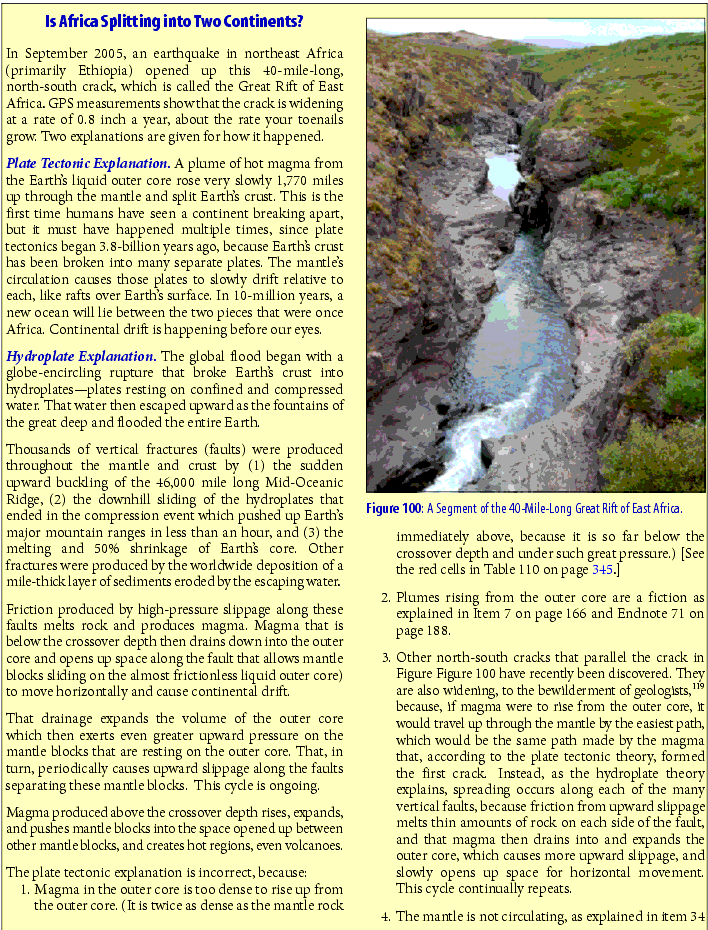
Chamberlin said the danger of teaching only one explanation is especially great in the earth sciences, where much remains to be learned. Both the plate tectonic theory and the hydroplate theory claim to explain ocean trenches, earthquakes, and the Ring of Fire. The plate tectonic theory dominates the earth sciences. A recent survey of scientists selected it as the most significant theory of the 20th century. Undoubtedly, Darwin’s theory of organic evolution would be voted as the most significant theory of the 19th century. Both dominate, despite growing recognition of their scientific problems, because schools and the media ignore competing explanations. Chamberlin warned about the comfort of conformity.
The subjects of “trenches, earthquakes, and the Ring of Fire” offer students and teachers a great opportunity. The two competing theories can be explained simply, as was done in Figures 82 and 86–89. More information can be added as student interest, time, and ability permit. Relevant topics could include fossils, volcanoes, gravity anomalies, flood basalts, seismic tomography, arcs, cusps, tides, the core-mantle boundary, earth’s magnetic field, the crossover depth, and many others. Students can examine and compare the evidence and tentatively decide which is the stronger theory. Teachers and parents have a simple, satisfying task: provide information, ask questions, challenge answers, and allow students the excitement of discovery.