• CSC Home Page
  • Order Book
  • Table of Contents
  • Preface
  • Endorsements
  • Part I: Scientific Case for Creation
    • Life Sciences
    • Astronomical and Physical Sciences
    • Earth Sciences
    • References and Notes
  • Part II: Fountains of the Great Deep
    • The Hydroplate Theory: An Overview
    • The Origin of Ocean Trenches
    • Liquefaction: The Origin of Strata and Layered Fossils
    • The Origin of the Grand Canyon
    • The Origin of Limestone
    • Frozen Mammoths
    • The Origin of Comets
    • The Origin of Asteroids and Meteoroids
  • Part III: Frequently Asked Questions
  • Technical Notes
  • Index

  • Previous Page
  • Next Page

This is the online edition of In the Beginning: Compelling Evidence for Creation and the Flood
(7th Edition) by Dr. Walt Brown. The online version of the book is designed to be read online.
A PDF version or hardbound print version may be ordered.
Copyright © 1995–2008, Center for Scientific Creation. All rights reserved.

Click here to order the hardbound print edition of this online book.

[ The Scientific Case for Creation ]

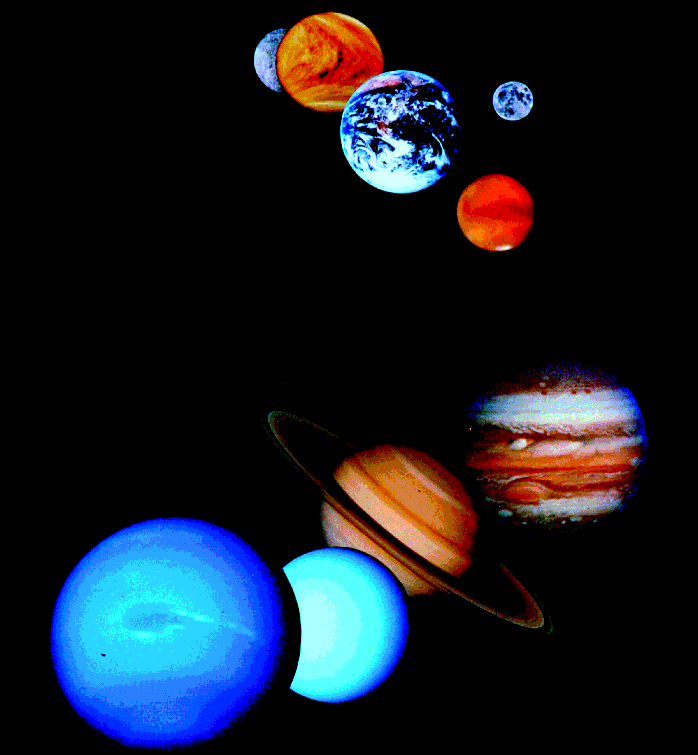
planets.jpg Image Thumbnail

Figure 21: Unique Planets. This is a composite photograph (not-to-scale) of all planets in the solar system, except Pluto. They are, from top to bottom: Mercury, Venus, Earth (with the Moon to the right), Mars, Jupiter, Saturn, Uranus, and Neptune. The photos were taken by Mariner 10 (Mercury), Pioneer Venus Orbiter (Venus), Apollo 17 astronauts (Earth), Earth-based telescopes (Moon and Mars), and the two Voyager spacecraft (the four giant planets).

Each planet is unique. Similarities that would be expected if the planets had evolved from the same swirling dust cloud are seldom found. Yet most planetary studies begin by assuming that the planets evolved and are therefore similar. Typical arguments are as follows: “By studying the magnetic field (or any other feature) of Planet X, we will better understand how Earth’s magnetic field evolved.” Actually, each magnetic field is surprisingly different. “By studying Earth’s sister planet, Venus, we will see how plate tectonics shaped its surface and better understand how plate tectonics works on Earth.” It is now recognized that plate tectonics does not occur on Venus.  (Part II of this book will explain why plate tectonics also does not occur on Earth.)

  • Previous Page
  • Next Page

This site is best viewed with a screen resolution of 1024 x 768 (XGA) or higher and a browser that supports cascading style sheets.
We have tested the site in Internet Explorer (Win), Netscape (Win), Safari (Mac), and Firefox (Mac and Win).
Please let us know if you have any suggestions or find any problems with the site.

Updated on Tuesday, May 13
Copyright © 1995–2008
Center for Scientific Creation
http://www.creationscience.com

(602) 955-7663