The Hydroplate Theory: Key Assumptions
Starting assumptions, as explained above, are always required to explain ancient, unrepeatable events. The hydroplate theory has one major and two minor starting assumptions. All else follows from them and the laws of physics. Proposed explanations for past events always have some initial conditions. Usually they are not mentioned.
Major Assumption: Subterranean Water. About half the water now in the oceans was once in interconnected chambers, 60 miles below the entire Earth’s surface. At thousands of locations, the chamber’s sagging ceiling pressed against the chamber’s floor. These solid contacts will be called pillars. The average thickness of the subterranean water was at least 1 mile. Above the subterranean water was a granite crust; beneath that water was Earth’s mantle. [See Figure 13.]
Minor Assumption 1: A Global Continent. The Earth’s preflood crust encircled the globe. On the crust were deep and shallow seas, and mountains, generally smaller than those of today, but some perhaps 5,000 feet high.
Minor Assumption 2: An Initial Crack. A small initial crack occurred in the Earth’s crust. (Several ways this crack could have started will soon be mentioned.) Once a tension crack formed, the high pressures in the chamber and the stress concentrations at each end of the crack would have quickly propagated the crack around the Earth in a great-circle path.
Why does the Mid-Oceanic Ridge also encircle the Earth a great-circle path? The violently escaping subterranean water widened the crack, which removed weight from the chamber floor below. That allowed the chamber floor to bulge upward and form the Mid-Oceanic Ridge. Thus the Mid-Oceanic Ridge also follows a great-circle path.
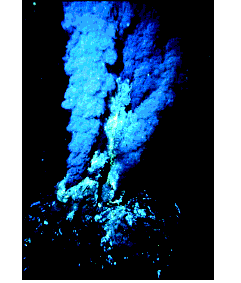
Figure 14: Black Smoker. Black smokers, some as hot as 867°F (464°C), were discovered in 1977 jetting up on a portion of the Mid-Oceanic Ridge in the Pacific. Many other black smokers have since been found along the entire, globe-encircling Mid-Oceanic Ridge, even inside the Arctic Circle and near Antarctica. As hot supercritical water (SCW)44 [explained on pages 136–137], from deep under the ocean floor, shoots up into the frigid ocean, dissolved minerals (and on rare occasions, asphalt ) precipitate out, giving the smoker its black color. SCW can hold vast volumes of dissolved minerals, such as copper, iron, zinc, sulfur, and sometimes hydrocarbons.46 SCW has been produced by man in strong, closed containers, but never before has SCW been seen in its natural state, even around volcanoes.
How do evolutionary geologists explain black smokers? They say water seeps down several miles below the ocean floor where it is heated by magma to these incredible temperatures and forced it back up through the floor. This could not happen, because SCW can only form in closed containers. Besides, water could not seep downward against a powerful pressure gradient. Uncontained liquid water, heated while slowly seeping downward, would expand, rise, and cool, long before it became supercritical.) If the evolutionary explanation were true, the surface of the magma body would quickly cool, form a crust, and soon be unable to transfer much heat to the circulating water. (This is why we can walk over lava days after a crust forms. The crust insulates us from the hot lava below.) Obviously, black smokers could not be millions of years old, because they are venting so much (1) heat, and (2) water from a finite reservoir below. However, black smokers must have been active for decades, because large ecosystems (composed of complex life forms, such as clams and giant tubeworms) have had time to become established around the base of smokers. Figure 13 explains the origin of black smokers.
All 25 major mysteries described earlier, such as major mountain ranges, ice ages, comets, and the Grand Canyon, are consequences of these assumptions. The chain of events that flows naturally from these starting conditions will now be described as an observer might relate those events. The events fall into four phases.