1. Ivars Peterson, “Liquid Sand,” Science News, Vol. 128, 12 October 1985, p. 235.
2. Committee on Earthquake Engineering, George W. Housner, Chairman, Commission on Engineering and Technical Systems, National Research Council, Liquefaction of Soils during Earthquakes (Washington, D.C.: National Academy Press, 1985), pp. 25, 27.
3. Why does this phenomenon occur primarily with sand and not other sedimentary particles, such as clay? Clay particles are flat and platelike. They stack on top of each other like playing cards, so little water can flow up between the particles and produce liquefaction.
Resistance to the upward flow of a fluid between solid particles increases enormously as the space between the particles becomes very small, as in clay. However, sand particles are more rounded, creating much larger gaps between particles. A pile of dry sand is so porous that air occupies about 35% of its volume. Particles deposited in water, especially sand, will be almost completely surrounded by water, so water can flow up through sand with relative ease. Even clay particles that have settled through water will be largely surrounded by a film of water for some time. Therefore, wet clay particles will be buoyed up to some extent by the water, so liquefaction can occur.
Some people and most animals panic when caught in quicksand. Although they sink only to about half the depth they would in pure water (which is less buoyant), thick sand-water mixtures create a suction that opposes movement. Animals frequently die of exertion or starvation. If ever caught in true quicksand, relax, let the sand-water mixture support your weight, be patient, and slowly “swim” out of it.
However, a dangerous situation arises if the upward flow of water slows so that water pressure no longer lifts each sand particle. Stepping into such loose sand or mud might be like stepping into a deep pit filled with powder. How far you sink depends on how firmly the particles compact below you as you drop.
4. Harold L. Levin, Contemporary Physical Geology, 2nd edition (New York: Saunders College Publishing, 1986), p. 251.
5. Arthur N. Strahler, Physical Geology (New York: Harper & Row, Publishers, 1981), p. 202.
6. As the rocks settle into a denser packing arrangement, their potential energy is quickly converted into the energy of pressurized water, which, in turn, will be converted into the kinetic energy of upward flowing water. That kinetic energy will be dissipated slowly as two types of friction.
The first occurs as the water flows up around the sedimentary particles. This frictional drag tends to lift each particle, although initially the upward force may not be enough to raise any particles. The second type occurs near the top of the bed of sediments. That is the point on the flow path where the pressure suddenly drops and, therefore, the flow velocity suddenly increases. If the velocity exceeds a specific threshold, the topmost particles will be lifted. This will remove weight from the particles directly below, allowing them to also rise. This chain reaction will continue down into the bed of sediments as long as enough energy remains. Particles lifted by water drag experience liquefaction.
7. “Breakthroughs in Science, Technology, and Medicine,” Discover, November 1992, p. 14.
8. Experiments have demonstrated this phenomenon as well. [See John T. Christian et al., “Large Diameter Underwater Pipeline for Nuclear Power Plant Designed Against Soil Liquefaction,” Offshore Technology Conference Preprints, Vol. 2, Houston, Texas, 6–8 May 1974, pp. 597–606.]
9. Bruce C. Heezen and Maurice Ewing, “Turbidity Currents and Submarine Slumps, and the 1929 Grand Banks Earthquake,” American Journal of Science, Vol. 250, December 1952, pp. 849–873.
10. “...the ocean floor in the neighborhood of the breaks is rather even with an average angle of slope with the horizon of 1°50' and that about half the breaks were on a slope of less than 1°.” Ibid., p. 855.
11. A tsunami is often confused with a tidal wave. Tsunamis are caused by undersea earthquakes or volcanic eruptions that initiate a wave that is sometimes destructive. A tidal wave is a twice-daily, long-period wave caused by tides—the gravitational pull of the Sun and Moon on Earth.
12. Because liquefied sediments will flow on gradual slopes and become increasingly horizontal, most sedimentary layers today are horizontal. Bent or steeply tipped layers resulted from the compression event described on page 138.
13. George E. Anderson, mechanical engineer, suggested that water hammers acted during the flood.
14. Lester Haar et al., NBS/NRC Steam Tables (New York: Hemisphere Publishing Corporation, 1984), p. 218.
15. E. D. McKee et al., “Flood Deposits, Bijou Creek, Colorado, June 1965,” Journal of Sedimentary Petrology, Vol. 37, September 1967, pp. 829–851.
u Steven A. Austin, Grand Canyon: Monument to Catastrophe (Santee, California: Institute for Creation Research, 1994), pp. 36–39.
16. Water would flow into the sediment tank at about one centimeter per second. With a longer column of sediments, velocities are even slower. My computer simulations of liquefaction on the flooded Earth showed typical velocities of about 0.1 centimeter per second. Liquefaction would begin at the top of a thick column of sediment and would grow downward as the wave trough approached. Hundreds of feet of sediments could experience liquefaction at one time. If the flood waters deposited more sediments on top of the column before the next liquefaction cycle began, the lowest sediments liquefied in earlier cycles might not experience liquefaction again. Thus, the least dense sediments will not all end up at the top of the sedimentary column.
17. The old adage that water flows only downhill is not always true. Water flowed uphill in the water lens, because the pressure was highest in the lowest part of the lens where the weight of overlying sediments was greatest.
18. Personal communication, Dr. Karen Jensen, 8 January 2001.
19. When a water lens began to form, it spread rapidly, because water flowed into the lens more easily than it flowed out. Flow into a lens loosened the resisting sediments and very fine particles blocking the flow channels, while water trying to flow out of a lens (up or down) compacted the resisting sediments, allowing fine particles to plug up the flow channels. Also, water was captured in proportion to the lateral extent of the lens, so the larger a lens became, the faster it grew.
During liquefaction, each sedimentary particle, surrounded by a thin film of water, would rotate and vibrate. The water’s flow around each irregular particle varied, causing sudden pressure changes that quickly altered forces all around the particle. (These are the same fluid forces that lift a wing, curve a baseball, or slice a golf ball.) When one particle collided with an adjacent particle, the effect would ripple “down the line” to some extent.
With all this “microagitation” and lubrication, particles would arrange themselves into a very dense packing arrangement that would drive out more water. Later, close packing would aid in cementing each horizontal stratum between former water lenses into a strong unit. [See “The Origin of Limestone” on pages 268– 273.] This is why horizontal cracks, called joints, separate strata.
Evolutionists believe that the global occurrence of sharp, horizontal interfaces between adjacent strata show long time intervals in which the environment changed so drastically that different types of sediments were deposited. (The sources of these new sediments are never thoroughly explained.) On the contrary, sharp interfaces mark former liquefaction lenses.
20. In 1835, creationist Edward Blyth was the first to publish and explain natural selection and how it supports creation—not evolution. [See “Natural Selection” beginning on page 54.]
21. Leonard R. Brand and Thu Tang, “Fossil Vertebrate Footprints in the Coconino Sandstone (Permian) of Northern Arizona: Evidence for Underwater Origin,” Geology, Vol. 19, December 1991, pp. 1201–1204.
u “The trackways (Fig. 4a–c) that were headed across the slope but with toes pointed upslope can perhaps be best explained by animals being pushed by a water current moving at an angle to the direction of their movement.” Leonard R. Brand, “Field and Laboratory Studies on the Coconino Sandstone (Permian) Vertebrate Footprints and Their Paleoecological Implications,” Paleogeography, Paleoclimatology, Paleoecology, Vol. 28, 1979, p. 38.
22. The most authoritative source for geological definitions is the Glossary of Geology. It defines uniformitarianism as:
The fundamental principle or doctrine that geologic processes and natural laws now operating to modify the Earth’s crust have acted in the same regular manner and with essentially the same intensity throughout geologic time, and that past geologic events can be explained by phenomena and forces observable today; the classical concept that “the present is the key to the past.” [See Robert L. Bates and Julia A. Jackson, editors, Glossary of Geology, 2nd edition (Falls Church, Virginia: American Geological Institute, 1980), p. 677.]
The principle of uniformitarianism was meant to exclude a global flood, which many geologists still abhor—for philosophical, not scientific reasons.
23. “The widespread deposition of such clean sand [in the St. Peter sandstone] may seem strange to a modern observer, since there is no region on earth where a comparable pattern of deposition can now be found.” Steven M. Stanley, Earth and Life through Time (New York: W. H. Freeman and Co., 1986), pp. 355–356.
24. “The United Nations Development Program notes that, in 2011, more than 40 countries experienced water stress; of those, 10 have nearly depleted their renewable freshwater supply. By 2050, one in four people globally may be hit by periodic shortages.” Margaret Catley-Carlson, “The Emptying Well,” Nature, Vol. 542, 23 February 2017, p. 413.
25. Thanks to Dr. Ian James Corrans in Australia who, on 24 July 2014, sent the following letter and acquainting me with jigging.
Dear Dr. Brown,
I first read your book “In the Beginning-----” in March 2012. To put it mildly, this made a huge impact on my understanding of the geology of sedimentary rocks, ore deposits and coal and oil formation, etc. Since then I have re-read many chapters and pondered further on the vast amount of highly credible information that you have covered. I now believe “Flood Geology” is the real explanation for what lies as evidence before our eyes.
Of particular interest to me is your discussion of the phenomenon of liquefaction as the origin of layered strata and fossils. This is absolutely correct in my view. During my working career, I was closely involved in mineral process engineering and mineral dressing. A well- known technique in mineral or ore dressing involves the use of the so-called “mineral dressing jig.” This is a device which imparts hydraulic (water) pulses to a bed of rock or mineral particles from below the bed. The particles are alternatively subjected to a lifting hydraulic force followed by a settling gravitational force. As a result the particles are sorted (i.e. stratified) according to density and size. A detailed description of the mineral dressing jig technique is available in any textbook on mineral dressing or on the internet.
Dr. Ian James Carrans
26. James W. Hagadorn et al., “Stranded on a Late Cambrian Shoreline: Medusae from Central Wisconsin,” Geology, Vol. 30, February 2002, pp. 147–150.
27. Ariel A. Roth, “Incomplete Ecosystems,” Origins, Vol. 21, No. 1, 1994, pp. 51–56.
28. Arthur V. Chadwick, “Megabreccias: Evidence for Catastrophism,” Origins, Vol. 5, No. 1, 1978, pp. 39–46.
29. To produce quartzite requires water and the extreme heating and compression of sand (quartz grains). The heating dissolves some of the quartz, placing silica (SiO2 ) in solution. As water vapor escapes, the compressed mixture cools and the solution becomes supersaturated. Then the silica, acting as a cementing agent, precipitates (recrystallizes) on the remaining sand grains and fills the tiniest spaces. The silica cement becomes harder than the initial sand grains. (When quartzite is broken with a hammer, the break passes through the sand grains, not the silica cement.)
Liquefaction sorted the sediments into water-saturated layers, one of which was almost pure sand (quartz grains). The compression event provided the compression and heating. How else can one explain quartzite?
30. “The grand puzzle of the Cambrian explosion surely must rank as one of the most important outstanding mysteries in evolutionary biology.” Christopher J. Lowe, “What Led to the Metazoa’s Big Bang?” Science, Vol. 340, 7 June 2013, p. 1170.
31. “Photographs of contact lines indicate that the Precambrian strata were water deposited on top of the Cretaceous.” Clifford L. Burdick, “The Lewis Overthrust,” Creation Research Society Quarterly, Vol. 2, June 1969, p. 96.
u For pictures, see Clifford L. Burdick, “Additional Notes Concerning the Lewis Thrust-Fault,” Creation Research Society Quarterly, Vol. 11, June 1974, p. 59.
32. “Older” and “younger” are relative terms. According to the hydroplate theory and liquefaction, an older fossil might have been perminantly buried a minute before a younger fossil was buried in a layer several inches above. According to evolution thinking, an older fossil might have been buried several million years before that younger fossil in the layer above. The evolutionist would argue that it takes millions of years for life forms to change and for enough dirt to fall through the atmosphere to do the burying.
33. George McCready Price, The New Geology, 2nd edition (Mountain View, California: Pacific Press Publishing Assn., 1923), 726 pp.
u George McCready Price, Evolutionary Geology and the New Catastrophism (Mountain View, California: Pacific Press Publishing Assn., 1926).
u George McCready Price, Common-Sense Geology (Mountain View, California: Pacific Press Publishing Assn., 1926).
34. John C. Whitcomb Jr. and Henry M. Morris, The Genesis Flood (Philadelphia, Pennsylvania: Presbyterian and Reformed Publishing Co., 1961), pp. 180–200.
35. Those who argue that water in the tiny pore spaces in rock could provide the necessary lubrication usually cite a 52-page paper by M. King Hubbert and William Rubey, entitled “Role of Fluid Pressure in Mechanics of Overthrust Faulting,” published in the Bulletin of the Geological Society of America in 1959. A key force overlooked in that paper is capillarity (due to the surface tension) of water with respect to rock. Just as you have seen a liquid rise in thin tubes (seemingly defying gravity), water molecules are attracted to rock and will resist flowing out of ultra thin channels in rock. Such thin channels would produce powerful capillary forces and would not allow enough lubrication.
36. This situation has been thoroughly analysed and can be found in many textbooks on fluid flow, under the heading Hagen-Poiseuville flow. For example, see Warren M. Rohsenow and Harry Y. Choi, Heat, Mass, and Momentum Transfer (Englewood Cliffs: Prentice-Hall, Inc., 1961), p. 36.
37. The overriding slab moved—relative to the bottom slab—to the right (east) in Figure 109. So you can see the slope requires the slab to move slightly uphill (based on today’s elevations), not downhill by gravity sliding. How could that happen?
Overthrusting was, in fact, driven by hydroplates sliding down the flanks of the Mid-Atlantic Ridge, which was suddenly uplifted by many miles. [See “Continental-Drift Phase” on page 136.] After accelerating downhill for most of one day, North America suddenly decelerated (due to either the loss of water lubricant below the 30-mile thick hydroplate or by colliding with a portion of the rising Mid-Oceanic Ridge (called the East-Pacific Rise) or both. (That Rise now runs under western California and produces frequent earthquakes). [See Endnote 49 on page 150.] The compression event pushed up the Rocky Mountains and produced massive liquefaction and many liquefaction lenses. [See "Liquefaction During the Flood" on page 207.]
The largest liquefaction lens isolated the water-saturated sediments above the lens from the water-saturated sediments below the lens. As that vast lens began to form, both blocks of sediments (above and below) were traveling west at the same speed. The Rocky Mountains were rising to the west, so their huge mass and inertia began retarding the top sediment block more than the bottom, more massive, sediment block. As a result, the top block slid on the liquefaction lens to the east relative to the block of sediments below the lens. Because the block below the lens had so much more mass and momentum, it continued to move westward. Suspended in that thick liquefaction lens was a slurry of denser sediments (silicates) and less dense sediments (carbonates, primarily limestone). Naturally, the less dense particles rose relative to the denser particles, so limestone (today’s Altyn Limestone) marks the thrust plane. It is easily seen as the white band exposed in many mountains in Glacier National Park. [See Figure 109.]
Another row could be added to Table 5on page 215, asking “What accounts for the Altyn Limestone?” You have just read the explanation based on the hydroplate theory. Evolutionists would say that limestone is deposited in warm shallow seas, so the land had to subside below sea level, then become an isolated inland sea, and wait for enough evaporation to cause limestone to precipitate, or for enough shelled creatures to proliferate. Even if that could happen, it would require millions of years and many unsupportable events, such as the warming of cold Montana’s frigid water. Finally, Glacier National Park would need to be lifted to its current elevation, more than a mile above sea level and display ripples on the Continental Divide, such as those shown in Figure 118. Quite a feat!
The Altyn Limestone is remarkably thin and uniform in thickness where it is seen throughout the 16,000 square miles of Glacier National Park. A large inland sea would not deposit limestone in a thin uniform layer. However, a liquefaction lens, which is itself thin, vast, and uniform in thickness would sort limestone out in a thin uniform layer.
38. See “Could Earth’s Mountain Ranges Form in Less Than an Hour?” on pages 485– 486.
39. Not only did flutter occur during the flood phase, it also occurred during the continental-drift phase. In explaining flutter in "Water Hammers and Flutter Produced Gigantic Waves" on page 207, the analogy of a flag fluttering in a wind was given. It does not matter if a flag is stationary and the air is moving or if the air is stationary and the flag is moving. Whenever a fluid (a gas or a liquid) has relative motion along a flexible surface (a flag, the wing of an aircraft, a vibrating reed in a musical instrument, or a hydroplate), resonant vibrations are easily set up. The faster and denser the fluid, the greater the flutter amplitudes. Compressed supercritical water is quite dense, and the relative velocity between the sliding, accelerating hydroplates and the water they rode on below was about 170 miles per hour! [See “Could Earth’s Mountain Ranges Form in Less Than an Hour?” on page 485, and study Figure 243.] Therefore, flutter amplitudes were probably so extreme that sediment layers, underlain by a liquefaction lens, could easily have ruptured, allowing the water in one or more lenses to escape upward and carry the leading edge of sediment layers with it, riding up over the top-most layer.
40. Dwight Hornbacher, Geology and Structure of Kodachrome Basin State Reserve and Vicinity, Kane and Garfield Counties, Utah (Master’s thesis, Loma Linda University, California, 1985).
41. This mound is located at 36°45'15.40"N, 109°34'45.87"W.
42. George Sheppard, “Small Sand Craters of Seismic Origin,” Nature, Vol. 132, 30 December 1933, p. 1006.
43. These ripples have a shallow slope up to each ripple’s crest, then a steep slope down from the crest. Therefore, the flow that produced these ripples was in one direction. Had the flow been in back-and-forth directions, as we see with waves near shore lines, each ripple’s shape would be symmetrical. This means that the ripples were not made in shallow water. The deeper the water, the more powerful the flow must be to form ripples, especially nonsymmetrical ripples on the sea floor.
44. The ripple marks (located between 48°41'36.68"N, 113°43'36.97"W and 48°41'15.05"N, 113°44'16.54"W) are also mentioned by Becky Lomax in “Hidden Lake Overlook,” Glacier National Park (Moon Handbooks, 2011), p. 100.
u “... ripple marks abound along the path from Logan Pass to Hidden Lake.” David Alt and Donald W. Hyndman, Roadside Geology of Montana (Missoula, Montana: Mountain Press Publishing Company, 1986), p. 64.
45. A tectonic plate of mass m moves with a velocity v. If all its kinetic energy were used to elevate the plate and no energy was lost due to such things as friction, how high, h, could the entire plate rise?
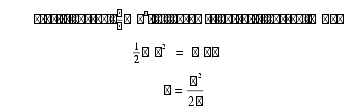
Today, crustal plates move about 4 cm/year—the rate a fingernail grows. [See Figure
94 on page
180.] Therefore,

where g is the acceleration of gravity (or 980 cm/sec2 ) and 31,556,736 seconds are in a year. Even if just the central 10% of the plate rose, as in buckling or crushing, it would rise only 8.2 × 10⁻¹⁷ cm. Therefore, today’s velocities of crustal plates couldn’t possibly push up mountains.
Could millions of years of steady, but slight, pressure of one plate on another eventually push up mountains? Not anymore than logs in a river’s log jam might steadily crush or buckle up over millions of years (assuming the logs did not disintegrate). Until the compression of one plate against another reaches a very high threshold—not even remotely reached by plate tectonics—the plates will not crush, buckle, or lift one iota. However, the compression event, at the end of the flood, easily explains how Earth’s major mountain ranges were pushed up in less than an hour.
46. “Spanish documents from the 16th century and scientists’ interviews of the area’s current inhabitants [descendants of ancient Mayan (A.D. 200–900) peoples of central Mexico and Central America] reveal a longstanding regional belief that water originates in mountains and issues out of caves.” Bruce Bower, “Openings to the Underworld,” Science News, Vol. 161, 18 May 2002, pp. 314–315.