Liquefaction During the Flood
The flooded Earth had enormous, unimpeded waves—not normal waves, but waves on top of and generated by fluttering hydroplates. With each flutter cycle, high water was forced down into and up out of the accumulating sediments on the seafloor. Under a wave peak, water was forced, not only down into the sediments below, but laterally through the sediments, toward pressure minimums that were simultaneously occurring one-half wavelength away, under wave troughs. Later, when a wave trough arrived, the flows reversed, and water flowed upward. Water almost completely surrounded each sediment particle deposited on the ocean floor during the flood, giving each particle maximum buoyancy. Therefore, the sediments were loosely packed and held much water.
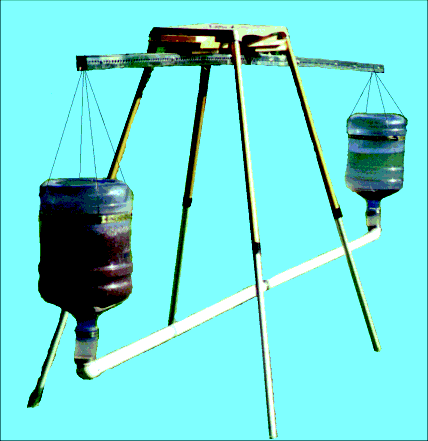
Figure 3: Liquefaction Demonstration. When the wooden blocks at the top of the horizontal beam are removed, the beam can rock like a teeter-totter. As the far end of the beam is tipped up, water flows from the far tank down through the pipe and up into the near tank, which holds a mixture of sediments. Once liquefaction begins, the sediments become mushy, their volume swells slightly, sedimentary particles fall or rise relative to each other, sorting themselves into layers, each having particles with similar size, shape, color and density. Buried objects with the density of plants and dead animals float up through the mushy sediments—until they reach a liquefaction lens. The same would happen to plants and animals buried during the flood.
Their sorting and later fossilization might give the mistaken impression that organisms buried and fossilized in higher layers evolved millions of years after lower organisms. A school of thought, with appealing philosophical implications for some, would arise that claimed changes in living things were simply a matter of time. With so many complex differences among protons, peanuts, parrots, and people, eons of time must have elapsed. With so much time available, many other strange observations might be explained. Some would try to explain even the origin of the universe, including space, time, and matter, using this faulty, unscientific school of thought. Of course, these ideas could not be demonstrated, as liquefaction can be, because too much time would be needed.
Half the time during the flood phase, water was pushed down into the sediments, stored for the other (discharge) half-cycle in which water flowed upward. During discharge, liquefaction occurred if the water’s upward velocity exceeded a specific minimum. When it did, interesting things happened.
A thick, horizontal layer of sediments provides high resistance to upward flowing water, because the water must flow through tiny, twisting channels between particles. Great pressure is needed to force water up through such layers. During liquefaction, falling sediments and high waves provide this high pressure.
If water flows up through a bed of sediments with enough velocity, water pressure will lift and support each sedimentary particle. Instead of thinking of water flowing up through the sediments, think of the sediments falling down through a very long column of water. Slight differences in density, size, or shape of adjacent particles will cause them to fall at slightly different speeds. Their relative positions will change until the water’s velocity drops below a certain value or until nearly identical particles are adjacent to each other, so they fall at the same speed. This sorting produces the sharply-defined layering seen in sedimentary rocks worldwide. As you will see, these vast, sharply-defined sedimentary layers are unmistakable characteristics of liquefaction and a global flood.
Such sorting also explains why sudden local floods sometimes produce horizontal strata on a small scale.15 Liquefaction can occur as mud settles through water or as water is forced up through mud.
To understand liquefaction better, I built the simple apparatus shown inFigure 3. The 10-foot-long metal beam pivoted like a teeter-totter from the top of the 4-legged stand. Suspended from each end of the beam was a 5-gallon container, one containing water and one containing a mixture of different sediments. A 10-foot-long pipe connected the mouths of the two containers.
Gently tipping the metal beam raised the water tank. Water flowed down through the pipe and up through the bed of mixed sediments in the other tank. If the flow velocity exceeded a very low threshold,16 the sediments swelled slightly as liquefaction began. Buried objects with the density of a dead animal or plant floated to the top of the tank. Once water started to overflow the sediment tank, the metal beam had to be tipped, so the water flowed back into the water tank. After repeating this cycle for 10 or 15 minutes, the mixture of sediments became visibly layered. The more cycles, the sharper the boundaries between sedimentary layers.
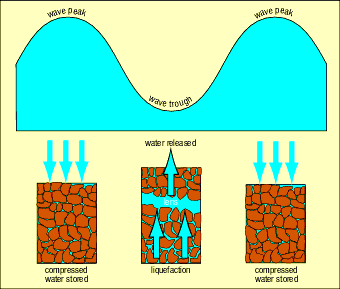
Figure 4: Liquefaction and Water Lenses. The wave cycle begins at the left with water being forced down into the seafloor. As the wave trough approaches, that compressed water is released. Water then flows up through the seafloor, lifting the sediments, starting at the top of the sedimentary column. During liquefaction, denser particles sink and lighter particles (and dead organisms, soon to become fossils) float up—until a liquefaction lens is encountered. Lenses of water form along nearly horizontal paths if the sediments below those horizontal paths are more permeable than those above, so more water flows up into each lens than out through its roof. Sedimentary particles and dead organisms buried in the sediments were sorted and resorted into vast, thin layers.
In an unpublished experiment at Loma Linda University, a dead bird, mammal, reptile, and amphibian were placed in an open water tank. Their buoyancy in the days following death depended on their density while living, the buildup and leakage of gases from their decaying bodies, the absorption or loss of water by their bodies, and other factors. That experiment showed that the natural order of settling following death was, from the bottom up: amphibian, reptile, mammal, and finally bird.18 This order of relative buoyancy correlates closely with “the evolutionary order,” but, of course, evolution was not the cause. Other factors influencing burial order at each geographical location were: liquefaction lenses, which animals were living in the same region, each animal’s mobility before the flood overtook it, and the animal or plant’s shape (how much fluid drag from the upward flowing water lifted the organism).