Liquefaction (Water) Lenses
An important phenomenon, which will be called lensing, was observed in the sediment tank. Some layers were more porous and permeable than others. If water flowed more easily up through one sedimentary layer than the layer directly above, a lens of water accumulated between them. Multiple lenses could form simultaneously, one a short distance above the other. Water in these nearly horizontal lenses always flowed uphill.17
Throughout the flood, countless water lenses grew and then decreased with each wave cycle. [See Figure4.] During liquefaction, organisms floated up into the lens directly above. Water’s buoyant force is only about half that of liquefied sediments, so a water lens was less able to lift dead organisms into the denser sedimentary layer directly above the lens. In each geographical region, organisms with similar size, shape, and density (usually members of the same species) often ended up in the same lens. There, they were swept by currents for many miles along those nearly horizontal channels.19
Coal. Vegetation lifted by liquefaction into a water lens spread out and formed a buoyant mat pressed up against the lens’ roof. Vegetation mats, composed of thin, flat, relatively impermeable sheets, such as intertwined leaves, ferns, grass, and wood fragments, could not push through that roof. These mats also prevented sedimentary grains in the roof from falling to the floor of the lens.
Each vegetation mat acted as a check valve; that is, during the portion of the wave cycle when water flowed upward, the mat reduced the flow upward through the lens’ roof, so the lens’ volume grew. During the other half of the wave cycle, when water flowed downward, the mat was pushed away from the roof allowing new water to enter the lens. Therefore, water lenses with vegetation mats thickened and expanded during the flood. Vegetation mats became today’s coal seams, some of which can be traced over 100,000 square miles.
Cyclothems. Sometimes, fifty or more coal seams are stacked one above the other with a special sequence of sedimentary layers separating the coal layers. A typical sequence between coal seams (from bottom to top) is sandstone, shale, limestone, and finally denser clay graded up to finer clay. These cyclic patterns, called cyclothems, are in the order one would expect from liquefaction: denser, rounder, larger sedimentary particles at the bottom and less dense, flatter, finer sedimentary particles at the top. Cyclothem layers worldwide generally have the same relative order, although specific layers may be absent.
Fossils. When a liquefaction lens slowly collapsed for the last time, plants and small animals were trapped, flattened, and preserved between the lens’ roof and floor. Fossils, sandwiched between thin layers, were often spread over a wide surface, which geologists call a horizon. Thousands of years later, these horizons gave some investigators the false impression that those animals and plants died long after layers below were deposited and long before layers above were deposited. A layer with many fossils covering a vast area was misinterpreted as an extinction event or a boundary between geologic periods.
Early geologists noticed that similar fossils were often in two closely spaced horizontal layers. It seemed obvious that the subtle differences between each layer’s fossils must have developed during the assumed long time interval between the deposition of each layer. Different species names were given to these organisms, although nothing was known about their inability to interbreed—the true criterion for identifying species. Later, in 1859, Charles Darwin claimed that a previously recognized mechanism, natural selection,20 accounted for the evolution of those subtle differences. However, if liquefaction simply sorted organisms based on their already existing natural variations, Darwin’s explanation is irrelevant.
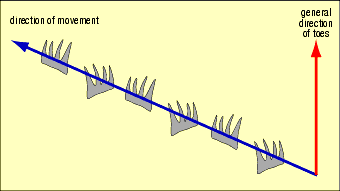
Figure 5: Drifting Footprints. Hundreds of footprints, along 44 different trackways, were discovered in cross-bedded sandstone layers of northern Arizona. Surprisingly, movement was in one direction, but the toes pointed in another direction—sometimes at almost right angles. This shows that the animals, probably amphibians, encountered some type of lateral flow while walking on sand.21 It also contradicts the standard story that cross-bedded sandstone layers were once ancient sand dunes. Almost all trackways moved uphill, and traces of the animal’s bodies are never found, even as fossils. Obviously, thick sediments must have gently and quickly blanketed the footprints to prevent their erosion—but how? Evolutionists have difficulty explaining what protected these delicate footprints.
How did it happen? During the early weeks of the flood, flutter amplitudes were large enough for the crust to rise repeatedly, but slowly, out of the flood waters. [See “Water Hammers and Flutter Produced Gigantic Waves” on page 207.] Frightened animals—and sometimes dinosaurs—scampered uphill onto the rising land, each leaving footprints. Minutes later, the crust again submerged, allowing sediments falling through the thick muddy waters to blanket and protect the prints while the rising water swept the animals’ bodies away. Other perishable prints—called trace fossils—were made in the same way. [See item 9 on page 212.]
Each time the fluttering crust rose above the muddy flood waters, it had (in evolutionary terms) “thousands of years” worth of additional layered sediments containing sorted dead things trapped in liquefaction lenses. The approximate order of burial, from the bottom up, was sea-bottom creatures, then animals and plants that were first overcome, ripped up, and deposited by the initial flood waters, followed by the larger animals that could float and live for a time (such as many dinosaurs), and finally mobile animals that could flee to high ground. Each region had its own mix of animals and plants. Once they were buried in sediments, liquefaction provided additional sorting by such characteristics as density and shape. Sometimes, dinosaur prints from the previous upward flutter minutes earlier were sandwiched between layers that never experienced liquefaction again.
Two Faulty “Principles.” Early geologists learned that fossils found above or below another type of fossil in one location were almost always in that same relative position, even many miles away. This led to a belief that the lower organisms lived, died, and were buried before the upper organisms. Much time supposedly elapsed between the two burials, because sediments—at least today—are usually deposited very slowly. Each horizon became associated with a specific time, perhaps millions of years earlier (or later) than the horizon above (or below). Finding so many examples of “the proper sequence” convinced early geologists they had found a new principle of interpretation, which they soon called the principle of superposition.
Evolutionary geology is built upon this and one other “principle,” the principle of uniformitarianism, which states that all geological features can be explained by today’s processes acting at present rates.22 For example, today, rivers deposit sediments at river deltas. Over millions of years, thick layers of sediments would accumulate. This might explain the sedimentary rocks we now see.
After considering liquefaction, the flaws in both “principles” become obvious. Sediments were sorted and deposited throughout a tall liquefaction column almost simultaneously by a large-scale process not occurring today. (These “principles” are really assumptions. Calling them “principles” gives them undeserved credibility.)