The Origin of Asteroids, Meteoroids, and Trans-Neptunian Objects
SUMMARY: The fountains of the great deep launched rocks and muddy water into space. As rocks moved farther from Earth, Earth’s gravity became less significant to them, and the gravity of nearby rocks became increasingly significant. Consequently, many rocks, assisted by their mutual gravity and surrounding clouds of water vapor that produced aerobraking, merged to become asteroids. (Isolated rocks in space are meteoroids.) Drag forces caused by water vapor and thrust forces produced by the radiometer effect concentrated most smaller asteroids in what is now the asteroid belt. Larger asteroids were acted by more powerful radiometer forces, which pushed them out beyond Neptune’s orbit, where they became trans-Neptunian objects. All the so-called “mavericks of the solar system” (asteroids, meteoroids, comets, and trans-Neptunian objects) resulted from the explosive events as the flood began.
Asteroids, also called minor planets, are rocky bodies orbiting the Sun. Ninety percent of them have orbits between the orbits of Mars and Jupiter, a region called the asteroid belt. The largest asteroid, Ceres, is almost 600 miles in diameter and has about one-third the volume of all other asteroids combined. Precise orbital details are known for some 625,000 asteroids.3 Some that cross Earth’s orbit might do great damage if they ever collided with Earth.
Textbooks give two explanations for the origin of asteroids: (1) they are the remains of an exploded planet, and (2) a planet failed to evolve completely. Experts recognize the problems with each explanation and are puzzled. The hydroplate theory offers a simple and complete—but quite different—solution that also answers other questions.
Exploded-Planet Explanation. Smaller asteroids are more numerous than larger asteroids, a pattern typical of fragmented bodies. Seeing this pattern led to the early belief that asteroids are the remains of an exploded planet. Later, scientists realized that all asteroids combined would not form one small planet.4 Besides, too much energy is needed to explode and scatter even the smallest planet. [See Item 21 on page 331.]
Failed-Planet Explanation. The most popular explanation today for asteroids is that they are bodies that did not merge to become a planet. Never explained is how, in nearly empty space, matter merged to become these rocky bodies in the first place,5 why rocky bodies started to form a planet but stopped,6 or why it happened primarily between the orbits of Mars and Jupiter. Also, because only vague explanations have been given for how planets formed, any claim to understand how one planet failed to form lacks credibility. [See Items 43–46 on pages 30– 33.] Orbiting rocks do not merge to become planets or asteroids unless special conditions are present, which the hydroplate theory provides. [See page 321 and Endnote 18 on page 338.] Today, collisions fragment and scatter asteroids, just the opposite of this “failed-planet explanation.” During the 4,600,000,000 years evolutionists say asteroids have existed, asteroids would have had so many collisions that they should be much more fragmented than they are today.7
Hydroplate Explanation. The fountains of the great deep launched rocks and water from Earth.8 Water droplets launched into space partially evaporated and quickly froze. Large rocks had large gravitational spheres of influence which grew as the rocks traveled away from Earth. The largest rocks became “seeds” around which ice particles, smaller rocks, and gas molecules collected gravitationally. Aerobraking by that gas, collapsed much of the mass around those “seed rocks,” forming asteroids. [See page 314.]
The size distribution of asteroids shows that at least part of a planet fragmented, but no known energy source is available to explode and disperse an entire Earth-size planet. [See item 21 on page 331.] However, the eruption of so much supercritical water (explained on page 129) from the subterranean chambers could have launched a small percent of the Earth. Astronomers have tried to describe the exploded planet, not realizing they were standing on the remaining 97 ±1% of it—too close to see it.
As floodwaters escaped from the subterranean chambers, pillars were crushed, because they were forced to carry more and more of the weight of the overlying crust. Also, the almost 60-mile-high walls of the rupture were unstable, because rock is not strong enough to support a cliff more than 5 miles high. As lower portions of the walls crumbled, blocks—some a staggering 200 meters in diameter—were swept up and launched by the jetting fountains. [See Figure 5.] Unsupported rock in the top 5 miles then fragmented. The smaller the rock, the faster it accelerated, and the farther it went, just as a rapidly flowing stream carries smaller dirt particles faster and farther.
.

PREDICTION 38: Asteroids are rock piles, often with internal ice acting as a weak glue.9 Large rocks that began the capture process are near the centers of asteroids and comets.
Four years after publishing this prediction in 2001 (In the Beginning, 7th edition, page 220), measurements of the largest asteroid, Ceres, found that it does indeed have a dense, rocky core and a mantle primarily of water-ice.10
On 23 January 2014, it was announced that two jets of water vapor were discovered escaping from Ceres at a combined rate of 13 pounds per second.
PREDICTION 39: Most of the rocks (pebble-size and larger) comprising asteroids and comets will be found to be rounded to some degree. (This rounding occurred as the rocks tumbled and were eroded in the powerful fountains of the great deep, just as rocks are tumbled and rounded in fast-flowing streams.)
The European Space Administration announced on 18 December 2014 that huge, rounded boulders—1 to 3 meters in diameter—are stacked “layer upon layer” “all over” Comet 67P. [See Figure 8 on page 358.] They jokingly call them dinosaur eggs, and believe they could be the basic building blocks that clumped together to form” comets.11
Question 1: Why did some clumps of rocks and ice in space become asteroids, and others become comets?
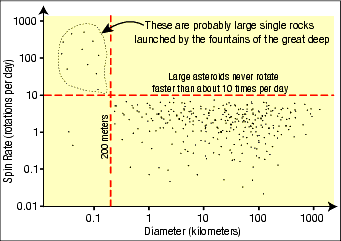
Figure 5: Rapidly Spinning Asteroids. Clumps of rocks in space, held together by only their weak mutual gravity, will fly apart if they spin faster than ten times a day. Asteroids larger than 200 meters across never spin faster than ten times a day, so those bodies may be clusters of loose rocks. Asteroids smaller than 200 meters often spin hundreds of times a day. Therefore, they must be solid rocks.12
How could solid rocks drifting in space have formed? Had they formed from dust or pebble-size grains, impacts by other particles would have scattered the merged, but weakly-held particles. Consequently, these bodies must be fragments of a much larger body, such as a planet.
But that raises another question. If a planet fragmented or exploded, how could the fragments gravitationally escape unless something accelerated them up to that planet’s escape velocity? As has already been explained in many ways, that something was Earth’s supercritical subterranean water escaping explosively as the fountains of the great deep.
The comet chapter, explains why the fountains of the great deep reached speeds of 32 miles per second, enough to accelerate 200-meter-diameter rocks up to and beyond 7 miles per second—Earth’s escape velocity. That high-velocity flow also tumbled and rounded each rock. [See predictions 39 and 40.]
Imagine living in a part of the world where heavy frost settled each night, but the Sun shone daily. After many decades, would the countryside be buried in hundreds of feet of frost?
The answer depends on several things besides the obvious need for a large source of water. If dark rocks initially covered the ground, the Sun would heat them during the
PREDICTION 40: Asteroids spinning faster than ten rotations per day will be found to be single, well-rounded rocks.
day, so frost settling on them during the night would evaporate. However, if the sunlight was dim or the frost was thick (so it reflected most sunlight during the day), little frost would evaporate. More frost would accumulate each night.
Now imagine living on a newly formed asteroid. Its spin would give you day-night cycles. Asteroids do not have enough gravity to hold an atmosphere for long. With little atmosphere for the Sun to warm, day temperatures at the asteroid’s surface would rise rapidly. At night, the day’s heat would quickly radiate, unimpeded, into outer space.
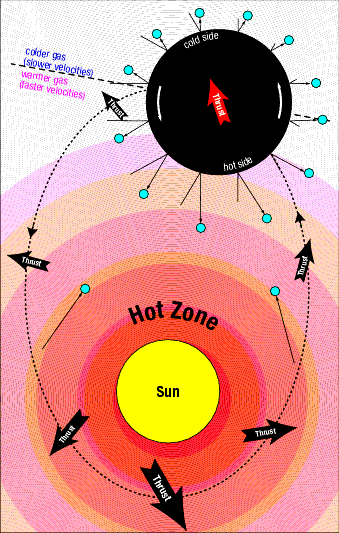
Figure 6: Thrust and Drag Acted on Asteroids. Sun, asteroid (large black circle), gas molecules (small blue circles), and orbit are not to scale. The fountains of the great deep launched rocks and muddy water from Earth. The larger rocks, assisted by water vapor and other gases within the spheres of influence of these rocks, captured other rocks and ice particles. Those growing bodies that were primarily rocks became asteroids.
The Sun heats an asteroid’s near side, while the far side radiates its heat into cold outer space. Therefore, large temperature differences exist on opposite sides of each rocky, orbiting body. The darker the body14 and the slower it spins, the greater that temperature difference. (For example, temperatures on the sunny side of our Moon reach a searing 240°F, while on the dark side, temperatures can drop to a frigid -270°F) Also, gas molecules between the Sun and asteroid, especially those coming from very near the Sun, are hotter and faster than those on the far side of an asteroid. Hot gas molecules hitting the hot side of an asteroid bounce off with much higher energy and momentum than cold gas molecules bouncing off the cold side. Those impacts slowly expanded asteroid orbits until too little gas remained in the inner solar system to provide much thrust. The closer an asteroid was to the Sun, the greater the outward thrust. Gas molecules, concentrated near Earth’s orbit for years after the flood, created a drag on asteroids. My computer simulations show that this gas could slowly move asteroids from many random orbits into the asteroid belt.15 Thrust primarily expanded the orbits. Drag circularized orbits and reduced their angles of inclination.
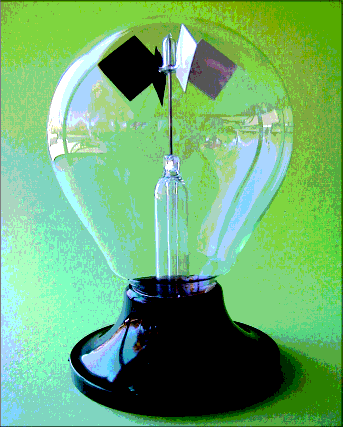
Figure 7: The Radiometer Effect. This popular novelty, called a radiometer, demonstrates the unusual thrust that pushed asteroids into their present orbits. Sunlight warms the dark side of each vane more than the light side. A partial vacuum exists inside the bulb, so gas molecules travel relatively long distances before striking other molecules. On average, gas molecules bounce off the hotter, black side with greater velocity and momentum than off the colder, white side. This turns the vanes away from the dark side.16
The black side also radiates heat faster when it is warmer than its surroundings. This can be demonstrated by briefly placing the radiometer in a freezer. There, the black side cools faster, making the white side warmer than the black, so the vanes turn away from the white side. In summary, the black side gains heat faster when in a hot environment and loses heat faster when in a cold environment. Movement is always away from the warmer side.
For 50 years after Sir William Crookes’ demonstrated the effect, in 1873, scientists did not correctly understand why it happened. Even the famous James Clerk Maxwell failed to understand the radiometer effect when he reviewed and approved Crookes’ paper for publication. Osborne Reynolds (of “Reynolds-number” fame) and Albert Einstein correctly explained key aspects of the effect in 1876 and 1924, respectively.16
The thrust on the radiometer acts primarily on the vane’s hot edges, not the vane’s relatively large area. The swarms of tiny rocks and ice orbiting the Sun during and after the flood had an astronomical number of hot edges, so the total thrust on each swarm was greater than on a regular radiometer.17
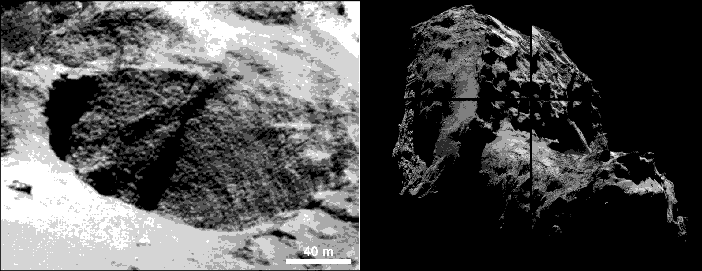
Figure 8: “Dinosaur Eggs.” These photographs, taken by the Rosetta spacecraft, show in the left picture layer upon layer of rounded boulders (nicknamed “Dinosaur Eggs” or “Goosebumps”) in the crater walls of Comet 67P/Churyumov–Gerasimenko.11
These spheres, 10 feet (3 meters) in diameter, sometimes fall out of vertical cliffs and collect at the base of the cliffs without crumbling. Therefore, those spheres are hard, solid rocks, not compacted dust or pebbles. The picture on the right shows (at the black cross), a cliff on the comet. Notice the spherical impressions made by spheres that fell out of the cliff. (Credits: ESA/Rosetta/MPS for OSIRIS Team MPS/UPD/LAM/IAA/SSO/INTA/UPM/DASP/IDA)
At the beginning of the flood, the 46,000-mile-long rupture that wrapped around the Earth formed two cliffs, each 60-miles high. Rock at the base of the cliffs, no longer compressed on all sides, crumbled, because the weight of the overlying rock exceeded granite’s crushing strength. That, in turn, removed support for the overlying rock at the top of the cliffs, so it collapsed, and the rupture’s width steadily grew. That debris was then swept up and out by the escaping subterranean water—the fountains of the great deep, which had speeds of up to 32 miles per second. The launched rocks—those smaller than 650 feet (200 meters) in diameter—were tumbled, eroded, and rounded as they accelerated upward and exceeded Earth’s escape velocity of 7 miles per second. Later, gravity and aerobraking (primarily with water vapor) gently merged those rounded rocks, along with water and dirt, into comets and asteroids.
Scientists at the European Space Agency (ESA) admit that they do not know how these spheres formed.18 Comet researchers and others will continue to be perplexed until they understand the power of the fountains of the great deep. Of course, that requires understanding the flood—especially the source of the water and the indescribable amount of energy that was released. In the next chapter, “The Origin of Earth’s Radioactivity,” you will see how that energy was released. You will also see why one must first understand the origin of Earth’s radioactivity before considering the Earth’s age. Earth’s radioactivity was a consequence of the flood and has nothing to do with the age of the Earth. [See “Why Do We Have Radioactivity on Earth?” on page 124.]
Those who refuse to consider the global flood can use another scientific approach. Instead of reasoning from cause to effect, as we have done, they could reason from effect back to its likely cause. In other words, they could look carefully at these pictures and ask what must have happened to explain their puzzling details. First, what rounded those huge rocks? Fast-flowing rivers tumble and round rocks, but that takes many years, even for the fastest rivers. There are no rivers on comets, and the rounded rocks on comet 67P are 10 feet in diameter, not little cobbles or river rocks you can hold in your hand. So, we need something flowing very fast. Besides, any liquid on a comet would immediately flash into vapor or freeze. The only flow in the near-vacuum of space that could round rocks would be a hypervelocity gas or plasma. Second, how were so many large rocks formed and rounded?
Solid rocks in space that big don’t assemble from smaller particles, because an impact by another small particle would scatter the particles that had already merged, and impacts in space are usually at high velocities. Therefore, something much larger (such as part of a moon or planet) may have been crushed before the rocks were rounded, since crushing produces somewhat uniform fragments. Then, the erosion and rounding process produces great uniformity, because the larger rocks, slower to accelerate and tumble, are eroded more by the hypervelocity fountains. When two very strange things happen at about the same time, such as (1) a hypervelocity flow that accelerates and rounds gigantic rocks, and (2) the crushing of part of a moon or planet, usually they are connected.
As the fountains of the great deep launched rocks and water droplets, evaporation in space dispersed an “ocean” of water molecules and other gases into the inner solar system. Gas molecules that struck the cold side of your spinning asteroid would become frost.13 Sunlight would usually be dim on rocks in larger, more elongated orbits. Therefore, little frost would evaporate during the day, and the frost’s thickness would increase. Your “world” would become a comet. However, if your “world” orbited relatively near the Sun, its rays would evaporate each night’s frost, so your “world” would remain an asteroid.
In general, lighter particles (dirt, water droplets, and rocks) were launched with greater velocity than heavier objects). The heavier rocks merged to become asteroids, while smaller particles, primarily water, merged to become comets, which usually have larger orbits. No “sharp line” separates asteroids and comets. In fact, some comets are also asteroids, and some asteroids are also comets.19
It should not be surprising that asteroids and comets have so many similarities, because both formed by similar processes from rocks and water launched by the fountains of the great deep, as the flood began.
Question 2: Wasn’t asteroid Eros found to be primarily a large, solid rock?
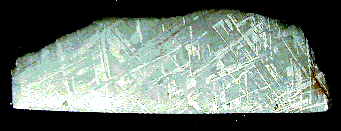
Figure 9: Hot Meteorites. Most iron-nickel meteorites display Widmanstätten patterns. That is, if an iron-nickel meteorite is cut and its face is polished and then etched with acid, the surface has the strange crisscross pattern shown above. This shows that temperatures throughout those meteorites exceeded 1,300°F.20 Why were so many meteoroids, drifting in cold space, at one time so uniformly hot?
Heating during an impact would be so brief that thermal conduction (a very slow process) could not produce the extremely uniform Widmanstätten patterns, nor would a blowtorch. The brief heating a meteor experiences in passing through the atmosphere is barely felt more than a fraction of an inch beneath the surface. Such iron meteorites had to have been “soaked” in an environment that was at least 1,300°F for a very long time before it entered cold outer space. If radioactive decay generated the heat, certain daughter products should be present, but are not. Question 5 explains how these high temperatures were reached.
A pile of dry sand here on Earth cannot maintain a slope greater than about 30 degrees. If it were steeper, the sand grains would roll downhill. Likewise, a pile of dry pebbles or rocks on an asteroid cannot have a slope exceeding about 30 degrees.21 However, 4% of Eros’ surface exceeds this slope, so some scientists mistakenly concluded that much of Eros was a large, solid rock. This conclusion overlooked the ice in asteroids that acts as a weak glue—as stated in Prediction 38 above. Ice in asteroids also explains their low density. Figure 5 gives another reason asteroids are probably flying rock piles.
Question 3: Objects launched from Earth should travel in elliptical, cometlike orbits. How could rocky bodies launched from Earth become concentrated in almost circular orbits between Mars and Jupiter?
Gases, such as water vapor and its components,22 were abundant in the inner solar system for years after the flood. Hot gas molecules striking each asteroid’s hot side were repelled with great force. This jetting action was like air rapidly escaping from a balloon, applying thrust in a direction opposite to the escaping gas.23 Cold molecules striking each asteroid’s cold side produced less jetting. This type of thrusting, which I call the radiometer effect, was efficiently powered by solar energy and spiraled asteroids outward, away from the Sun, concentrating them between the orbits of Mars and Jupiter. [See Figures 6 and 7.]
Question 4: Could the radiometer effect push asteroids 1–2 astronomical units (AU) farther from the Sun?
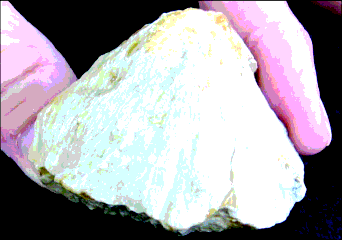
Figure 10: Shatter Cones. When a large, crater-forming meteorite strikes the Earth, a shock wave radiates outward from the impact point. The passing shock wave often breaks rock surrounding the crater into meteorite-size fragments having distinctive patterns called shatter cones. (Until shatter cones were associated with impact craters by Robert S. Dietz in 1969, impact craters were often difficult to identify.)
If large impacts on asteroids launched asteroid fragments toward Earth as meteorites, a few meteorites should have shatter cone patterns. None have ever been reported. Therefore, meteorites are probably not derived from asteroids. Likewise, impacts have not launched meteorites from Mars. [For other reasons, see page 368.]
Each asteroid began as a swarm of particles (rocks, ice, and gas molecules) orbiting within a large sphere of influence—much like a swarm of bees hovering around a beehive. The swarm’s volume was quite large, so its spin was much slower than it would be once aerobraking collapsed the swarm into a single asteroid. The slow spin produced extreme temperature differences between the hot and cold sides. The cold side would have been so cold that water molecules striking it would tend to stick as frost, thereby adding “fuel” to the developing asteroid. When the swarm rotated 180°, that frost evaporated, adding pressure, and therefore thrust, to the hot side. This cycle (freezing followed by evaporating and thrusting) was probably repeated thousands of times, especially in larger swarms.
Because the swarm’s volume was large, the radiometer pressure acted over a large area and produced a large thrust. The swarm’s large thrust and low density caused the swarm to rapidly accelerate—much as a feather placed in a steady breeze. Also, the Sun’s gravity 93,000,000 miles from the Sun (the Earth-Sun distance) is 1,600 times weaker than Earth’s gravity here on Earth.24 So, pushing a swarm of rocks and debris farther from the Sun was surprisingly easy, because there is almost no resistance in outer space.
Question 5: Why are 4% of meteorites almost entirely iron and nickel? Also, why do meteorites rarely contain quartz, which constitutes about 27% of granite’s volume?
Pillarlike structures formed in the subterranean chamber when the thicker, denser portions of the crust settled through the subterranean water onto the chamber floor. [Pages 469– 474 describe pillars and how, why, when, and where they formed.] Twice daily, during the centuries before the flood, tides in the subterranean water stretched and compressed these pillars. This powerful heating process steadily raised pillar and subterranean water temperatures, dissolved quartz, and made pillars porous (spongelike). Figure 9 explains why these temperatures exceeded 1,300°F, enough to do all this and allow iron and nickel to settle downward and concentrate in the pillar tips.25 Gravitational settling also concentrated iron and nickel in the Earth’s core after the flood began. [See “Melting the Inner Earth” on pages 620– 623.]
Evolutionists have difficulty explaining iron-nickel meteorites. First, everyone recognizes that a powerful heating mechanism must first melt some of the parent body from which the iron-nickel meteorites came, so iron and nickel can sink and be concentrated. How this could have occurred in extremely cold asteroids drifting in outer space has defied explanation.26 Second, the concentrated iron and nickel, which evolutionists visualize in the core of a large asteroid, must then be excavated and blasted into space. The evidence shows this has not happened.27
Question 6: Aren’t meteoroids chips off asteroids?
This commonly-taught idea contains an error in logic. Asteroids and meteoroids have some similarities, but that does not mean that one came from the other. Maybe a common event produced both asteroids and meteoroids.
Also, four major discoveries suggest that meteoroids came not from asteroids, but from Earth.
1. By 1975, the Pioneer 10 and 11 spacecraft traveled out through the asteroid belt. NASA expected that the particle detection experiments on board would find 10 times more micrometeoroids in the belt than are present near Earth’s orbit.28 Surprisingly, the number of micrometeoroids diminished as the asteroid belt was approached,29 showing that micrometeoroids are not coming from asteroids but from nearer the Earth’s orbit. [See Figure 17 on page 364.]
2. A faint glow of light, called zodiacal light, extends from the orbit of Venus out to the asteroid belt. The light is reflected sunlight bouncing off dust-size particles. This lens-shaped swarm of particles orbits the Sun, near Earth’s orbital plane. On dark, moonless nights, zodiacal light can be seen best in the spring in the western sky after sunset and in the fall in the eastern sky before sunrise. Debris chipped off asteroids would have a wide range of sizes and would not be as uniform and fine as the particles reflecting the zodiacal light. The fine dust particles expelled by the fountains of the great deep would lie near Earth's orbital plane, provide the faint uniform glow, and better explain zodiacal light.
3. Many meteorites have remanent magnetism, so they must have come from a larger magnetized body. Eros, the only asteroid on which a spacecraft has landed and taken magnetic measurements (as of 2018), has no net magnetic field. If this is true of other asteroids as well, meteorites probably did not come from asteroids.31 If asteroids are flying rock piles, as it now appears, any magnetic fields in the randomly oriented rocks would be largely self-canceling, so the asteroid would have no net magnetic field. Therefore, instead of coming from asteroids, meteorites likely came from a magnetized body, such as a planet. Because Earth’s magnetic field is 2,000 times greater than that of all other rocky planets combined, meteorites probably came from Earth.
Some believe that meteorites were chipped off asteroids millions of years ago. Actually, remanent magnetism decays, so meteorites must have recently broken away from their parent magnetized body.
PREDICTION 41: Most rocks comprising asteroids will be found to be magnetized.
4. Meteorites fall into three classes: 95% are stones, 4% are irons, and 1% are in an intermediate class, stoney irons—more correctly called pallasites. (Pallasites were discovered in 1794 by German naturalist Peter Simon Pallas.) Stones are rich in the chemical element silicon and the mineral olivine.32 Irons are an iron-nickel mixture that was initially molten. Pallasites formed from a molten iron-nickel mixture injected into or mixed with fragments, primarily of olivine. We know the iron and nickel were molten, because smelting is required to extract and concentrate iron and nickel from ores or rocks containing those elements.
Once in a dense, liquid state, the iron-nickel drained downward along cracks. Later, it cooled and solidified as one unit—separately encasing millions of olivine crystals. (Figure 11 explains this in more detail.)
What provided the heat that melted so much iron and nickel? Evolutionists claim that Earth evolved as rocks fell from outer space onto an asteroid-size body that steadily grew over millions of years into today’s Earth. Those impacts supposedly heated the growing Earth so much it became molten, allowing iron and nickel to settle to form Earth’s core. [The many reasons this is not true are explained in “Forming the Core” on page 165.] This common error led to the view that meteorites also impacted and melted large asteroids, so they too formed liquid cores. That is doubtful, because powerful impacts could shatter asteroids (which are just flying rock piles). Also, asteroids are so much smaller than Earth that they rarely receive impacts, and they lose heat faster than Earth. (Smaller bodies have a higher surface-to-volume ratio, so they radiate their heat faster into outer space.) This is why asteroids, since their formation, have been cold, and never molten.

Figure 11: Pallasites. Think how surprised you would be if you saw water frozen in a tank with thousands of ping-pong balls evenly distributed throughout the ice. That would be strange enough, but when sunlight shines through those ping-pong balls, they glow. Pallasites are just as surprising.
This 22-pound pallasite meteorite is a thin slice of the larger, 925-pound Fukang meteorite that fell in 2000 in the Gobi Desert in China's Xinjiang Province. Sunlight from behind, shining through the olivine crystals, makes them glow—like Sun shining through a stained-glass window. Each translucent piece of gem-quality olivine was suspended in a molten (gray) iron-nickel mixture when that liquid froze in the frigid environment of outer space and encased the olivine grains. This presents a problem. Olivine’s density is about 3.7 grams/cubic centimeter, while the density of iron-nickel is about 7.8 grams/cubic centimeter—more than twice as dense. Why didn’t the low-density olivine float to the top of the dense iron-nickel liquid?
Obviously, no gravity was acting to separate these particles when the molten iron-nickel froze. Zero gravity means the meteorite, containing molten iron and nickel, was drifting weightlessly in outer space as it froze. Then why was the less dense olivine scattered within the dense molten iron-nickel? The meteorite was tumbling as it was launched. This book has described many similar events.
Why is the olivine gem-quality and, therefore, so bright? The suspended crystals merged (grew in size) as the iron-nickel solidified in the weightless environment of space—precisely the conditions in which crystals can grow most uniformly and become gem-quality. Thus, light can shine through each of the olivine crystals with minimal distortion, as shown above.
Earth’s mantle is rich in silicon and olivine, and Earth’s core is iron-nickel rich, so pallasites were thought to have come from some core-mantle boundary. Few, if any, ever considered Earth as the parent body for any meteorites, let alone pallasites, because few could have imagined, in their wildest dreams, an energy source that could have launched large rocks at speeds greater than Earth’s escape velocity: 7.0 miles per second (11.2 km/sec).33 Besides, wouldn’t iron meteorites need to come from Earth’s iron-nickel outer core, 1,800–3,200 miles below Earth’s surface? Therefore, everyone reasoned—incorrectly, it turns out—that meteorites came from much smaller bodies. Asteroids, with a (hoped for) iron-nickel core, seemed to fit the bill, but even then, excavating and launching iron meteorites from an asteroid large enough to possibly have a solid, iron-nickel core was still difficult to imagine.27
But pallasites present five other problems:
- Since iron-nickel liquid is twice as dense as olivine, how could olivine fragments be scattered throughout molten iron and nickel? All the low-density olivine should float to the top. [See Figure 11.]
- The boundary between a silicon-rich mantle and molten iron-nickel core should be extremely thin, even if such a boundary existed in an asteroid. The number of pallasites that could come from that thin boundary would be far less than the 1:4 ratio of pallasites to iron meteorites.
- Tests on eight pallasites showed that the molten iron-nickel mixtures cooled at such diverse rates that they could not have originated at a core-mantle boundary, even in an asteroid.34 Cooling rates at such a boundary would have been quite uniform. However, cooling rates inside rocks launched into frigid outer space would differ considerably, because of the different sizes of the rocks.
- Some pallasites contain remanent magnetism, showing that the molten metal cooled in the presence of various magnetic fields, some were up to twice as strong as Earth’s field today.35 (There is no direct evidence that any asteroid ever had a magnetic field, although many believe that story.) In the next chapter, you will see that the fluttering hydroplates and pounding pillars produced a steady stream of powerful electrical surges and magnetic fields within the crust and pillars.
- Probably no asteroid is big enough to have ever had a molten core, let alone a magnetic field. Yes, 90% of all meteorites show evidence of at least some melting, but that is because they came from the hot subterranean chamber, not from an asteroid in supercold space. Many have tried unsuccessfully to explain this long-standing problem: “What heated the asteroids?”36 They have failed, because the heating occurred in the subterranean chamber before the asteroids formed.37
The hydroplate theory solves all five problems.
Twenty-six additional observations either (1) support the proposed explanation that meteoroids and the material that formed asteroids came from Earth, or (2) are inconsistent with current theories on the origin of asteroids and meteoroids.
1. For decades, astronomers have said that asteroids are rocky bodies and comets are dirty snowballs.38 Why then do at least some asteroids have water-ice on and inside them? 39 [See Prediction 40 and Figure 16 on page 373.] If ice or water vapor came out from inside an asteroid, how did the water get inside? Certainly, not from outside, because almost all asteroids are too close to the Sun for water (liquid or ice) to remain? 40 [See “Earth: The Water Planet” on page 32.]
Answer: Some water and complex organic matter that were formerly on the Earth are now in asteroids and comets. [See “Rosetta Mission” on pages 319.] No “sharp line” separates asteroids and comets.
The hydroplate theory provides the details. As the flood began, the fountains of the great deep launched muddy water and some organic material from Earth. In the cold vacuum of space, about half of that water quickly evaporated, and the remainder froze. Later, gravity (as explained beginning on page 321) formed asteroids and comets from some of that material. Since the flood, almost all ice on asteroid surfaces has sublimated (vaporized), leaving behind a crust of dirt that protects the deeper ice within. If internal ice is suddenly exposed by an impact or by fracturing, water vapor will briefly vent and form a temporary atmosphere for the asteroid. Eventually, that water vapor will either escape or become frost on the asteroid’s surface. Water-ice has been discovered on asteroids Themis and Cybele.39
PREDICTION 42: Water-ice on asteroids will be rich in deuterium.
PREDICTION 43: A deep, penetrating impact on a large asteroid, such as Ceres, will release vast volumes of water vapor. (This prediction has now been confirmed.9 See Figure 12.)
2. Minerals in meteorites are remarkably similar to those in the Earth’s crust. 41 Some meteorites contain very dense elements, such as nickel and iron. Those heavy elements seem compatible only with the dense, rocky planets: Mercury, Venus, Mars, and Earth—Earth being the densest.
A few asteroid densities have been calculated. They are generally low, ranging from 1.2 to 3.3 gm/cm3. The higher densities match those of the Earth’s crust. The lower densities imply the presence of voids between loosely held rocks. One asteroid is too massive to be porous inside, so it must contain a very rigid, low-density substance, such as water-ice.42
PREDICTION 44: Rocks in asteroids are typical of the Earth’s crust. Expensive efforts to mine asteroids 43 to recover strategic or precious metals will be a waste of money.
3. Most meteorites44 contain metamorphosed minerals, showing that they reached extremely high temperatures and pressures, despite a supposed lifetime in the “deep freeze” and weightlessness of outer space.
Asteroids have also experienced extreme heating.37 Radioactive decay within such small bodies could not have produced the necessary heating, because too much heat would have escaped from their surfaces. Stranger still, liquid water altered some meteorites45 while they and their parent bodies were heated—sometimes multiple times.46
Impacts in space are often proposed to explain this mysterious heating throughout an asteroid or meteorite. However, an impact—similar to throwing a baseball into a bean-bag chair—would raise the temperature only for an instant near the point of impact. Before gravel-size fragments from an impact could become uniformly hot, they would radiate their heat into outer space.47
For centuries before the flood, tidal pumping generated considerable heat within pillars in the subterranean water chamber. [See Question 5 on page 356.] As the flood began, the powerful fountains of the deep launched rock fragments into space—fragments of hot, crushed pillars and rocks from the crumbling walls of the ruptured crust. Those rocks became meteoroids and asteroids.
4. Diamonds, the hardest of all minerals, have been found in meteorites,48 showing that at one time both temperatures and pressures within those rocks were extremely high.49 Asteroid impacts in supercold space (almost absolute zero) might produce the pressures needed, but would not produce the necessary temperatures. Meteorites entering Earth’s atmosphere are heated but only on their surface, and their tumbling action would probably not produce the necessary pressure. Both the compression event and pounding pillars, described in detail by the hydroplate theory, would each produce the temperatures and pressures needed to form diamonds. Besides, diamonds are a solid form of pure carbon. Pure, solid carbon is extremely rare in outer space, but common on Earth. (Vegetation doesn’t grow in outer space.)
5. Because the material that later merged to become asteroids came from Earth, asteroids typically spin in the same direction as Earth—counterclockwise, as seen from the North. However, collisions have undoubtedly randomized the spins of many smaller asteroids in the last few thousand years.50

Figure 12: Bright Spots on Ceres. In March 2015, NASA’s Dawn spacecraft began orbiting Ceres, the largest of all asteroids (almost 600 miles in diameter). In the next few months, scientists discovered 130 bright spots on Ceres which, after months of debate, were identified as salt52 and water ice, usually in the bottom of craters. When sunlight warms the largest and brightest spot (shown above in a 2.5 mile deep crater), the ice, whose melting temperature is lowered by the salt, sublimates into a low cloud of water vapor that reflects even more sunlight. The cloud appears and disappears in step with the day-night cycle on Ceres. Most water vapor remains below the high crater rim, although a few kilograms of this water escape from Ceres each second. Therefore, this crater is young.53
The hydroplate theory, pages 113– 160, explains how the salt was concentrated in the subterranean water chamber and transported to Ceres. How did ice and its dissolved salts collect in the bottom of craters? Within a few years (or perhaps centuries) after the flood, aerobraking collapsed each swarm of rocks, ice, and dirt, releasing heat and forming the solar system’s asteroids and comets. When Ceres, the most massive asteroid formed, such great heat was released that considerable internal ice melted, causing liquid water to rise and collect under the frozen surface of Ceres. Later impacts on Ceres produced craters that exposed the ice below or collected water that melted from the impact, drained into the crater, and froze. (Water ice is 25% of Ceres by weight.)
6. Some asteroids have captured one or more moons. [See Figure 4.] Sometimes the “moon” and asteroid are similar in size. Impacts would not create equal-size fragments that could capture each other.51 The only conceivable way for this to happen is if a potential moon enters an asteroid’s expanding sphere of influence while traveling about the same speed and direction as the asteroid. If even a thin gas surrounds the asteroid, the moon will be drawn closer to the asteroid, preventing the moon from being stripped away later. An “exploded planet” would disperse relatively little gas. The “failed planet explanation” meets none of the requirements. The hydroplate theory satisfies all requirements.
Also, tidal effects, described on pages 593– 596, limit the lifetime of the moons of asteroids to about 100,000 years.54 This fact and the problems in capturing a moon caused evolutionist astronomers to scoff at early reports that some asteroids have moons.
7. Meteorites contain different isotopes of the chemical element molybdenum, each isotope having a slightly different atomic weight. If, as evolutionists teach, a swirling cloud of gas and dust mixed for millions of years and produced the Sun, its planets, and meteorites, then each meteorite should have about the same combination of these molybdenum isotopes. Because this is not the case,55 meteorites did not come from a swirling dust cloud or any source that mixed for millions of years.
(The next chapter, “The Origin of Earth’s Radioactivity,” will explain why different mixes of isotopes are in different meteorites, but for now remember that most meteorites are fragments of crushed pillars and each pillar was subjected to a different isotope-producing environment when the flood began.)
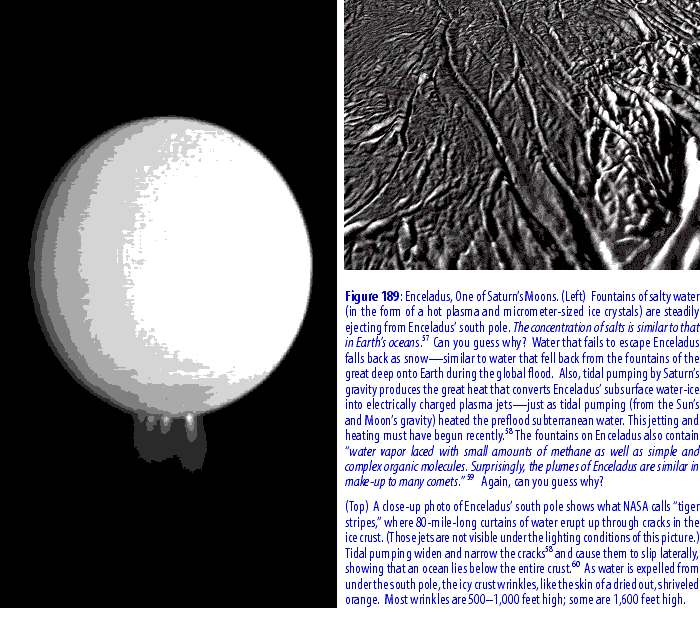
8. The smaller moons of the giant planets (Jupiter, Saturn, Uranus, and Neptune) are captured asteroids. Astronomers generally accept this conclusion, but do not know how these captures could have occurred.56
As explained earlier in this chapter, the radiometer effect, powered by the immense energy of the Sun, spiraled asteroids outward from Earth’s orbit for decades after the flood. Water vapor tended to collect as thick envelopes (temporary atmospheres) around asteroids and planets, causing aerobraking which allowed massive planets to capture asteroids. Without these temporary atmospheres (or some yet to be explained means for removing orbital energy), capture is nearly impossible.61
Saturn’s 313-mile-wide moon, Enceladus (en-SELL-uh-duhs), is an asteroid, captured by aerobraking, and is therefore in a highly elliptical orbit. [See Figure 13.] Asteroids are icy and weak, so those captured by a giant planet experience strong tides. Tidal pumping at Enceladus slowed its spin, and generated considerable internal heat that melted ice and boiled deep reservoirs of water. Because this capture was quite recent,58 the water jetting from cold Enceladus is still a hot plasma. “Dark green organic material”62 is on its surface, and the Cassini spacecraft measured “concentrated and complex macromolecular organic material with molecular masses above 200 atomic mass units.63 Because those molecules are so large and complex, they are probably from life that was on Earth before the flood. The water escaping Enceladus supplies Saturn’s E ring,64 and contains salts resembling those in Earth’s ocean waters.57 This loss of internal water has buckled the surface near the geysers as shown in Figure 13.
The farther Enceladus is (on its elliptical orbit) from Saturn, the more Enceladus’ crust is stretched at its south pole and the more water vapor and ice particles are ejected. Tidal stresses widen and narrow the fractures that connect the tiger stripes to the Lake-Superior-size global “ocean” below Enceladus’ crust.58
But some researchers object.65 They say that heat generated by tidal pumping could not “keep a global [subsurface] ocean from freezing,” 66 let alone melt ice in the first place. What is overlooked is that tidal pumping and internal heating were greatest immediately after asteroid Enceladus was captured as a moon only about 5,000 years ago. Since then, its spin rate has slowed, and frictional heating has diminished. [To understand tidal heating using an example closer to home, see “Tidal Pumping” on page 129 and pages 612– 613.]
9. Saturn’s moon, Dione, has a subsurface, liquid-water, global ocean, heated by tidal pumping and estimated to be under 100 kilometers of water ice.67 Therefore, as explained above, it is also a recently captured asteroid.
10. Mars has two tiny moons, Phobos (FOH-bus), 14 miles in diameter, and Deimos (DEE-mus), 8 miles in diameter. In 2008, a spacecraft passing near Phobos measured its density (1.876 gm/cm3); Phobos contains up to 30% empty space68 or something much lighter than rock, such as water-ice. Asteroids and Phobos have similar low densities. Both moons have similar surface materials as asteroids,69 but different surface materials than Mars. Therefore, Phobos and Deimos probably were not blasted off Mars, but instead are captured asteroids.70
PREDICTION 45: Mars’ smaller moon, Deimos, also will be found to have a very low density.
Astronomers would normally conclude that both moons are captured asteroids, except for the inconvenient laws of orbital mechanics which show it is virtually impossible to perturb asteroids from circular orbits in the asteroid belt and place them in circular orbits around Mars. Astronomers are perplexed.
However, asteroids did not come from the asteroid belt; they formed from rocks and water (ice) launched from Earth by the powerful fountains of the great deep. Then, the radiometer effect, powered by solar energy, spiraled asteroids out through Mars’ orbit. Water from asteroids and comets impacting Mars gave Mars a temporarily thick atmosphere able to capture asteroids by aerobraking. Similar events account for the more than 180 moons around the giant planets.
This scenario on Mars is largely confirmed by the fact that both of its moons have circular orbits that lie in Mars’ equatorial plane.72 Why? In the years following the flood, Mars’ atmosphere had a very low density but grew temporarily to be thousands of miles thick.73 This facilitated asteroid capture and transferred enough angular momentum from Mars’ rotation to circularized Phobos and Deimos and align them in Mars’ equatorial plane.
Similar captures of outward spiraling asteroids occurred farther out, placing moons with circular orbits in the equatorial planes of the giant planets.72 Because asteroids did not spiral inward, Venus and Mercury acquired no asteroids as moons.
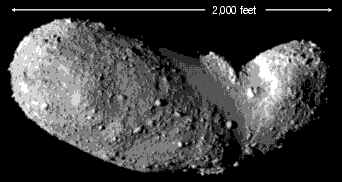
Figure 14: Asteroid Itokawa (E-toe-KA-wah). The fountains expelled dirt, rocks, and considerable water from Earth. About half of that water quickly evaporated into the vacuum of space, freezing the remainder. Each evaporated gas molecule became an orbiting body in the solar system. Later, as explained on pages 352–360, asteroids and comets formed—many shaped like peanuts.78
Gas molecules captured by asteroids or released by icy asteroids became their temporary atmospheres. Asteroids with thick atmospheres sometimes captured (by aerobraking) smaller asteroids as moons. If an atmosphere remained long enough, those moons would lose altitude and gently merge gravitationally with their asteroids, forming peanut-shaped asteroids. If an atmosphere dissipates before merging, a moon remains, as shown in Figure 4 on page 351. We see merging (called aerobraking) when a satellite or spacecraft reenters Earth’s atmosphere, slowly loses altitude, and falls to (merges with) Earth. Without an atmosphere, merging in space becomes almost impossible.
Itokawa formed from two smaller asteroids with different densities (1,750 kg/m3 and 2,850 kg/m3) that merged after each accumulated its layered sediments.79 Donald Yeomans, a member of NASA’s Jet Propulsion Laboratory, admitted,
The mystery is solved when one understands that water vapor and aerobraking in weightless outer space gently merged the material in comets and asteroids.
Comet 67P, described in the “Rosetta Mission” on page 306, also has a peanut shape, but is described as looking like a “rubber duckie”: two rounded bodies that merged—the smaller duck’s head sitting midway on its potato-shaped body. For over a year scientists were mystified for the reasons Donald Yeomans explained above. Therefore, they proposed an explanation that most people would consider crazy: maybe something in the vacuum of space eroded only the narrow neck region where the two lobes joined. Although the scientists finally saw enough evidence that showed the two bodies merged,81 they are still mystified for the reason Yeomans gave, but all of you know why the merging by aerobraking was gentle. [See p. 307.]
As explained in Prediction 39 on page 353, notice on Itokawa’s surface the many rounded boulders, some 150 feet in diameter. An exploded planet or impacts on asteroids would produce angular rocks. Japan’s Hayabusa spacecraft traveled alongside asteroid Itokawa for two months in 2005. The spacecraft landed on asteroid Itokawa, scooped up 1534 tiny rocks (up to 0.18 millimeters in diameter) and returned them to Earth in 2010. The wide range of minerals in those rocks were typical of Earth’s most common minerals, but their chemical elements were quite different from the solar system’s most common chemical elements. Analyses of Itokawa’s minerals show that at some time in the distant past, they reached temperatures of up to 1472°F, which would have been typical of the rocks in the subterranean chambers. Average temperatures on the asteroid itself are 1,900°F colder! 82
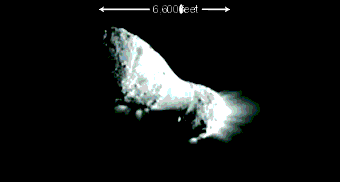
Figure 15: Comet Hartley 2. On 4 November 2010, the Deep Impact spacecraft passed within 435 miles of Comet Hartley 2 and took this photograph. Hartley 2 has a peanut shape, as does asteroid Itokawa (shown in Figure 14) and some other asteroids and comet nuclei, because they all formed by the same special mechanism.
Once launched into space by the fountains of the great deep, smaller debris gravitationally merged with large rocks traveling nearby with similar velocities and directions. The velocities of merging pairs were similar, because they were launched about the same time and place and with similar directions and speeds. Smaller bodies that came within the spheres of influence of larger rocks briefly orbited the larger bodies. Then, if the gas in those spheres of influence (gas also launched into the inner solar system) removed enough orbital energy, the larger body captured the smaller body. Once captured, aerobraking decayed the orbits and, over weeks to years, the two gently merged.
Eventually, the larger rocks gravitationally attracted enough matter (swarms of ice, dust, gases, and organic material ) that they became large globs. The larger a glob became, the larger its sphere of influence, so the glob could pull in even more material. Finally, if two large globs gently merged, they became peanut-shaped comets or asteroids. [See Figures14 and 15.]
If merged bodies have spent much of their lives orbiting close to the Sun, their frozen surface volatiles would have completely evaporated; we call them asteroids. However, if the merged bodies spent little time near the Sun, their volatiles would still be venting today when they passed near the Sun, and we call them comets. This is why asteroids and comets have so many similarities, why a few are catalogued as both comet and asteroid, and why asteroids impacted by space debris will suddenly start venting their frozen internal volatiles.
What was the source of the organic material? Probably it came from something living, although that is not absolutely necessary. Further space missions will clarify this. If it turns out that it came from life, one would be wise to bet that the life came from the preflood Earth, not that life originated in outer space. The latter is absurd, because life is so complex, and organisms exposed to space radiations for millions of years would be dead.
Surprisingly, Hartley 2 is expelling more carbon dioxide (CO2) than water vapor. Undoubtedly, other comets and asteroids once contained frozen CO2 (dry ice). Because Hartley 2, a small comet, is still sublimating, it must be very young. To understand all of this, see “Why Do Comets have so Much Carbon Dioxide?” on page 314.
11. Many asteroids, called active asteroids,74 suddenly develop comet tails, so they are considered both asteroid and comet. The hydroplate theory says that asteroids are weakly joined piles of rocks and ice. If such a pile cracked slightly, perhaps due to an impact by space debris, then internal ice, suddenly exposed to the vacuum of space, would violently vent (sublimate) water vapor and produce a comet tail. The hydroplate theory explains why comets are so similar to asteroids.
12. A few comets have nearly circular orbits within the asteroid belt. Their tails lengthen as they approach perihelion and recede as they approach aphelion. If comets formed beyond Neptune, it is highly improbable that they could end up in nearly circular orbits in the asteroid belt.75 So, these comets almost certainly did not form in the outer solar system. The hydroplate theory explains how comets (icy rock piles) recently entered the asteroid belt.
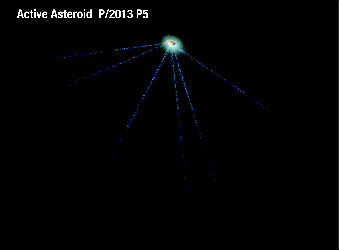
Figure 16: Six Tails. “We were literally dumbfounded when we saw [this 1,600-foot-diameter asteroid],” said lead investigator David C. Jewitt, who viewed this asteroid with the Hubble Space Telescope. “It was hard to believe we’re looking at an asteroid.” 84 For at least 5 months, it looked like a rotating lawn sprinkler. “Because nothing like this has ever been seen before, astronomers are scratching their heads to find an adequate explanation for its out-of-this-world appearance.”84
Why should we be surprised? The fountains of the great deep launched water, rocks, and dirt. Later, the gravity of each very large rock, drifting weightlessly in space, pulled in smaller nearby rocks, water-ice, and dirt in the large rock’s sphere of influence. (Aerobraking by all the water vapor then accomplished the merging.) Therefore, asteroids are flying rock piles held together by gravity and ice acting as a weak glue.
An external impact or shift within an asteroid would open hairline cracks exposing some of its internal ice to the vacuum of space. The ice would begin to generate water vapor (sublimate). At the base of such cracks deep inside the asteroid, pressures would suddenly increase and resemble a jet aircraft’s combustion chamber, except an asteroid’s jets would be hundreds of tons of water vapor and entrained dust, not burning aviation fuel.
Jewitt and other astronomers recognized that internal ice would explain what their eyes were clearly telling them, but how could water get inside an asteroid? In the vacuum of space, water (liquid or ice) closer to the Sun than 5 AU vaporizes and is blown out of the solar system by solar wind.40 This asteroid is only 2.2 AU from the Sun. Besides, how could ice in asteroids stick around for billions of years. It should have escaped by now.7 Jewitt mistakenly concludes:
[The asteroid] is an unlikely carrier of water ice, and sublimation is unlikely to account for the observed activity ... While some [asteroids] are suspected to contain water ice whose sublimation is responsible for the expulsion of dust, others [asteroids] are impact-produced while, for a majority, the origin [of the ice] is unknown.85
Yes, about half of every water droplet in the fountains flashed into steam, but that evaporative cooling quickly froze the remaining liquid. When the ice crystals, vapor, rock, and dust mixture in a large rock’s sphere of influence eventually merged to form an asteroid, the ice was already inside. All of this began during the flood, only about 5,000 years ago. Problem solved.
This asteroid is in the asteroid belt. Comets, on the other hand, have elongated orbits and come in much closer to the Sun. As a comet heats up near its perihelion, it develops many jets. [See Figure 169 on page 310.] Because comets vent near the Sun, a strong solar wind acts on a comet’s jets and pushes them away from the Sun as a unit—forming a comet’s tail.
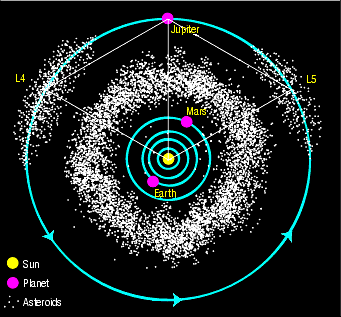
Figure 17: Asteroid Belt and Jupiter’s L4 and L5. The size of the Sun, planets, and especially asteroids are magnified, but their relative positions are accurate. About 90% of the 732,884 catalogued asteroids lie between the orbits of Mars and Jupiter, a doughnut-shaped region called the asteroid belt. A few small asteroids cross Earth’s orbit.
Jupiter’s Lagrange points, L4 and L5, lie 60° ahead and 60° behind Jupiter, respectively. They move about the Sun at the same velocity as Jupiter, as if they were fixed at the corners of the two equilateral triangles shown. Items 16 and 17 explain why so many asteroids—called Trojan asteroids—have settled near L4 and L5, and why significantly more oscillate around L4 than L5.
13. If asteroids passing near Earth came from the asteroid belt, too many of them have circular orbits,76 and diameters less than 50 meters.77 However, we would expect this if the rocks that formed asteroids were launched from Earth.
14. Computer simulations, both forward and backward in time, show that asteroids traveling near Earth have a maximum expected lifetime of only about a million years. They “quickly” collide with the Sun.83 This raises doubts that all asteroids began 4,600,000,000 years ago as evolutionists claim—living 4,600 times longer than the expected lifetime of near-Earth asteroids.
15. Earth has one big moon and several tiny moons—up to 650 feet in diameter.86 The easiest explanation for the small moons is that they were launched from Earth with barely enough velocity to escape Earth’s gravity. (To understand why the largest of these small moons is about 650 feet in diameter, see Figure 5.)
16. Asteroids 3753 Cruithne, 2010 SO16, 2002 AA29, and a few others are traveling companions of Earth.87 They delicately oscillate, in a horseshoe pattern, around two points that lie 60° (as viewed from the Sun) forward and 60° behind the Earth but on Earth’s nearly circular orbit. These points, predicted by Lagrange in 1764 are called Lagrange points. They are stable places where an object would not move relative to the planet if the object could once occupy either point going at zero velocity relative to the planet. But how could a slowly moving object ever reach, or get near, either point? Most likely, it barely escaped from Earth.
Also, Asteroid 3753 could not have been in its present orbit for long, because it is so easy for a passing gravitational body to perturb it out of its barely stable niche. Time permitting, Venus will pass near this asteroid 8,000 years from now and may dislodge it.88
17. Each planet has two Lagrange points on its nearly circular orbit. The first, called L4, lies 60° (as seen from the Sun) in the direction of the planet’s motion. The second, called L5, lies 60° behind the planet. [See Figure 17.]
Visualize planets and asteroids as large and small marbles rolling in orbitlike paths around the Sun on a large frictionless table. At each Lagrange point is a bowl-shaped depression that moves along with each planet. Because there is no friction, small marbles (asteroids) that roll down into a bowl normally pick up enough speed to roll back out. However, if a chance gravitational encounter slowed one marble after it entered a bowl, it might not exit the bowl. Marbles trapped in a bowl would normally stay 60° ahead of or behind their planet, gently rolling around near the bottom of their moving bowl.
One might think an asteroid is just as likely to get trapped in Jupiter’s leading bowl as its trailing bowl—a 50–50 chance, as with the flip of a coin. Surprisingly, 1068 asteroids are in Jupiter’s leading (L4) bowl, but only 681 are in the trailing bowl.89 This shouldn’t happen in a trillion trials if an asteroid is just as likely to get trapped at Jupiter’s L4 as L5. What concentrated so many asteroids near the L4 Lagrange point?
According to the hydroplate theory, asteroids formed near Earth’s orbit. Then, the radiometer effect spiraled them outward, toward the orbits of Mars and Jupiter. Some spiraled through Jupiter’s circular orbit and passed near both Jupiter’s L4 and L5. Asteroids that entered the “L5 bowl” received a forward gravitational tug from Jupiter that tended to pull them out of that bowl, while those that entered the “L4 bowl” received a backward gravitational tug that tended to keep them in the “L4 bowl.” The excess number of asteroids near Jupiter’s L4 is what we would expect based on the hydroplate theory.
18. NASA is planning to launch two 450 million dollar (U.S.) space missions, one of which will examine two of Jupiter’s Trojan asteroids in 2030. Why? Because NASA thinks they are “oddballs.” 90 One of the “oddball” Trojans, named “Psyche,” is an iron and nickel asteroid. NASA scientists think that billions of years ago Jupiter and its Trojan asteroids condensed from the same swirling dust cloud, so why are Psyche and Jupiter (a gas planet) so different? Those scientists should (1) learn the origin of asteroids, (2) understand why asteroids spiraled outward, allowing many to settle into two of Jupiter’s Lagrange points (L4 and L5), and (3) learn how iron and nickel collected in the base of Earth’s preflood pillars before they were smashed and the fragments launched into space by the fountains of the great deep. Of course Psyche and Jupiter are different.
In 2032, the second mission will examine two of Jupiter’s Trojans that are orbiting each other. That also puzzles NASA’s scientists, because only one slight gravitational perturbation over millions of years would separate the delicately orbiting pair, especially with so many other perturbing asteroids nearby. What a waste of taxpayer’s money, since these observations (and hundreds of others) are explained or predicted by the hydroplate theory.
19. Without the hydroplate theory, one has difficulty imagining situations in which an asteroid would (a) settle into any of Jupiter’s Lagrange points (let alone one of Jupiter’s symmetric Lagrange points), (b) capture a moon, or (c) have a circular orbit, along with its moon, about their common center of mass. If all three happened to an asteroid, astronomers would be shocked; no astronomer would have predicted that it could happen to a comet. Nevertheless, an “asteroid” discovered earlier, named 617 Patroclus, satisfies (a)–(c). Patroclus and its moon, Menoetius, have such low densities that they would float in water; therefore, both are probably comets 91—dirty, fluffy snowballs. Paragraphs 6, 11, 12, and 17 (above) explain why these observations make perfect sense with the hydroplate theory.
20. Asteroid 2015BZ509 travels very near Jupiter’s entire orbit—but backwards (retrograde, clockwise as viewed from the north star)! This presents astronomers with three problems,92 all solved by the hydroplate theory.
a. If 2015BZ509 has been there for millions of years, how did it avoid colliding with the more than a thousand asteroids traveling prograde near Jupiter’s orbit?
b. Why, after all this time, has Jupiter’s gigantic gravity not flung 2015BZ509 far from its current orbit?
Answers for a and b: Asteroids are not millions of year old. They formed only a few thousand years ago—as a result of the flood.
c. How could an asteroid end up in a retrograde orbit?
Answer: Some of the debris launched by the fountains of the great deep (that later merged to become asteroids) orbited the Sun in the retrograde direction.
21. As explained in “Shallow Meteorites” on page 44, meteorites are almost always found surprisingly near Earth’s surface. The one known exception is in southern Sweden, where 40 meteorites and thousands of grain-size fragments of one particular type of meteorite have been found at different depths in a few limestone quarries. The standard explanation is that all these meteorites somehow struck this same small area over a 1–2-million-year period about 480-million years ago.106
A more likely explanation is that a meteorite launched during the flood did not have quite enough velocity to escape Earth’s gravity. The meteorite fragmented into many pieces as it slammed back into the atmosphere. The pieces embedded themselves at slightly different depths in mushy, recently-deposited limestone layers in what is now southern Sweden.
22. Light spectra (detailed color patterns, much like a long bar code) from so many comets and asteroids show that complex organic compounds and kerogen, a coal-tar residue107—and even amino acids—were in those bodies when they formed.108 Life as we know it could not survive in such a cold, radiation-filled region of space, but common organic matter launched from Earth could have been preserved.
23. Many asteroids are reddish and have light characteristics showing the presence of iron.109 On Earth, reddish rocks almost always imply iron oxidized (rusted) by oxygen gas. If iron on asteroids is oxidized, the oxygen probably came from dissociated water molecules.
Mars, often called the red planet, derives its red color from oxidized iron. Again, oxygen in the water vapor launched from Earth during the flood probably accounts for Mars’ red color.
Mars’ topsoil is richer in iron and magnesium than Martian rocks beneath the surface. The dusty surface of Mars also contains carbonates, such as limestone.110 Because meteorites and Earth’s subterranean water contained considerable iron, magnesium, and carbonates, it appears that Mars was heavily bombarded by meteorites and water launched from Earth’s subterranean chamber. [See “The Origin of Limestone” on pages 268 – 273.]
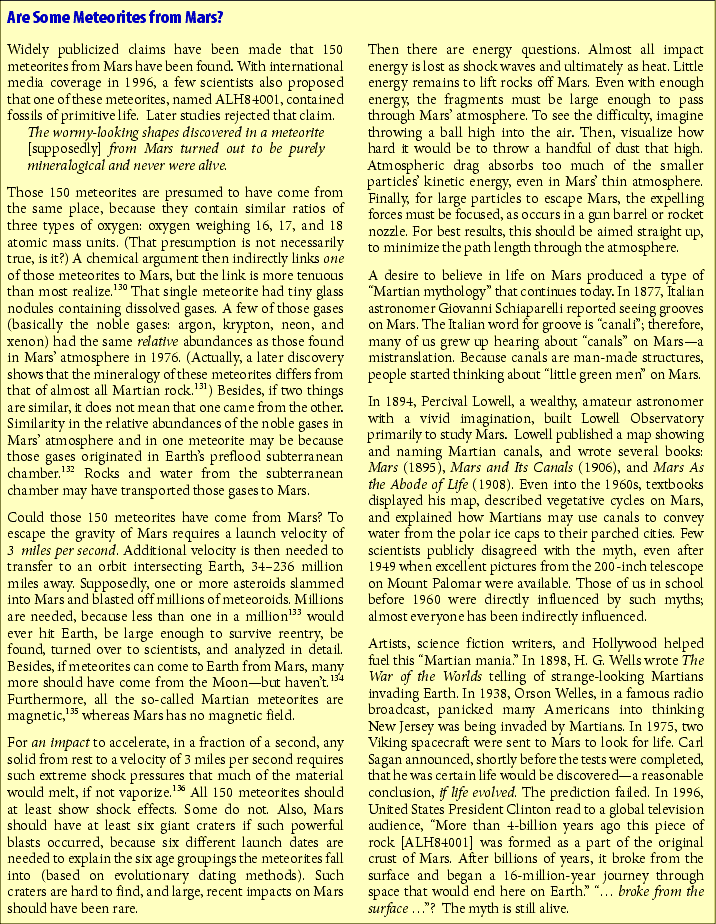
Those who believe that meteorites came from asteroids have wondered why meteorites do not have the red color of most asteroids.111 The answer is twofold: (a) as explained on page 356, meteorites did not come from asteroids but both came from Earth, and (b) asteroids have their red color because they contain water that oxidizes the iron in the asteroid’s rocks.
24. Mars has relatively little gravity, travels very near the asteroid belt, and has a thin atmosphere. However, Mars should not have any atmosphere if asteroids have been pummeling it for 4.5 billion of years. Evidently, asteroids have not been around for 4.5-billion years.112
25. Asteroids and comets delivered that water to Mars. (All asteroids and comets formed from rocks and water launched at the beginning of the flood by the fountains of the great deep.) This is confirmed by the unusual deuterium-to-hydrogen ratio found in water locked in Martian clays. That ratio is the same as we determined was in water launched from the subterranean chamber when the flood began.113
26. Mars’ water does not need to be replenished, because so much water was delivered, and it happened recently (only about 5,000 years ago). Therefore, Mars’ water has had little time to escape.
Because of its distance from the Sun, Mars is cold, averaging at least -80°F (112°F below freezing). One might think that any liquid water on Mars surface would quickly freeze, especially at Mars’ low atmospheric pressures.114 However, comparisons of detailed photographs show that water has flowed on Mars within the last few years115—and today, during Martian summers, saltwater appears to flow out of equatorial facing slopes! 116 How could that be?117
Did the liquid water originally come from below Mars’ surface or above? Many say that subsurface water on Mars migrated upward for hundreds of miles to the surface. However, that would not carve erosion gullies on crater walls, as shown in Figure 19, or on a Martian crater’s central peak. Besides, the water would freeze a mile or two below the surface.118 Even volcanic eruptions on Mars would not melt ice fast enough to release the estimated 10–1,000 million cubic meters of water per second needed to cut each stream bed.119 (This exceeds the combined volume flow rate of all of Earth’s rivers that enter oceans.)
The salty water came from above Mars’ surface. Soon after Earth’s global flood, the radiometer effect spiraled asteroids out to the asteroid belt, just beyond Mars, where there were frequent opportunities to collide with Mars. Comets also impacted Mars. When an icy impact occurred, the impactor’s kinetic energy became heat energy, instantly melted some ice, gouged out a crater, and kicked up into Mars’ thin atmosphere large amounts of debris mixed with water (liquid, ice crystals, and vapor)—and complex organic molecules that obviously came recently from life.120 Then, the dirt and salt-water mixture settled back to the surface in vast layers of thin sheets—strata—especially around the crater.
Mars’ stream beds usually originate on parts of crater walls instead of in smaller tributaries as on Earth.121 Martian drainage channels and layered strata are found at almost 200 isolated locations.122 Most gullies are on crater slopes at high latitudes123—extremely cold slopes that receive little sunlight. One set of erosion gullies is on the central peak of an impact crater. 124
Impact craters at many latitudes sometimes expose thin ice layers a foot or so beneath Mars’ surface.125 “At polar latitudes, as much as 50 percent of the upper meter of soil may be [water] ice.”126
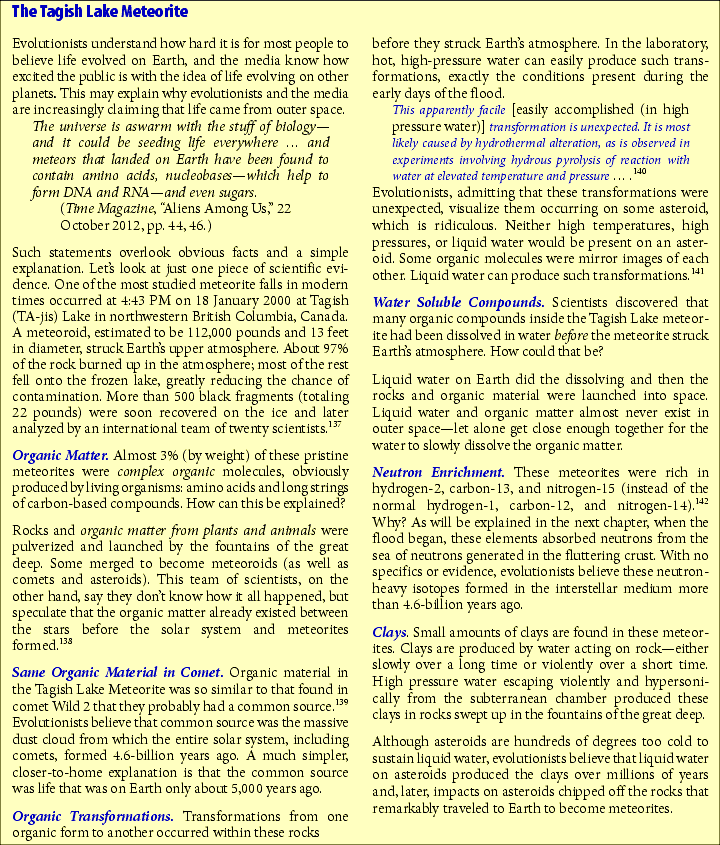
Icy asteroids and comets bombarding Mars released liquid water, which often pooled inside craters or flowed downhill and eroded the planet’s surface.127 (Most liquid water soaked into the soil and froze.) Each impact was like the bursting of a large dam here on Earth. Brief periods of intense, hot rain and localized flash floods followed.128 These Martian
hydrodynamic cycles quickly “ran out of steam,” because Mars receives little heat from the Sun. While the consequences were large for Mars, the total water was small by Earth’s standards—about twice the water in Lake Michigan.
Today, when meteorites strike icy soil on Mars, some of that ice melts. Liquid water then flows down the crater wall, leaving the telltale gullies that have shocked the scientific community.115
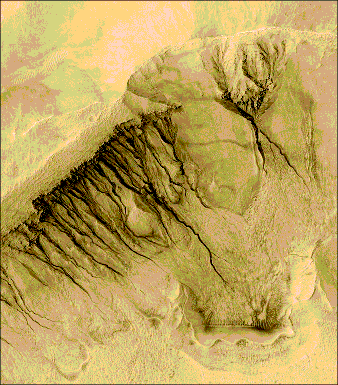
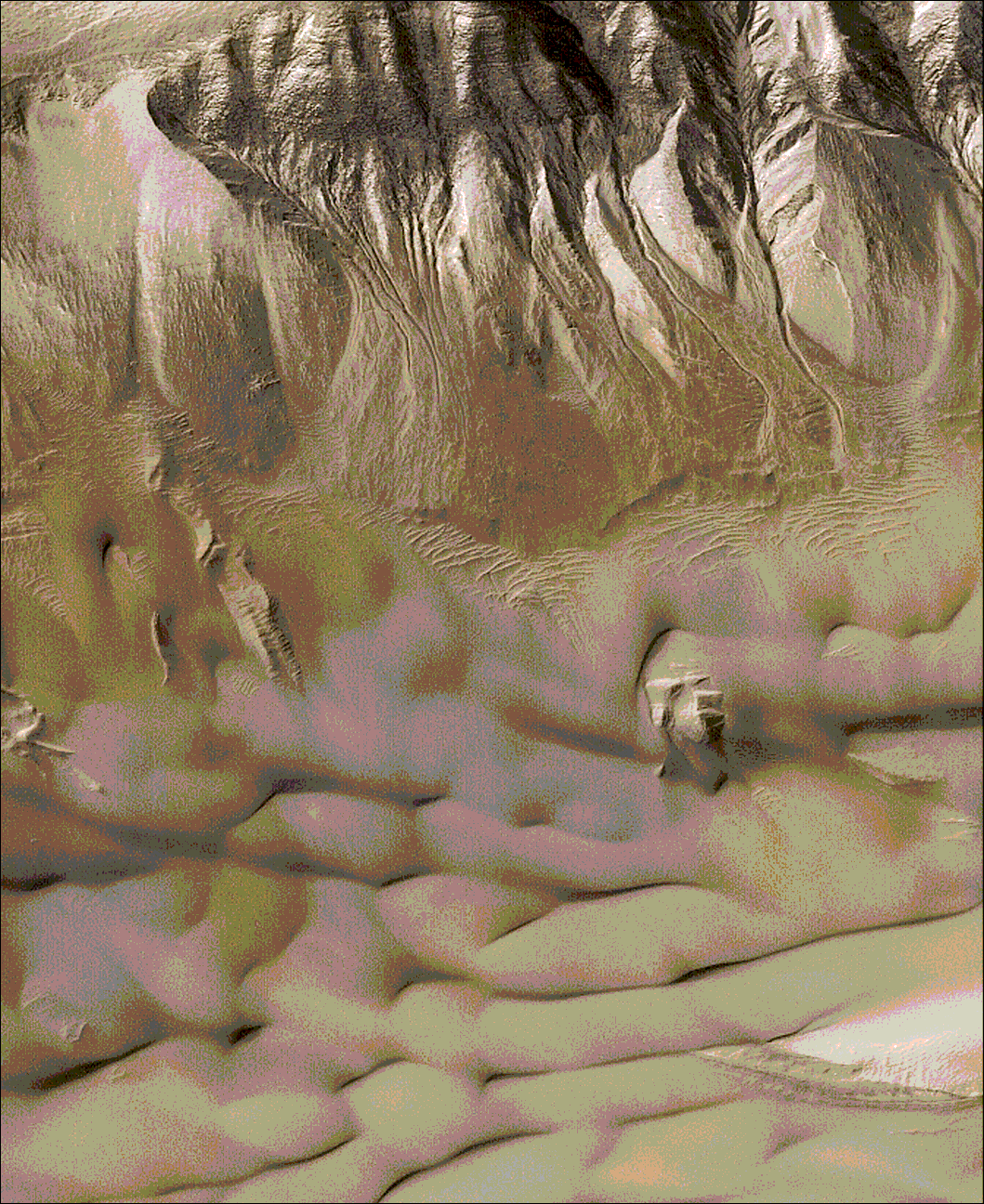
Figure 19: Erosion Channels on Mars. These erosion channels frequently originate in scooped-out regions, called amphitheaters, high on a crater wall. On Earth, where water falls as rain, erosion channels begin with narrow tributaries that merge with larger tributaries and, finally, “rivers.” Comet and asteroid impacts would have instantly formed these craters, gouged out amphitheaters, and melted the impacter’s ice. Mars, whose average equatorial temperature is colder than the average temperature in Antarctica, would need a heating source, such as impacts, to produce liquid water.
Since Martian ice melts when equatorial and mid-latitude temperatures are below 32°F (0°C), salts must be dissolved in the water to lower its freezing point. Other clues have narrowed the type of dissolved salts to chlorides (sodium, magnesium, or calcium).116 Also, water appears to be draining down 25°–40° slopes in streams that are up to 1,800 feet long and 1–15 feet wide! (Those dark drainage streaks slowly disappear in the fall and winter, only to begin growing the next spring.) With so much liquid water draining at lower latitudes, that water must have been placed there recently.146 Liquid water that evaporates on Mars, ends up near the poles as frost.
PREDICTION 46: Most sediments taken from layered strata on Mars and returned to Earth will show that they were deposited through Mars’ atmosphere, not through water. (Under a microscope, water deposited grains have nicks and gouges, showing that they received many blows as they tumbled along stream bottoms. Sediments deposited through an atmosphere receive few nicks.)
Mars also has bulk water ice at its equator—at less than 1 meter depths and under “unusually low density soil.” Peak summer surface temperatures on Mars within ±30° latitude of Mars’ equator are warm enough to melt ice.147 How can the existence of this ice be explained?
In summary, comets and asteroids containing large amounts of water ice bombarded Mars for centuries after the flood. Although that ice instantly became liquid water upon impact, it quickly refroze. Dirt kicked up by the many impacts on Mars settled through Mars’ atmosphere, burying and quickly insulating the ice in low density (powdery) soil. Since this happened in the last several thousand years, not enough time has passed for the summer’s heat on Mars to soak into even shallow soil to melt the ice.
PREDICTION 47: As has been discovered on the Moon and apparently on Mercury, frost, rich in heavy hydrogen, will be found within asteroids and in permanently shadowed craters on Mars.