Rocket Science
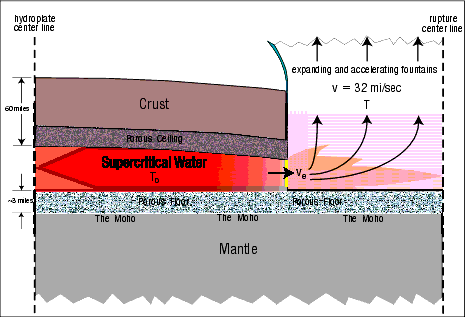
Figure 11: Jetting. Shown (not to scale) is a cross section of the Earth’s crust and the jetting supercritical water (SCW) hours to weeks after the rupture. The left and right dashed lines are the vertical center lines of a hydroplate and the rupture, respectively. A mirror image of this figure (not shown) would lie to the left and right of each center line. Because of this symmetry, the dashed lines can be thought of as barriers beyond which matter will not flow. The Moho marks the bottom of the porous, spongelike region, about 3 miles below the chamber floor.
Here, SCW acts like a rocket’s propellent, escaping with a velocity ve to the right of the rocket’s nozzle (represented by the vertical, yellow line). The “rocket” (shown in silhouette) cannot move to the left, since an identical jetting rocket (because of symmetry) is pushing to the right with an equal force.
For centuries before the flood, the powerful ability of SCW to dissolve certain minerals opened up a myriad of twisting, spaghetti-thin channels throughout the chamber’s floor and ceiling. Once the flood began, weeks of steady heating from nuclear reactions in the fluttering crust continuously pressurized the SCW in those miles of long, thin, interconnected channels. That, in turn, greatly elevated the pressure in the subterranean chamber, thereby accelerating the escaping subterranean water even more, not just while it was under the crust but also as it was accelerating upward in the fountains.
Today, SCW is still coming out of what was the porous floor of the subterranean chamber. [See Figures 55 and 56 on pages 127 and 132.] The hot water in the spongelike pockets, which absorbed much of the nuclear energy, also heated the adjacent rock. Today, that heat accounts for much of the geothermal heat and increasing temperatures as one descends into deep caves or drills into the Earth. The Moho, explained in Figures 55 and 68 on pages 127 and 145, lies at the base of that global, porous layer, which was about 3-miles thick.
Jet fuel in a high-performance aircraft contains about 20,000 BTU of chemical energy per pound. Greater aircraft speeds might result if the energy content could be increased or the metals containing the hot gases could be strengthened to withstand even higher combustion temperatures and pressures. In comparison, SCW has many orders of magnitude more energy per pound, and its container (Earth’s thick crust) was much stronger than an aircraft’s combustion chamber. Obviously, the exit velocities, expansion rates, and mass of the fountains of the great deep were vastly greater than any jet expelled by an aircraft.
The next time you see contrails in the sky, recognize that escaping, hot, high-pressure gases (primarily water vapor) from a jet aircraft expand downstream so much that they cool, condense and sometimes freeze. The fountains of the great deep experienced much greater expansion and cooling in an environment a few hundred degrees colder than where jet aircraft fly. Recall that billions upon billions of tons of supercold ice crystals suddenly fell from the fountains and buried and froze many mammoths—and much of Alaska and Siberia, and, no doubt, other places (at least temporarily). [See pages 276– 307.]
The temperature, T, in an expanding supersonic flow is determined by the Mach number, M, stagnation temperature, T0, and the ratio of specific heats, k, which for a perfect gas is about 1.4.1
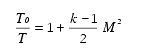
The stagnation temperature for the situation in Figure 11 is the temperature in the subterranean chamber. Iron-nickel meteorites exceeded 1,300°F. [See Figure 185 on page 341]. Because meteorites are broken-up rocks launched from the subterranean chamber, T0 was about 1,300°F. Launch velocities of at least 32 miles per second were required to place near-parabolic comets in retrograde orbits.2 [See page 328.] If the sonic velocity in the downstream flow was 0.2 miles per second, then
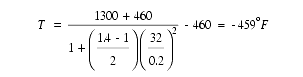
where absolute zero on the Fahrenheit scale is - 460°F. Although M, T0, and the effective sonic velocity can only be estimated, after the expansion the temperature of the flowing gas was so cold, it was almost absolute zero !
The fountains, unlike a jet aircraft’s exhaust, did not collide with and transfer much of their kinetic energy to the atmosphere. Seconds after the rupture, only the thin boundary layer (shown in blue) made contact with the atmosphere. The thinness of that boundary layer must be compared with the great width of the rupture. As explained in Endnote 93 on page 424, the rupture was initially about 6 miles wide, and then, because of erosion and the crumbling walls adjacent to the rupture, grew to hundreds of miles. Most of the heat transferred into that boundary layer would have ended up at the top of the atmosphere—lifted by both natural convection and entrainment.
The fountains split and spread the atmosphere, allowing most of the water and rocks to escape into the vacuum of outer space. Some water within the boundary layer was slowed enough to fall back to Earth as rain or ice. However, rocks carried much more momentum than water droplets, so their trajectories were less deflected by the boundary layers. Therefore, few rocks (and very few larger rocks) fell back to Earth. Almost all the energy in the rocks and SCW launched from Earth became kinetic energy, not heat. Much of that energy was electrical (as explained in Endnote 59 on page 151); its release and the acceleration of the fountains probably continued outside the atmosphere.
Notice that the mechanism for accelerating the fountains to hypersonic velocities is not the same as in a standard supersonic jet aircraft or rocket propulsion system. There, a high pressure combustion chamber is upstream of the entire flow, having to push all the fluid downstream through a converging-diverging nozzle. No matter how high the combustion chamber’s pressure, its pressure pulses (which only travel at the velocity of sound) cannot outrun the converging flow which, if properly designed, reach the velocity of sound at the nozzle’s throat.
However, in the fountains of the great deep, every fluid bundle, throughout the entire column, expanded continuously because of the properties of supercritical water and its vast energy content. The column’s expansion was extreme, because the surrounding pressure dropped, in seconds, from the enormous pressure in the subterranean water to almost zero pressure in the vacuum of space.
A closer analogy than that of a standard propulsion system is a bullet traveling down a gun tube. A propellant burns and generates gas throughout the expanding gas behind the bullet, steadily accelerating the bullet until it leaves the gun tube. Some pistols, many rifles, and most artillery pieces steadily accelerate their projectiles to supersonic velocities while in relatively short gun tubes. [See “Paris Gun,” Figure 215 on page 395.] The fountains were in an approximately 60-mile-long “gun tube,” not to mention the hundreds-to-thousands of miles of acceleration before and after reaching that “tube.” Back pressure from the escaping SCW (like the recoil of a gun or the thrust of a rocket) retarded the flow of SCW trying to escape from the chamber.
At every location on Earth where the visibility of falling rain permitted, the fountains of the great deep would have been seen in the daytime—days and weeks after the rupture—as dark curtains rising above the horizon at two or more locations. At night, those curtains would have glowed from reflected sunlight and internal lightning. The undulations of the fluttering crust must have been even more terrifying.
Once the momentum of the escaping flow from under the crust dropped below a certain threshold, the sagging edge of the plate (fluttering at about one cycle every 30 minutes, as explained on page 628) slammed into the chamber floor for the last time. The flood water above the crust then began falling back into the 60-mile-deep chasm, shutting off the jetting of the fountains. Within minutes “the floodgates of the sky were closed,” but “the rain from the sky was restrained” (Genesis 8:2). Fluttering and jetting ceased, but the rain diminished gradually. By suddenly stopping the jetting fountains, few large rocks fell back to Earth. However, the smaller, less dense water droplets slowed by the boundary layer drifted and fell back through the atmosphere for days. The huge amounts of water that were still trapped under the crust came out slowly and raised the flood waters until they covered all preflood mountains on the 150th day of the flood. [See also “The Water Prevailed” on page 494.]