Details Relating to the Hydroplate Theory
1.  Formation Mechanism,
Ice on Mercury, Mars, and the Moon. About 38% of a comet’s mass is frozen water. Therefore, to understand comet origins, one must ask, “What was the source of a comet’s water?” Earth, sometimes called “the water planet,” must head the list. (The volume of water on Earth is ten times greater than the volume of all land above sea level.) Other planets, moons, and even interstellar space92 only have possible water, or traces of water, which may have been delivered by comets or by water vapor that the fountains of the great deep launched into space.
Formation Mechanism,
Ice on Mercury, Mars, and the Moon. About 38% of a comet’s mass is frozen water. Therefore, to understand comet origins, one must ask, “What was the source of a comet’s water?” Earth, sometimes called “the water planet,” must head the list. (The volume of water on Earth is ten times greater than the volume of all land above sea level.) Other planets, moons, and even interstellar space92 only have possible water, or traces of water, which may have been delivered by comets or by water vapor that the fountains of the great deep launched into space.

PREDICTION 29: Soil in “erosion” channels on Mars will contain traces of earthlike soluble compounds, such as salt, from Earth’s preflood subterranean chambers. Soil far from “erosion” channels will not. (This prediction was first published in April 2001. Salt was first discovered on Mars in March 2004.93 )
The Mars Reconnaissance Orbiter has photographed eight examples of smooth horizontal layers of water ice on Mars—some thicker than 100 meters and only 1–2 meters below the planet’s surface.94 (One layer is 500-feet thick!) To form a thick horizontal layer of water ice, liquid water had to first collect in that geometric shape—in what we today would call a pond. Furthermore, a large amount of water had to have been rapidly deposited on Mars near each pond, because the water would quickly evaporate in Mars’ thin atmosphere while the rest of the flowing water rapidly froze. If that water fell to the surface of Mars as snow, a pond would not have formed. However, if a separate comet delivered the water for each of the eight ponds, each impact would have formed a depression for the pond, melted the comet’s ice, and kicked up a cloud of dirt which would account for the 1–2 meters of dirt now on top of the ice layers.
How could so many comets have recently hit the Moon, Mars, and Mercury that ice remains today? Ice on Mars, the Moon, and certainly on hot Mercury, should disappear faster than comets deposit it today. The question is answered if the material that formed 50,000 comets was ejected recently from Earth and an “ocean” of water was injected into the inner solar system. On Mars, comet impacts on slopes created brief saltwater flows, which then carved “erosion” channels. [See Figure 195 on page 355.]
To form comets in space, should we start with water as a solid, liquid, or gas?
Gas. In space, gases (such as water vapor) will expand into the vacuum if not gravitationally bound to some large body. Gases by themselves would not contract to form a comet. Besides, the Sun’s ultraviolet radiation breaks water vapor into hydrogen (H), oxygen (O), and hydroxyl (OH). Therefore, comets would not normally form from gases.
Solid. Comets might form by combining smaller ice particles, including ice condensed as frost on microscopic dust grains that somehow formed. However, one icy dust grain could not capture another nearby grain unless their speeds and directions were nearly identical and one of the particles had a rapidly expanding sphere of influence or a gaseous envelope. Because ice molecules are loosely bound to each other, collisions among ice particles would fragment, scatter, and vaporize them—not merge them.
Liquid. The fountains of the great deep launched large rocks, dirt, and water. Water droplets in the expanding supercritical water quickly froze. [See “Rocket Science” on page 598.] The ice partially evaporated (sublimated) but left dirt behind, encasing the remaining ice. (Recall that the nucleus of Halley’s comet was black, and a comet’s tail contains dust particles.)
Jetting water escaping from the subterranean chamber eroded dirt and rocks of various sizes. Water vapor then concentrated around the larger rocks escaping from Earth. These “swarms” and their expanding spheres of influence captured nearby particles moving at similar velocities. Comets quickly formed.95
Other reasons exist for concluding that water in a gas or solid state cannot form comets.96 Water from the fountains of the great deep meets all requirements.
2.
Crystalline Dust. Sediments eroded by high-velocity water escaping from the subterranean chamber would be crystalline, much of it magnesium-rich olivine.
3.  Near-Parabolic Comets. Because the same event launched all cometary material from Earth, comets falling from the farthest distances (near-parabolic comets) are falling back for the first time and with similar energy. They would also have the largest range of aphelions, and that longer range would include the aphelions of more comets.
PREDICTION 30: Some large, near-parabolic comets, as they fall toward the center of the solar system for the first time, will have moons. Tidal effects may strip such moons from their comets as they pass the Sun. (A moon may have been found orbiting incoming comet Hale-Bopp.) 97
If near-parabolic comets are falling in from 50,000 AU (as claimed by Oort Cloud theories), they would have orbital periods of about 4-million years. How then could they have been launched during the flood that began only about 5,000 years ago?
Is the 50,000 AU distance correct? Comets more than 12 AU from the Sun are too faint to see. Their aphelions and orbital periods must be calculated from the tiny portions of their orbits seen when they are close to Earth.
In 1992, trans-Neptunian objects (TNOs) were first discovered. An estimated 70,000 TNOs, 60–1500 miles in diameter, are 30-50 AU from the Sun, a region called the Kuiper Belt.109 Near-parabolic comets spend 99% of their time inside or beyond the Kuiper Belt. During that 99% of their lifetime, they receive an additional acceleration toward the Sun by the Kuiper Belt.28 When near-parabolic comets are close enough to Earth to be seen with telescopes, they appear to have gained their extra speed by falling back from much farther out than their true aphelion. (TNOs are explained in more detail in the next chapter.)
More Evidence of that Extra Mass. Of the periodic comets (comets observed on at least two passes through the inner solar system), three appeared to have traveled farther from the Sun than all others. All three returned earlier than they should have, assuming that they did not encounter extra mass (such as TNOs) beyond 30 AU that pulled them back early. The Great Comet of 1680 is explained on page 319. Comet Ikeya-Zhang’s (ee-KAY-uh ZAING) earliest observed perihelion was on 29 January 1661. Its orbital period, neglecting perturbations by TNOs, should have been 367 years. However, it returned on 19 March 2002, 26 years early. Comet Herschel-Rigollet’s earliest observed perihelion was on 20 November 1788. Its orbital period, based on the accepted mass of the solar system, and neglecting TNOs, should have been 162 years. However, it returned on 9 August 1939, 11 years early.111
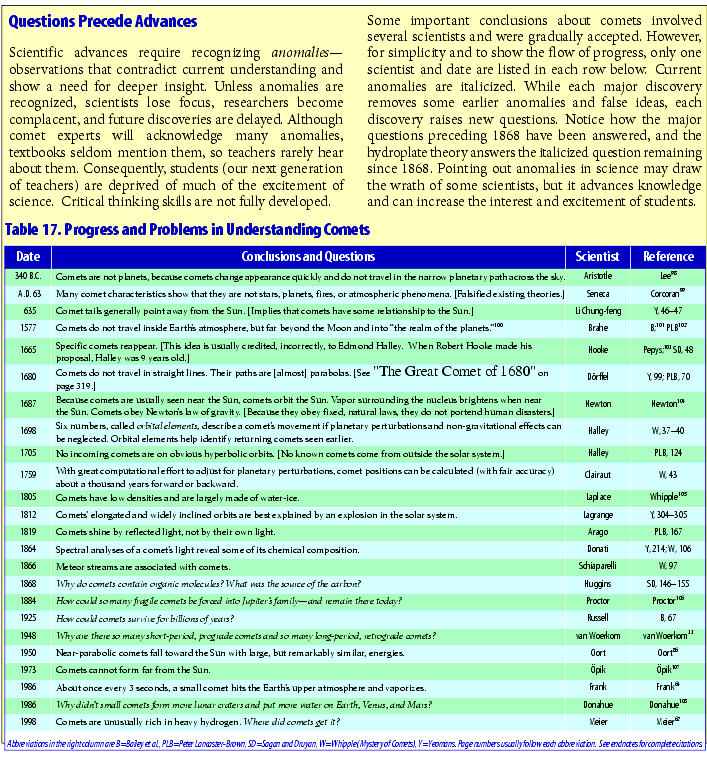
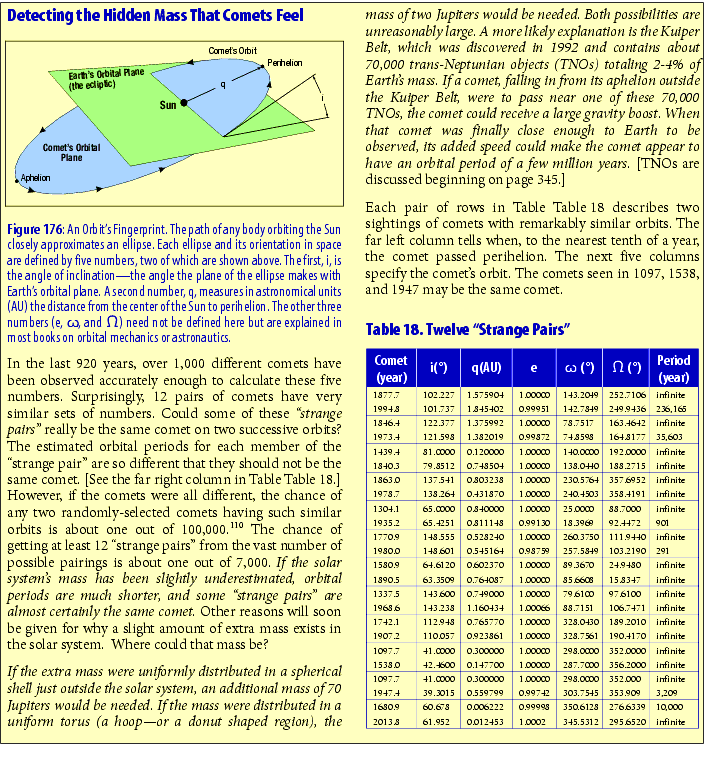
What if two comet sightings, a century or more apart, were of comets which we assumed had such long periods that they should not be the same comet, but whose orbits were so similar they probably were the same comet? We might suspect that both sightings were of the same comet, and it encountered some extra mass beyond 30 AU (in the Kuiper Belt) that pulled it back much sooner than expected. twelve “strange pairs” are known, suggesting that extra, unseen mass beyond Neptune’s orbit affects long-period comets but is not felt within the planetary region. These “strange pairs” are explained in Figure 14 and Table 16.
4.
Random Perihelion Directions. Comets were launched in all directions, because the rupture encircled the rotating Earth and crossed almost all latitudes.
5.
Orbit Directions and Inclinations,
Two Separate Populations. A ball tossed in any direction from a high-speed train will, to an observer on the ground, initially travel almost horizontally in the train’s direction. Likewise, low-velocity cometary materials launched in any direction from Earth received most of their orbital velocity from Earth’s high, prograde velocity (18.5 miles per second) about the Sun. Earth, by definition, has zero angle of inclination. This is why almost all short-period comets (whose material was launched with low velocity) are prograde and have low angles of inclination.
PREDICTION 31: Up to 70 Jupiters of mass are distributed 30 –600 AU from the Sun, enough to give recently observed near-parabolic comets orbital periods of about 5,000 years. (This prediction has not yet been verified. However, with the discovery of so many TNOs, the great mass of many Jupiters is not needed. A close pass of an incoming comet by one or more of the 70,000 TNOs could provide the needed perturbation.)
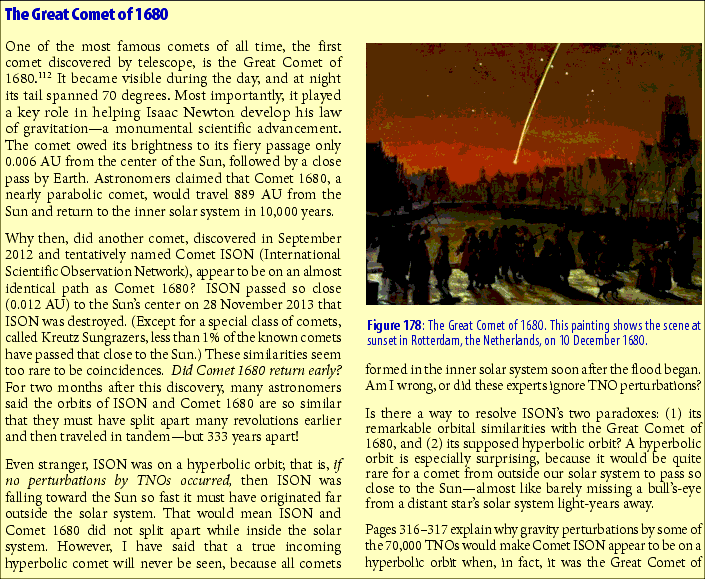
PREDICTION 32: Because the solar system is slightly “heavier” than previously thought, some comet pairs listed inTable 16 are the same comet seen on successive orbits. More “strange pairs” will be found each decade. [Comet ISON, discovered in 2012, and the Great Comet of 1680 are one example. See “The Great Comet of 1680” on page 319.]
Cometary materials launched with greater velocities than Earth’s orbital velocity traveled in all directions. Those launched in the prograde direction had an additional 18.5 miles-per-second boost because of Earth’s prograde direction, so some of those launches exceeded 26.3 miles per second, causing them to escape the solar system. Nevertheless, those velocity boosts insured that slightly more long-period comets travel in the prograde direction. [See Table 12 on page 316.] (Almost all other bodies orbiting the Sun are prograde: planets, asteroids, meteoroids, short-period comets, and trans-Neptunian objects.)
While this explains how two populations formed, did the material launched from Earth that later formed comets have enough velocity to blast through the atmosphere, escape Earth’s gravity, and enter large, even retrograde, orbits?
Water pressurized by the weight of 60 miles of rock would launch comets from Earth’s surface at only 3 miles per second. To escape Earth’s gravity and enter a circular orbit around the Sun requires a launch velocity of 7 miles per second . However, to enter a near-parabolic, retrograde orbit, requires a launch velocity of 32 miles per second !
Yes, the fountains of the great deep were powerful enough to reach these speeds. To appreciate the huge, mind-boggling energy in the subterranean water, requires understanding tidal pumping, supercritical water, and the origin of Earth’s radioactivity—explained on pages 129, 612– 613, and 391– 429. Earth’s atmosphere would offer comparatively little resistance at such speeds. In seconds, the pulsating, jetting fountains would push the thin atmosphere aside, much as water from a fire hose quickly penetrates a thin wall.
6.
Jupiter’s Family. A bullet fired straight up slows to almost zero velocity near the top of its trajectory—its farthest point from Earth. A comet also moves very slowly near its aphelion. If a comet’s aphelion is ever near Jupiter during any of Jupiter’s orbits, Jupiter’s large gravity will pull the nearly stationary comet steadily toward Jupiter for the long duration the comet is near its aphelion. Even the comet’s orbital plane is slowly but steadily aligned with Jupiter’s. Thus, aphelions of short-period comets tend to be pulled toward Jupiter’s nearly circular orbit, regardless of whether the aphelion is inside, outside, above, or below that circle. The closer a comet’s aphelion is to Jupiter’s orbit, the more rapid the attraction. [See Figure 15.]
One can also think of Jupiter’s mass as being spread out in an imaginary hoop along Jupiter’s circular orbit. (This simplifies the analysis of many long-term gravitational effects.) Comets feel more pull toward the nearest part of the hoop.
My statistical examination of all historical sightings of every orbit (almost 500) of every comet in Jupiter’s family confirms this effect. The hydroplate theory places the source of comets at Earth—well inside Jupiter’s orbit. Therefore, many comets reach their slowest speeds within a few astronomical units of Jupiter’s hoop. Thousands of years of gentle gravitational tugs by this hoop have gathered Jupiter’s family. Although Jupiter sometimes destroys comets or ejects them from the solar system, many comets in its family remain, because they were recently launched. A similar but weaker effect is forming Saturn’s family. [See Figure 10.]
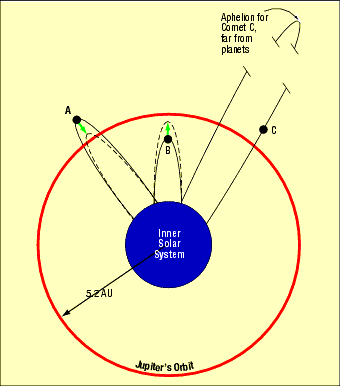
Figure 15: Adoption into Jupiter’s Family of Comets. If comets were launched from anywhere in the inner solar system, many, such as comets A and B, would have aphelions within a few astronomical units (AU) of Jupiter’s orbit. Comets spend much of their time near aphelion, where they move very slowly. There, they often receive gentle gravitational pulls (green arrows) of long duration, toward Jupiter’s orbit, 5.2 AU from the Sun.
Let’s say Comet C’s came from the supposed Oort Cloud, 50,000 AU from the Sun. (At this figure’s scale, Comet C’s aphelion would be 1/5 mile from where you are sitting.) Comet C steadily gains speed as it falls toward the inner solar system for thousands of years, crossing Jupiter’s orbit at tremendous speed. To slow C down enough to join Jupiter’s family would require such powerful forces that the comet would be torn apart, as shown in Figure 8 on page 315. (Comets are fragile.) Could many smaller gravitational encounters pull C into Jupiter’s family? Yes, but close encounters are rare, and about half would speed the comet up and probably throw it out of the solar system. Once in Jupiter’s family, the average comet has a life expectancy of only about 12,000 years.24
Clearly, comets must have originated recently from the inner solar system (the home of the Sun, Mercury, Venus, Earth, and Mars) to join Jupiter’s family. Such comets could not have come from far beyond Jupiter’s orbit.
7.
Composition,
Heavy Hydrogen. When the fountains of the great deep erupted, rocks were crushed, eroded, and sometimes reduced to clay. Mixed with that debris were minerals that form only in the presence of scalding hot liquid water, such as cubanite (described on page 320).52 Also common in comets is sodium, because salt, NaCl, from the subterranean chamber contains sodium. Organic compounds—including methane, ethane, the amino acid glycine, and other complex compounds listed in
Table 13 on page 321—are found in comets,1 because that water contained pulverized vegetation from preflood forests (as well as bacteria and other traces of life) from within a few hundreds miles of the globe-encircling rupture.
Comets are rich in heavy hydrogen, because the water in the subterranean chambers was isolated from other water in the solar system. Our oceans have half the concentration of heavy hydrogen that comets have. So, if half the water in today’s oceans came from the subterranean chambers (as assumed on page 128), then almost all heavy hydrogen came from the subterranean chambers. (This will become even more clear after reading the radioactivity chapter on pages 391– 429.) Because molecular oxygen (O2) is dissolved in and saturates Earth’s surface waters, and the water in comets came from Earth, it is not surprising that the ice in Comet 67P contains dissolved O2.
PREDICTION 33: Excess heavy hydrogen will be found in salty water pockets five or more miles below the Earth’s surface.
Items a–e on page 320 lists six surprising materials discovered on comet Tempel 1 by the Deep Impact mission in 2005. Only the hydroplate theory seems to explain the fluffy, porous texture of comets, and crystalline silicates, clays, calcium carbonates, organic material, sodium, oxygen, and, of course, liquid water. Dust particles brought back to Earth by the Stardust Mission in 2006 were also crystalline and contained “organics” and “water.”
Item f (thick surface layers of very fine dirt with the consistency of talcum powder) is probably loess, a type of dirt composed of fine particles in the muddy ice that formed comets. Each time Tempel 1 came near the Sun in its 5 1/2-year orbital period, more ice on the comet’s surface sublimated, leaving behind the embedded powdery dirt. Loess is described in more detail on pages 284 and 289.
PREDICTION 34: Spacecraft landing on a comet’s nucleus will find that comets, and bodies hit by comets, such as Mars, contain loess, salt, bacteria, and traces of vegetation.
8.
Small Comets. Muddy droplets launched with the slowest velocities could not move far from Earth, so their smaller spheres of influence produced small comets. Their orbits about the Sun tend to intersect Earth’s orbit more in early November than mid-January. Because small comets have been falling on Earth for only about 5,000 years, little of our oceans’ water came from them—or from any comets. Few small comets can reach Mars.
9.
Recent Meteor Streams,
Crater Ages. Disintegrating comets produce meteor streams. If meteor streams were older than 10,000 years, the particles in them would be sorted by size. [See
“Poynting-Robertson Effect” on
page 45.] Because this is not seen, meteor streams and comets must be younger than 10,000 years. Only the hydroplate theory claims that comets began this recently. Impact craters on Earth are also young.
10.
Other/Enough Water. Did the subterranean chamber have enough water to produce all the comets the solar system ever had?
Consider these facts. Earth’s oceans contain 1.43 × 10 9 cubic kilometers of water. If comet Tempel 1 (the most accurately measured comet as of 2015) is typical of all comets, then a comet nucleus is about 38% water by mass and has a density of about 0.62 gram per cubic centimeter.5 Over 1,000 comets have been observed with enough detail to calculate their elliptical orbits. If 50,000 comets were initially launched (many of which escaped the solar system or were later destroyed) and their average radius was 4.9 kilometers,113 then they contained about 1/250th of the water now in the oceans.
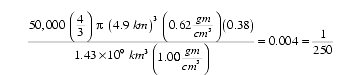
With such a small fraction of Earth’s water required, the water in comets could have easily come from Earth.
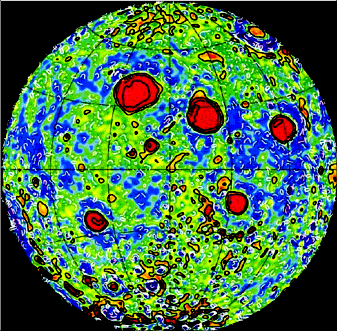
Figure 17: Mascons. Five prominent and dense concentrations of mass are on the side of the Moon that today always faces the Earth. (None on the Moon’s far side is comparable.) This map shows how the Moon’s gravity varies over its surface. Red indicates unusually strong gravity. Obviously, the Moon received five extremely powerful impacts. Rarely would five impacts be so close to each other unless the impactors were traveling on similar paths and struck the Moon about the same time.
Notice that the three largest mascons, each associated with a basin, lie on a straight line. When a large body’s gravity pulls a comet apart, as shown by the “string of pearls” in Figure 8 on page 315, the comet fragments are aligned, and they stay aligned if they don’t travel far. Perhaps the large rocks that formed the mascons were part of the same comet (or asteroid) that was pulled apart by the Moon’s or Earth’s gravity.
11.
Other/Death and Disaster. Comets, launched at the onset of the flood, are being steadily removed from the solar system. For centuries after the flood, comets would have been seen much more frequently than today. Some must have collided with Earth, just as Shoemaker-Levy 9 collided with Jupiter in 1994. People living soon after the flood would have seen many comets grow in size and brightness in the night sky over several weeks. Some of those frightening sights would have been followed by impacts on Earth, skies darkened with water vapor dumped by comets, and dramatic stories of destruction. Memories of these experiences spread worldwide. Early cultures probably learned from their ancestors that comets and their destruction were seen right after the flood, so comets became associated with death and disaster worldwide—hence the word “disaster”: dis (evil) + aster (star).
12.
Other/Near Side of Moon. Moonquakes, lava flows, and large multiringed basins are concentrated on the side of the Moon that now always faces the Earth. [See Figure 13 on page 323 and Figure 17.] Before the flood, the Moon was relatively smooth, and it is likely that one side did not always face the Earth. Approximately 5 days after the fountains of the great deep erupted, about 1.2% of the rocky debris impacted the Moon in a small area somewhere on the leading side of the Moon. This changed the Moon’s inertia and caused the Moon to oscillate like a decaying pendulum swinging above the Earth. Eventually, tidal stretching of the Moon removed most of its spin energy, so the oscillations subsided and the Moon became gravitationally stabilized where the denser, heavier side of the Moon now always faces Earth. (Five large, dense mass concentrations, called mascons, were discovered in 1968 just below the surface on today’s near side of the Moon.114)
The Moon has been heavily bombarded. If these impacts removed only 6% of the Moon’s orbital energy, the Moon’s preflood orbital period would have been 30 days, as viewed from Earth. If the length of a month was exactly 30 days and the Moon was in a circular orbit before the flood, only 1.2% of the debris would need to impact the Moon to give it the current 29.53-day month and 0.055 eccentricity (slightly elliptical shape orbit). A 30-day period, coupled with the preflood 360-day year (as explained on page 169 and Endnote 35 on page 193), would have provided excellent clocks for everyone on Earth—simple, free, visible to all, and standardized worldwide. [See “Did the Preflood Earth Have a 30-Day Lunar Month?” on page 603.]