Gravity: How and Why Most Things Move
Gravity pulls us toward Earth’s solid surface. This produces friction, a force affecting and slowing every movement we make. Since we were babies, we have assumed that everything behaves this way. Indeed, none of us could have taken our first steps without friction and the downward pull of gravity. Even liquids (such as water) and gases (such as air) create a type of friction called drag, because gravity also pulls liquids and gases toward Earth’s solid surface.
In space, things are different. If we were orbiting Earth, its gravity would still act on us, but we would not feel it. We might think we were “floating” when, in fact, we would be falling. In a circular orbit, our velocity would carry us away from Earth as fast as we fell.
As another example, in 1965 astronaut James McDivitt tried to catch up (rendezvous) with an object orbiting far ahead of him. He instinctively increased his speed. However, this added speed moved his orbit higher and farther from Earth where gravity is weaker and orbital velocities are slower. Thus, he fell farther behind his target. Had he temporarily slowed down, he would have changed his orbit, lost altitude, sped up, and traveled a shorter route. Only by slowing down could he catch up—essentially taking a shortcut.
All particles attract each other gravitationally. The more massive and the closer any two particles are to each other, the greater their mutual attraction. To determine the gravitational pull of a large body, one must add the effects of all its tiniest components. This seems a daunting task. Fortunately, the gravitational pull of a distant body behaves almost as if all its mass were concentrated at its center of mass—as our intuition tells us.
Hollow Shell. But what if we were inside a “body,” such as the universe, a galaxy, or Earth? Intuition fails. For example, if Earth were a hollow shell and we were inside, we would “float”! The pull from the side of the spherical shell nearest us would be great because it is close, but more mass would pull us in the opposite direction. In 1687, Isaac Newton showed that the two opposite pulls always balance.13
Tides. A water droplet in an ocean tide feels a stronger gravitational pull from the Sun than from the Moon. This is because the Sun’s huge mass (27 million times greater than that of the Moon) more than makes up for the Sun’s greater distance. However, ocean tides are caused primarily by the Moon, not the Sun. This is because the Sun pulls the droplet and the center of the Earth toward itself almost equally, while the much closer Moon pulls relatively more on either the droplet or the center of the Earth (whichever is nearer). We best see this effect in tides, because the many ocean droplets slip and slide so easily over each other. (To learn more about what causes tides, see page 593.)
Tidal effects act everywhere on everything: gases, liquids, solids—and comets. When a comet passes near a large planet or the Sun, the planet’s or Sun’s gravity pulls the near side of the comet with a greater force than the far side. This difference in “pulls” stretches the comet and sometimes tears it apart. If a comet passes very near a large body, it can be pulled apart many times; that is, pieces of pieces of pieces of comets are torn apart as shown in Figure 8.
Spheres of Influence. The Apollo 13 astronauts, while traveling to the Moon, dumped waste material overboard. As the discarded material, traveling at nearly the same velocity as the spacecraft, moved slowly away, the spacecraft’s gravity pulled the material back. To everyone’s surprise, it orbited the spacecraft all the way to the Moon.14 When the spacecraft was on Earth, Earth’s gravity dominated things near the spacecraft. However, when the spacecraft was far from Earth, the spacecraft’s gravity dominated things near it. The region around a spacecraft, or any other body in space, where gravity can hold an object in an orbit, is called that body’s sphere of influence
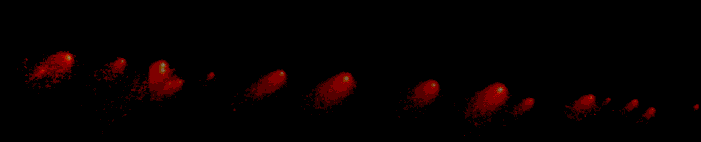
Figure 8: Weak Comets. Tidal effects often tear comets apart, showing that comets have almost no strength. A comet nucleus several miles in diameter could be pulled apart by two humans. In comparison, the strength of an equally large snowball would be gigantic. In 1992, tidal forces dramatically tore comet Shoemaker-Levy 9 into 23 pieces as it passed near Jupiter. Two years later, the fragments, resembling a “flying string of pearls” strung over 180,000,000 miles, returned and collided with Jupiter. A typical high-velocity piece released about 5,000 hydrogen bombs’ worth of energy and became a dark spot, larger than Earth, visibly drifting for days in Jupiter’s atmosphere. We will see that Jupiter, with its huge gravity and tidal effects, is a comet killer.
An object’s sphere of influence expands enormously as it moves farther from massive bodies. If, for many days, rocks and droplets of muddy water were expelled from Earth in a hypersonic jet, the spheres of influence of the rocks and water would grow dramatically. The more the spheres of influence grew, the more mass they would capture, so the more they would grow, etc.15
A droplet engulfed in a growing sphere of influence of a rock or another droplet with a similar velocity might be captured by it.16 However, a droplet entering a body’s fixed sphere of influence with even a small relative velocity would seldom be captured, because it would gain enough speed as it fell toward that body to escape from the sphere of influence at about the same speed it entered.
Earth’s sphere of influence has a radius of about 600,000 miles. A rock inside that sphere is influenced more by Earth’s gravity than the Sun’s. A rock entering Earth’s sphere of influence at only a few feet per second would accelerate toward Earth. It could reach a speed of almost 7 miles per second, depending on how close it came to Earth. Assuming no collisions, gravity would whip the rock partway around Earth so fast it would exit Earth’s sphere of influence about as fast as it entered—a few feet per second. It would then be influenced more by the Sun and would enter a new orbit about the Sun.17
Exiting a sphere of influence is more difficult if it contains a gas, such as an atmosphere or water vapor. Any gas, especially a dense gas, slows an invading particle, perhaps enough to capture it. Atmospheres are often relied upon to slow and capture spacecraft. This technique, called aerobraking, generates heat. If the “spacecraft” is a liquid droplet, capture is even easier, because evaporation makes the droplet smaller and the atmosphere denser.
A swarm of mutually captured particles will orbit their common center of mass. If the swarm were moving away from Earth, the swarm’s sphere of influence will grow, so fewer particles would escape by chance interactions with other particles. Particles in the swarm, colliding with gas molecules, would gently settle toward the swarm’s center of mass. How gently? More softly than large snowflakes settling onto a windless, snow-covered field, because the swarm’s gravity is much weaker than Earth’s gravity. Eventually, most particles in this swarm would become a rotating clump of fluffy ice particles with almost no strength. The entire clump would stick together, resembling a comet’s nucleus in strength, size, density, spin, texture, orbit, and composition—especially molecules from living things on Earth. The pressure at the center of a comet nucleus 3 miles in diameter is about what you would feel under a blanket here on Earth.
In contrast, spheres of influence hardly change for particles in nearly circular orbits about a planet or the Sun. Colliding particles rarely stick together. Even when particles pass near each other in empty space, capture does not occur, because their relative velocities almost always allow them to escape each other’s sphere of influence, and their spheres of influence do not expand. Forming stars, planets, moons, or meteoroids by capturing 18 smaller orbiting bodies is far more difficult than most people realize.19 However, if gases are inside these spheres, capture becomes more likely, and the more particles captured, the larger the sphere of influence becomes.