Details Requiring an Explanation
Summarized below are the hard-to-explain details which any satisfactory theory for the origin of comets should explain.
Formation Mechanism. Experimentally verified explanations are needed for how comets formed and acquired water, dust particles of various sizes, and many chemicals.
Ice on Moon and Mercury. Large amounts of water-ice are in permanently shadowed craters near the poles of the Moon, and planet Mercury.
Crystalline Dust. Comet dust is primarily crystalline.
Near-Parabolic Comets. The observed near-parabolic comets are falling toward the Sun for the first time—and from all directions. Why are so many comets represented by the tall red bar in Figure 12?
Random Perihelion Directions. Comet perihelions are scattered on all sides of the Sun.
No Incoming Hyperbolic Orbits. Although a few comets leave the solar system on hyperbolic orbits, no obvious incoming hyperbolic comets are known. That is, no comets are known to come from outside the solar system.
Small Perihelions. Perihelions of long-period comets are concentrated near the Sun, in the 1–3 AU range, not randomly scattered over a larger range.
Orbit Directions and Inclinations. About half the long-period comets have retrograde orbits (orbiting in a direction opposite to the planets), but all planets, and almost all short-period comets, are prograde. Short-period comets have orbital planes near Earth’s orbital plane, while long-period comets have orbital planes inclined at all angles.
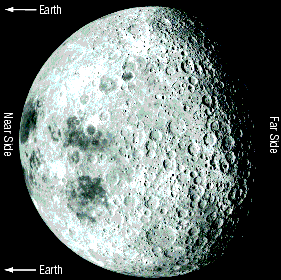
Figure 13: Near and Far Sides of the Moon. Today, as the Moon orbits around Earth, the same side of the Moon always faces Earth. Surprisingly, the near and far sides of the Moon are quite different. Almost all deep moonquakes are on the near side.67 The surface of the far side is rougher and has more craters, but the near side has most of the Moon’s volcanic features, lava flows, dome complexes, and giant, multiringed basins. Also, lava flows (darker regions) have smoothed over many craters on the near side.68
Some have proposed that the Moon’s crust must be thinner on the near side, so lava can squirt out more easily on the near side than the far side. However, measurements of gravity,69 heat flow, and seismic activity destroy that idea. The Moon’s density throughout is almost as uniform as that of a billiard ball.70 Not only did large impacts form the giant basins, but their impact energy melted rock below, generated lava flows, and expanded the Moon’s radius by 0.6–4.9 kilometers ! The GRAIL satellites detected the cracks that brought the lava to the surface—apparently rapidly and recently.71 [See “Hot Moon” on page 42.]
Large impacts would also shift rock within the moon and produce deep frictional melting. Magma produced below the Moon’s crossover depth would sink to the Moon’s center and form the Moon’s small liquid core that was discovered in 2011.72 That core has not had time to cool and solidify. [The crossover depth is explained on pages 161– 162.]
Contemporaries of Galileo misnamed these dark lava flows “maria” (MAHR-ee-uh), Latin for “seas,” because they filled low-lying regions and looked smooth. These maria give the Moon its “man-in-the-moon” appearance. Of the Moon’s 31 giant basins, only 11 are on the far side.73 (See if you can flip 31 coins and get 11 or fewer tails. Not too likely. It happens only about 7% of the time.) Why should the near side have so many more giant impact features and almost all the maria74 and deep moonquakes? Opposite sides of Mars and Mercury are also different.75
If the impacts that produced these volcanic features came rapidly from a single direction, only one side would be primarily hit. If the impacts occurred rapidly from all directions or slowly—longer that one orbital period (30 days for the Moon)—from a single direction, all sides would be equally hit. Therefore, large lunar impactors were apparently launched rapidly from Earth. Similar statements can be made for Mars and Mercury, so this bombardment event affected the solar system.
Large impacts would kick up millions of smaller rocks that would create secondary impacts. Some rocks would escape the Moon and possibly hit Earth. Today, both sides of the Moon are saturated with smaller, secondary craters, so Earth’s flood cataclysm also beat up the Moon.
This is further confirmed by historical records and orbital calculations. Many ancient cultures worldwide had a 360-day year and a 30.00-day lunar month—or “moonth.” Presumably the word “month” was a carryover from preflood times. This would have given all humans on Earth—from creation until the flood—a marvelous calendar system. Regardless of where people lived, they could easily and simply tell time without an expensive, mechanical clock.
If only 1.22% of the debris launched from Earth by the fountains of the great deep hit the Moon, the lunar month would have changed from 30.00 days to its present 29.53-day lunar month, and the Moon’s circular orbit would have become the elliptical shape we see today (eccentricity of 0.0549). Other key parameters for the Moon’s orbit would also change to what we see today. This bombardment during the flood would explain all the Moon’s craters and the details listed above. [See “Did the Preflood Earth Have a 30-Day Lunar Month?” by R. Brown on page 586.]
Lunar rocks have relatively few volatile elements: water, nitrogen, hydrogen, chlorine, sulfur, and the noble gases. However, lunar soil contains these elements—and lots of water! 76 The isotope ratios of these elements in lunar soil correspond not to the solar wind but to what is found on Earth77—suggesting again that they came from Earth. Also, the rocks astronauts brought back from the Moon have identical oxygen and titanium isotopic ratios as those on Earth.78 If large impactors came from Earth, most moonquakes should be on the near side. They are.67 If these impacts were recent, they might still be occurring. They are.
Two Separate Populations. Why are long-period comets so different from short-period comets? Even millions of years and many gravitational interactions with planets would rarely change one kind into the other.
Jupiter’s Family. How did Jupiter recently collect its large family of comets, each with a short life expectancy of only about 12,000 years? 24 [See Figure 10 on page 317.]
High Loss Rates of Comets. Comets are being destroyed, diminished, or expelled from the solar system at high rates that are difficult for some theories to explain.
Composition. Comets are primarily water, silicate dust (such as olivine), carbon dioxide, sodium,79 and combinations of hydrogen, carbon, oxygen, and nitrogen. Comets also contain limestone, clays, methane, and the amino acid glycine that is almost exclusively produced by life on Earth. Surprisingly, one compound in comets, cubanite, is produced only in scalding hot liquid water. Comet 67P has molecular oxygen (O2) dissolved in its ice.
Heavy Hydrogen. The high concentration of heavy hydrogen in most comets means comets did not come from today’s known hydrogen sources—in or beyond the solar system.
Small Comets. What can explain the strange characteristics of small comets, including their abundance and nearness to Earth, but not to Mars? Small comets have never been seen impacting Mars, but there have been many sketchy reports of flashes of light on the Moon.80
Missing Meteorites. Meteor streams are associated with comets and have similar orbits. Meteorites are concentrated in Earth’s topmost sedimentary layers, so they must have fallen recently, after most sediments were deposited.81 [See “Shallow Meteorites” on page 44.] Comets may have arrived recently as well.
Recent Meteor Streams. As comets disintegrate, their dust particles form meteor streams which orbit the Sun. After about 10,000 years, solar radiation should segregate particles by size. Because little segregation has occurred, meteor streams, and therefore comets, must be recent. [See “Poynting-Robertson Effect” on page 45.]
Crater Ages. Are the ages of Earth’s impact craters consistent with each comet theory?