The Origin of Trans-Neptunian Objects (TNOs)
A trans-Neptunian object (TNO) is any minor planet orbiting the Sun at a greater average distance than Neptune.
There are at least 70,000 TNOs with diameters larger than 100 km [62 miles]. 148
Powerful telescopes can see and precise orbits are known for 2,300 TNOs. They are usually 30–1500 miles in diameter. However most are unseen, but detected by their gravity.
The Kuiper Belt—a doughnut-shaped region 30–50 AU from the Sun—contains about 70% of all TNOs—those with nearly circular orbits near the plane of the ecliptic. According to the hydroplate theory (as will be explained), radial forces and the Sun’s energy acted on the larger asteroids and spiraled them out beyond Neptune where they are now called TNOs, not asteroids. TNOs are larger than asteroids in the inner solar system—except for a few asteroids that may have merged after the flood. TNOs have a total weight of 3% of Earth’s mass, give or take 1%.149
Phoebe. About 30% of these TNOs were perturbed in their outward spirals from Earth by the giant planets and are now scattered around the Kuiper belt. A few were captured by the giant planets. Phoebe, a tiny moon of Saturn, is one example. Its capture explains (1) its relatively eccentric orbit which is almost perpendicular to Saturn’s equatorial plane, and (2) the unusual spectral characteristics of its water-rich surface, which match those of TNOs.150

PREDICTION 48: Table 19 on page 390 lists the irregular moons of the giant planets. Some of them will show the spectral characteristics of Phoebe and TNOs, because they too came from Earth.56
Recall that the asteroid belt contains 90% of all asteroids—those that were not scattered as they spiraled outward. So, the asteroid belt, like the Kuiper Belt, is also a doughnut-shaped region in the plane of the ecliptic. Because of their smaller size, asteroids in the inner solar system “ran out of steam” when they were only about 2.8 AU from the Sun.
Crystalline Water-Ice. Quaoar [KUA wahr], the 5th largest TNO, and Charon, Pluto’s largest moon, have crystalline water-ice on their surfaces.151 That ice, which has the familiar hexagonal pattern of snowflakes, forms only at temperatures warmer than -260°F, but temperatures in the TNO region are much colder—about -370°F. Water-ice at that temperature should be amorphous—water molecules stacked randomly, like the molecules in glass.151 Therefore, those TNOs were once in a warmer environment, such as that of the inner solar system. After about 40,000 years to 10-million years, ultraviolet light and cosmic rays should have bombarded and randomized those ice molecules, so they are no longer crystalline.152 Since this has not yet happened, that ice is probably young.
Moons. About 11% of TNOs—and asteroids in the inner solar system—have moons,153 a fact that baffles astronomers who had scoffed at the possibility that an asteroid could have a moon. Scoffing ended in 1993 when spacecraft began photographing moons orbiting asteroids. [See Figure 4 on page 351.] Pluto, the largest TNO, has five known moons!
How could TNOs acquire moons? Capturing a moon while beyond Neptune’s orbit should be almost impossible.154 Too much empty space separates adjacent bodies. A potential moon, falling thousands of miles toward a TNO, would almost certainly be traveling too fast to be captured as a moon; it would whip around the TNO and speed away as fast as it fell in. To capture a moon, other bodies must be near the TNO (and in just the right places at the right time) to slow the potential moon down gravitationally. But again, too much empty space lies between adjacent bodies to expect that other bodies would be near the TNO—let alone in the right places. Besides, how could Pluto have hung onto its five moons? Gravitational perturbations by so many potential moons whipping by Pluto would have stripped off its moons—certainly in a million years.
Plutinos. One-fourth of the TNOs in the Kuiper Belt are called plutinos. As their name implies, plutinos are smaller versions of Pluto, the most famous TNO. Pluto and plutinos occupy the inner portion of the Kuiper Belt and have a stable 2:3 resonance with the giant planet Neptune. That is, for every two orbits a plutino makes around the Sun, Neptune makes exactly three orbits.
Resonances.: Two Choices. It is clear that Neptune has gravitationally caused plutinos to be in resonance with Neptune. This could be because (1) plutinos migrated through Neptune’s orbit, or (2) because Neptune moved past the plutinos. Obviously, it is much easier to move smaller bodies than large bodies. (Neptune is 3,400 times more massive than the largest plutino.) As you will see, the hydroplate theory explains four mechanisms that moved asteroids, TNOs, and plutinos. Some have claimed that Neptune moved as it was forming from much smaller objects that gravitationally pulled it away from the Sun. However, that proposal requires too many unverifiable “just so” conditions, and has received little acceptance.
Many other TNOs have resonances with Neptune (not just the more common and very stable 2:3 but also 3:5, 4:7, 1:2, 2:5, and others). Therefore, we could have concluded that TNOs spiraled out through Neptune’s orbit—choice (1) above—since it required the least energy and the fewest assumptions. Knowledge of the hydroplate theory was not required, although the hydroplate theory provides the simple mechanisms. (Today most TNO’s are too far from Neptune to be significantly perturbed by its gravity).
Contact Binaries. Surprisingly, half of the plutinos appear to be contact binaries155—two bodies that once orbited each other but now are in permanent contact. Figures 14 and 15 on page 371 show examples of asteroids that are contact binaries. Notice their peanut-like shapes. Contact binaries are like spinning dumbbells in outer space—two massive weights joined by a very short rod. Figure 14’s caption explains why they mystify astronomers and how, based on the hydroplate theory, they formed among some asteroids, comets and, most surprisingly, TNOs.
In 2014, the European Space Agency’s Rosetta mission, landed instruments for the first time on a comet, Comet 67P—a spectacular engineering achievement. [See page 319.] After weeks of study to understand its surprising shape, it too was determined to be a contact binary—a comet shaped like what the media called a “rubber duckie.” The body of the “rubber duckie” was the larger of the pair of spherical comets, and the duck’s head, stuck onto the body, was the smaller comet.
Rings. At least one TNO has rings, similar to those around Saturn, Uranus, Neptune, and Jupiter!156 [See Figure 25 on page 33.] It has been difficult enough for astronomers to explain how rings formed around the giant planets;157 how can they now explain rings around TNOs as well? To make matters worse, rings are also around centaurs, bodies that resembles both comets and asteroids, and therefore are named centaurs, after the mythical man/horse creatures. One centaur, Chariklo, has icy rings158 that appear to be young (a few thousand years old).159
An estimated 44,000 centaurs are larger than 1 kilometer (0.6 mile). All are unstable, because they cross the orbits of the giant planets and frequently collide with or are ejected by those giants. Therefore, centaurs are quite young.
How young? Horner et al. simulated centaur orbits both forward and backward in time and found that centaurs have a half-life of about 2,700,000 years.160 This means they are probably younger than 10,000,000 years and could be much younger—such as a few thousand years. They could not have formed when evolutionists say the solar system was evolving—4,500,000,000 years ago.
[Centaur Chariklo] has two narrow, dense rings separated by a small gap.”161 “There’s no doubt that there’s a ring, but nobody knows what it means. Even planetary rings are an enigma. 162
Rings around planets, TNOs, and centaurs are not an enigma, but are easily explained by the hydroplate theory. Large gravitational bodies frequently perturbed the outward spiraling asteroids and TNOs, causing those flying rock piles to became scattered rocks orbiting as rings around those bodies. This is how Saturn (and the other giant planets) got their rings. [See “Planetary Rings” on page 33.] Large pieces of asteroids or TNOs that didn’t completely fragment frequently became centaurs with rings.
PREDICTION 49: Many TNOs will be found with rings.
In 2017, NASA’s Cassini spacecraft ended its 19-year, 4-billion dollar mission to Saturn by diving many times between Saturn’s rings. NASA’s scientists thought the spacecraft would collide with particles between those rings and disintegrate. Everyone was surprised that those gaps were almost empty.163 Obviously, not enough time had passed since the rings formed for many ring particles to scatter into those gaps. Again, the rings are young.
Reddish, Similar to Asteroids. In 1992, TNOs began to be discovered and their common characteristics identified. Planet Pluto, discovered in 1930, fit these characteristics, so Pluto can be considered both a TNO and (for historical reasons) a planet. [See “Is Pluto a Planet?” on page 32.] Like Mars and many asteroids, TNOs are often reddish in color164 probably due to surface rocks containing oxidized (rusted) iron. The oxygen may have come from the water (H2O) launched from Earth by the fountains of the great deep. [See Item 23 on page 354.]
Young Pluto. NASA’s New Horizons spacecraft arrived at Pluto on 14 July 2015 and found signs of youth: towering, mountains (15,000 feet high) made of water ice,165 and the absence of craters on both Pluto and its largest moon, Charon. If some surface process filled in craters, how could ice mountains almost as high as the Rockies form and not be eroded in a million years? Jeff Moore of the New Horizons Geology, Geophysics and Imaging Team said, “This is one of the youngest surfaces we've ever seen in the solar system.” 166
Even more surprising were the discoveries on Pluto of a frozen lake made of carbon monoxide ice, and an atmosphere being blown 1,600 kilometers (1,000 miles) away from Pluto’s solid surface by solar wind, at a rate of 500 tons each hour! 167 Obviously, that loss was too rapid to have been going on for even a million years. Pluto is young.
Pluto’s Young Moons. Pluto’s five tightly packed moons present another problem. How can they remain in such close proximity to each other for even millions of years (not to mention billions of years) without most being expelled by the gravitational perturbations of the others?
These tightly packed systems place severe constraints on theories of planetary-system formation. ... How some systems end up with objects in closely packed orbits is an open question.167
It’s a little bit mysterious how the four [small] moons got there.168
Wide Binaries. At least 70 pairs of TNOs, called wide binaries, are seen orbiting each other, but are so far apart that capture should have been nearly impossible! 169 Professor Jean-Luc Margot explains the problem:
Binary systems—two objects [of similar size] orbiting each other—are astronomical treasures for both the observer and the theorist. Their very existence raises perplexing questions about their formation, stability and evolution. ... seven such objects have now been identified in the Kuiper Belt. ... Such wide separations between [binary pairs] are truly arresting and defy accepted ideas about the processes of binary formation ... How did such a [wide binary] system form? Why does it have such large orbital separation and angular momentum? How did it survive collisions? What does the large proportion of binary Kuiper-Belt objects—estimated as at least 1% of the known population—indicate about the collisional environment in that population?170

Figure 20: Ultima Thule. These two photographs of the trans-Neptunian object, Ultima Thule, were taken on New Years day in 2019 by NASA’s New Horizons spacecraft when it was 4 billion miles from Earth. This was the most distant and technically challenging exploration ever made by man. Can you explain, beginning with the eruption of all the fountains of the great deep, how this extremely distant contact binary formed? If not, read on.
Why is each TNO in a wide binary of similar size as its twin, and how can we answer the professor’s many other questions?
As explained above, capture began during the flood, in the inner solar system when the bodies were much closer together. Gas (from oceans of evaporated water) produced gentle aerobraking, which steadily drew bodies within a sphere of influence closer together. Then, in the years after the flood, these swarms spiraled out to their present locations.
If one swarm had captured another, and their masses and dimensions were similar, both would experience a similar outward thrust from the Sun. Therefore, neither swarm would escape from the other. As each rotating swarm contracted, it eventually become tidally locked to the other, thereby transferring its rotational angular momentum to the pair’s orbital angular momentum about their mutual barycenter. Consequently, they slowly moved farther apart as they spiraled outward. Mysteries solved.
Aerobraking even caused some pairs, such as those shown in Figures 14 15 and 20, to make gentle contact while in the inner solar system. In the centuries after the flood, solar energy spiraled these merged pairs (called contact binaries) out into the Kuiper belt, including one named Ultima Thule (UT),171 which is now a billion miles beyond Pluto. UT was visited on New Year’s Day in 2019 by the New Horizons spacecraft that flew by Pluto in July 2015. UT presents the ultimate challenge to astronomers, because mergings—let alone gentle mergings—so far out, where bodies are typically millions of miles apart, should be virtually impossible, as explained in Figure 14 on page 371. However, these gentle mergings did not occur “out there.” they occurred in the inner solar system, crowded by debris launched from Earth as the flood began. Then they spiraled out beyond Pluto.172 Most bodies in the Kuiper belt are contact binaries.155
Growth. Since asteroids are flying rock piles, a far more difficult problem is growing an asteroid to the size of a TNO. An asteroid must capture not just a few rocks, but millions—a mind-boggling task considering how difficult it is to capture only a few rocks as moons.173
But the worst problem of all is growing anything in the Kuiper Belt. For the past 150 years, we were all taught that the Solar System began as a swirling dust cloud. If so, the spacing between dust particles in the Kuiper Belt region would have been so great that no gravitational accretion could have occurred. None!
... there is not enough matter in the Kuiper Belt to account for the existence of any objects of any size. If all the material in all existing KBOs [Kuiper Belt Objects] had started out as a primordial cloud of icy dust, that cloud would have been too widely dispersed to ever form into anything at all. The very existence of the Kuiper Belt therefore appears inconsistent with how theorists believe it must have formed.174
Low Density, Similar to Asteroids. The density of a TNO of known size can be calculated if it has a moon whose orbital period and orbital radius are known. Most of those TNOs are unusually light, similar to asteroids. For example, Pluto’s density is 2.0 gm/cm3. Therefore, TNOs contain considerable empty space and/or ice. (If a TNO were a solid rock, its density would be about 3.0 gm/cm3.)175
The Orbital Parameter w. At least twelve TNOs are unique in that they have large eccentricities (very elongated orbits), higher angles of inclination, and will travel 75–1000 AU from the Sun, much farther than all other known TNOs. Surprisingly, all twelve have similar values for the characteristic called “the argument of the perihelion (w).” 176 Figure 23 shows what w represents. It is one of six numbers, called orbital elements, which specify the orbit and location of a body in space. Why would all twelve of the most distant TNOs currently known have similar values of w? That is less likely than rolling twelve dice and having each be a five or a six.

Figure 21: Pluto’s Mountains and Polygons. The relative flat region, centered on Pluto in the left picture, is a partially frozen lake about 750 miles in diameter and composed primarily of nitrogen ice, but also methane and carbon monoxide (as explained in Figure 24). The small square (bounded by the dashed white line) on that lake is enlarged in the picture to the right. There, at the left, are some of Pluto’s 15,000-foot -tall mountains which are made of water ice—not rock.165 They are almost as tall as Earth’s Rocky Mountains. In the top-right corner of that right-hand picture are interlocking polygons, much like a pattern in a tile floor. Each polygon is typically 6–25 miles across.183 Both Pluto’s mountains and polygons tell a fascinating and consistent story.
What was the source of all that water and nitrogen? Earth, sometimes called the water planet, has plenty of water, some launched by the fountains of the great deep into space during the flood. Evolutionists also have difficulty explaining the nitrogen.182 Earth’s atmosphere is 78% nitrogen by volume. Some nitrogen was also expelled into space. Therefore, swarms, especially the largest swarm that became Pluto, had large amounts of water and nitrogen.
What explains Pluto’s mountains? Heat. Because Pluto is the largest known TNO, it probably absorbed more heat-producing impacts than all other TNOs as it collapsed from its swarm stage to become a TNO. That sudden heating melted some of Pluto’s internal water ice causing slushy geysers to erupt onto Pluto’s surface184 Eruptions on Earth produce volcanic cones; on Pluto eruptions produced icy mountains, some with calderas on top.
Don’t be misled by those who say Pluto’s considerable internal heat comes from radioactive decay deep inside. There is no direct evidence for radioactive materials inside Pluto. Besides, Pluto’s low density (1.86 grams/cubic centimeter) means Pluto cannot have much dense radioactive material.
What explains Pluto’s polygons? As the swarm that became Pluto spiraled out into the extremely cold, outer solar system, its water froze, leaving primarily nitrogen gas for Pluto’s atmosphere. Eventually the nitrogen atmosphere was so cold it liquefied, fell as rain, and filled craters that were forming from impacts during the swarm’s collapse. Nitrogen freezes at a frigid -346°F, but Pluto’s atmosphere would have been somewhat warmer than its current -380°F as it was spiraling out. Some heat deep inside Pluto still contributes to the nitrogen lake’s slushiness. The lake’s surface probably freezes during Pluto’s 77-hour-long night and melts during the equally long day.
The polygon patterns are familiar to anyone who has watched a pan of water simmer on the stove. Heat coming up through the bottom of the pan warms and expands the deepest liquid, making it more buoyant and causing it to rise (convect) in multiple columns called Benard cells. At the surface, the liquid cools, contracts slightly, and sinks, completing the circulation. Viewed from the top, these circulating cells take on the shape of polygons. Because Pluto is so small and receives only 1/1,600th of the heat Earth receives from the Sun, Pluto would be frozen solid if it began millions of years ago. It would not have enough internal heat to produce today’s vigorous circulation after so much time. As one researcher admitted, “Pluto’s surface is surprisingly young and geologically active.” 186
Astrophysicist Megan E. Schwamb, writing in Nature primarily about two of these twelve TNOs (Sedna and 2012 VP113), explains the problem this discovery presents.
The two objects [Sedna and 2012 VP113] have similar values for one of their orbital parameters: the angle [w] between the point of perihelion and where the orbit crosses the plane of the Solar System [from south to north]. Interestingly, the most distant [TNOs], with semimajor axes greater than 150 AU and perihelia beyond Neptune, also seem to have values for such angles comparable to those of Sedna and 2012 VP113 . Such clustering of orbital angles seems to be unexplainable by the gravitational influence of Neptune alone. This result may be the first hint we have of an identifiable signature of the ... formation mechanism [for TNOs]. If true, any formation mechanism proposed for the origin of Sedna and 2012 VP113 [and the other ten most distant TNOs] will need to explain this orbital structure.177 [emphasis added]
Notice that Schwamb and Nature’s editors seem to know of no satisfactory explanation for TNOs.
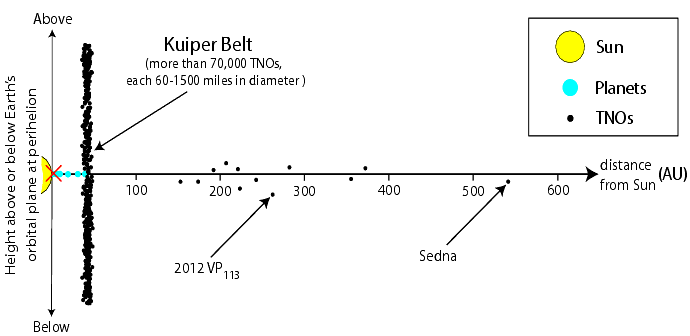
Figure 22: TNOs. Sizes of the Sun, planets, and trans-Neptunian objects (TNOs) are not to scale, although their average distances from the Sun are. Earth is at the red X, 1 astronomical unit (AU) from the Sun. This figure shows several baffling features of TNOs—at least for conventional astronomers. How could the Kuiper Belt have formed so far beyond what was once thought to be the edge of the solar system? Astronomers who have studied TNOs recognize that the Kuiper Belt could not have evolved that far away—or from a swirling dust cloud, that we were incorrectly taught produced the solar system and Earth.174
Notice how close the twelve most distant TNOs are (at their perihelions) to Earth’s orbital plane and how scattered all the other TNOs are from that plane at their perihelions. That extreme closeness cannot be due to chance. What caused it? A simple explanation, based on the hydroplate theory, will be given.
Also, what could account for the twelve TNOs that are more than 150 AU from the Sun, Sedna being at the most extreme distance? Mike Brown, a leading discoverer of TNOs, remarked when learning of Sedna’s location so far from the Sun (532 AU on average):
Yes, there was something different. The same problem exists for the other eleven most distant TNOs.190 Table 18 on page 385 lists many TNO mysteries.
Where did conventional astronomers go wrong? Their “swirling dust cloud” is a fiction, and believing in billions of years allows them to imagine and promote hypotheses that cannot be tested. The public has heard little about the tens of thousands of TNOs, because they are so perplexing to astronomers. Scott S. Sheppard, a co-discover of 2012 VP113, admitted: “These objects couldn’t get out there with what we currently know.” 191 What don’t these experts “currently know”? The consequences of the earthshaking, catastrophic global flood.
Schwamb’s findings are just the “tip of the iceberg.” Not only do her twelve TNOs have w values that cluster too tightly to be attributed to chance, but all 2,300 TNOs whose orbits are known (taken as a group) have w values that cluster near either 0 ° or 180 °. Chance could produce such a departure from a random distribution only once out of 10,000 times!178
Anyone interested can duplicate these results provided by astronautics Professor R. B. Brown. He downloaded from the Jet Propulsion Laboratory’s Small-Body Database the orbital elements for all 2,300 TNOs with known orbits. He then constructed a histogram for w that showed two prominent peaks—one near w = 0 ° and one near w = 180 °. A simple chi-square test showed that the distribution was non-uniform with a confidence level of 99.99%.179 Professor Brown concluded that “many TNOs recently received powerful thrusts from near the plane of the ecliptic. Thrusts directed up above the ecliptic, produced w values near 0°; thrusts directed downward produced w values near 180 °.” He projected many TNOs and asteroids back in time and
showed that Neptune’s gravity could have provided that thrust for only a few of these bodies over the last 22,000 years. Therefore, other planets near the ecliptic plane were involved. Were these TNOs even closer to the Sun than Neptune?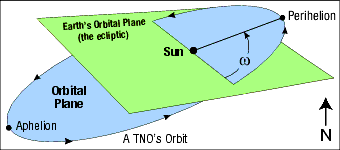
If that thrust occurred millions of years ago, random perturbations would have smoothed out those peaks, so the values for w would have been spread out uniformly between 0 ° and 360 °.180 Therefore, “recently” must be less than millions of years ago—perhaps 5,000 years ago. What can explain this?
Another TNO authority described in a different way the discovery that Megan Schwamb explained:
All the objects beyond 150 astronomical units come closest to the sun, a point known as perihelion, at nearly the same time that they cross the plane of the solar system. There’s no reason for these perihelia to bunch up like that. Billions of years of evolution should have left the perihelia scattered, like the rest of the Kuiper Belt—unless something was holding the perihelia in place.181
On the contrary, there is a straight-forward explanation that will now be given for why all twelve perihelia lie in the orbital plane of the planets—why w is nearly 0°. Why have those perihelia not scattered after billions of years? Billions of years have not elapsed. TNOs have existed only since the flood, about 5,000 years ago.
Theories for the Origin of Trans-Neptunian Objects
The Hydroplate Theory. Asteroids have already been explained, beginning on page 352. Some asteroids were larger than those typically seen in the inner solar system. For four reasons, these larger asteroids spiraled out beyond Neptune and became TNOs.

Figure 24: Pluto’s Carbon-Monoxide Lake. Why does Pluto have a frozen lake with carbon monoxide ice, shown in green? (The white contours show increased carbon-monoxide concentration near the lake’s center.)
First, there must be a large source of carbon, such as
we have in abundance here on Earth. Obviously, vegetation does not grow on Pluto. Next, the carbon compounds must be burned (oxidized), but with a limited supply of oxygen. If plenty of oxygen is available, carbon dioxide is produced, not carbon monoxide, a poisonous gas. The Sun’s radiation would have separated some water vapor from the fountains into oxygen and hydrogen. Water vapor also provided the necessary aerobraking to merge solid materials into comets, asteroids, and TNOs. As solid debris launched by the fountains, including pulverized vegetation from Earth’s preflood forests, collapsed to become comets, asteroids, and TNOs, great heat was released, especially for Pluto the largest known TNO. That heat then drove the combustion which produced carbon monoxide gas. Eventually, that gas escaped into Pluto’s cold atmosphere, instantly became liquid carbon monoxide, fell as rain, collected in depressions on Pluto’s solid surface (as indicated by the white contour lines above) and quickly froze.
If future astronauts travel to Pluto, they might want to pack their ice skates.
First, each asteroid began as a growing swarm of rocks, ice, and gas orbiting within the sphere of influence of a large “seed” rock. As its sphere of influence grew, it pulled in more mass and grew even more. Larger swarms intercepted more of the Sun’s radiation, especially for a few years after the flood. As explained earlier, the Sun’s gigantic energy produced the thrust that spiraled swarms and asteroids outward.
Second, larger swarms had more gravity, so they could hang on to their gases more firmly. Those gases were heated on the day side and, therefore, reached higher pressures than gases on the frigid night side. As long as gases remained, the swarms acted as Carnot [CAR-no] engines,187 delivering thrust from the greater pressure pushing the swarms away from the Sun. The difference between the heat absorbed by the swarm and the heat rejected (one-half rotation cycle later) became thermodynamic work—a force (thrust) acting through a distance.
As each swarm moved farther from the Sun, its gases cooled, so were even less likely to escape. Just beyond the asteroid belt, a “tipping point” was reached for the larger asteroids. The swarm’s gas was cold enough to rarely escape, allowing the Sun’s energy to push the swarm farther from the Sun, so the gases were even less likely to escape. Pluto, for example, still has its very cold (-382°F or 43 K) atmosphere.
Third, larger swarms spun more slowly, for the same reason the skater shown on page 158 spins more slowly when her arms are outstretched. The swarm’s slower spin made the daylight side hotter, and the night side colder. Greater temperature differences provide greater thrust and efficiency, just as engines produce more power and have greater efficiency if they operate between higher hot temperatures and colder cold temperatures. These effects also added orbital angular momentum as explained in Endnote 23, allowing the swarm to spiral outward beyond the orbit of Neptune. [For details, see: Ralph D. Lorenz and Joseph N. Spitale, “The Yarkovsky Effect as a Heat Engine,” Icarus, Vol. 170, July 2004, pp. 229–233.] Some TNOs, developed resonances with Neptune as they spiraled out through Neptune’s orbit.
Fourth, a swarm also acted as a solar sail. Photons (particles of light) from the Sun transfer their momentum to orbiting objects they strike. Solar sails are now propelling some spacecraft, and someday may send future spacecraft to a nearby star. Today’s solar sails are not much larger than a living-room rug, but a swarm of rocks, ice, and gas would have been thousands of times larger—and provided thousands of times more thrust to steadily accelerate the swarm.
Each individual transfer [of a photon’s momentum to a solar sail] amounts to no more than a mosquito’s breath, but over time that breath accumulates to a steady wind that a spacecraft can ride just as a sailboat rides the wind on Earth. After 100 days, a solar sail could reach 14,000 kilometers per hour; after three years it could be zipping along at 240,000 kilometers per hour. At that rate it could get to Pluto in less than five years, rather than the nine years [normally required using jet propulsion].193
Water-ice on TNOs formed recently in the inner solar system from relatively warm water, so we should not be surprised to find crystalline water-ice on Quaoar and Charon.
After a few years, smaller asteroids lost their gas; 90% of them (those not scattered by gravitational perturbations) settled into the asteroid belt. However, larger asteroids could hang on to their cooling gases which continued to provide thrust by capturing the Sun’s energy. They became TNOs. The fountains of the great deep launched rocks, mud, and water. The larger rocks became seeds around which thousands of smaller objects orbited—or swarmed (as a swarm of bees might hover around a beehive). Aerobraking from all the surrounding water vapor slowly and gently merged most of those particles. Those that didn’t merge by the time all their gas escaped became moons. (Thus Pluto has five tightly packed moons in chaotic, unstable orbits.) Gaseous drag slowly circularized each swarm’s orbit about the Sun and reduced the orbit’s angle of inclination, so TNOs not perturbed by a planet as they spiraled out past Neptune ended up in the doughnut-shaped Kuiper Belt.
As you might expect, many swarms, trying to spiral out beyond Neptune, were (1) perturbed by Jupiter, Saturn, Uranus, or Neptune, (2) pulled apart by tidal forces, and (3) given gravity boosts.194 These bodies, called centaurs (after the mythical man/horse creatures) resemble both asteroids and comets. One centaur, Chariklo, has icy rings158 that appear to be young (a few thousand years old).159 An estimated 44,000 centaurs are larger than 1 kilometer (0.6 mile). All are unstable, because they cross the orbits of the giant planets and frequently collide with or are ejected from the solar system by those giants. Therefore, centaurs are quite young.
Some asteroids large enough to become TNOs received gravity boosts from the giant planets. Because those gravity boost began near the ecliptic, w was either near 0° (if the TNO was boosted above—north of—the ecliptic), or 180° (if the boost flung the asteroid below the ecliptic). Approximately 5,000 years of perturbations have modified these orbits to some extent, but not enough to erase the w ª 0° or 180° signature that Dr. R. Brown discovered for all TNOs taken as a group. Certainly, millions of years of perturbations would have randomized the w values.
Pluto’s Towering Mountains and a Carbon-Monoxide Lake. As explained in Figure 21 on page 381 , the swarm that collapsed to form Pluto (the largest known TNO) probably generated more heat producing impacts than any other TNOs. That rapid internal heating would have partially “burned” (or oxidized) vegetation incorporated into Pluto from the debris launched from Earth’s preflood forests by the fountains of the great deep. Water (H2O) supplied limited amounts of oxygen (O). Carbon monoxide (CO), normally a low density gas, is produced by the partial oxidation of carbon compounds. However, once that gas escaped during the eruptions into Pluto’s extremely cold atmosphere, it liquefied, fell as rain, collected in surface depressions, and quickly froze as carbon-monoxide lakes. Carbon monoxide gas at atmospheric pressures here on Earth liquefies at -313°F and solidifies at -337°F, but Pluto’s atmosphere is an even colder -382°F.
Methane (CH4 ) and Life on Pluto. Pluto’s atmosphere contains methane. On Earth, bacteria produce 90–95% of all methane.195 Did bacteria produce methane on Pluto?
If pulverized vegetation launched by the fountains of the great deep was incorporated into Pluto, as indicated above by the carbon-monoxide lake, then bacteria would have been attached. Bacteria, with their food supply (vegetation), would have been prolific producers of methane. Some bacteria would not have survived Pluto’s harsh conditions, but those that did had more food and thus reproduced their kind more abundantly.
Because methane has been reported on Mars, many scientists suspect that bacteria are on Mars. However, in rare cases, methane, can be produced when liquid water interacts with certain rocks. Although liquid water may be inside Mars where conditions are warmer, that possibility does not apply to Pluto, where temperatures are so cold there should be no liquid water on or inside Pluto to produce methane. Therefore, Pluto’s methane is probably from bacterial life—life that came from Earth!
All the giant planets and some moons and comets have methane in their atmospheres, so—for the same reasons—they may have (or had) life in the form of bacteria.
The Evolution of the Solar System Theory. From an evolutionist’s perspective, Sedna, 2012 VP113, and the other ten distant and highly eccentric TNOs should not be where they are—far beyond the Kuiper Belt and the outer edge of the solar system.
To all intents and purposes, in the current architecture of the Solar System, Sedna and 2012 VP113 should not be there. These objects are in a no-man’s-land between the giant planets and the [hypothetical] Oort cloud where nothing in the known configuration of the modern day Solar System could have emplaced them.196
Two astronomers (Konstantin Batygin and Mike Brown, both at California Institute of Technology), grasping at straws to solve this problem, announced on 20 January 2016, through most media outlets in the world, that a planet nearly the size of Neptune must orbit the Sun seven times farther out than Neptune (over 200 AU from the Sun). They said that the gravity of this predicted planet has pulled six of these twelve TNOs into their elongated, extremely distant orbits, and telescopes will find this Planet X by January 2021.197
These astronomers are unaware of the mechanism that produced all twelve (not just six) of these extremely distant, highly eccentric and inclined TNOs. Therefore, Evolution theories do not explain how the tens of thousands of TNOs formed.
PREDICTION 50: Planet X will not be found in the next 5 years (by January 2021), because it does not exist.
| Key: |
 |
Explained by theory. |
|
|
 |
Theory has moderate problem with this item. |
|
|
 |
Theory has serious problems with this item. |
Pluto may be the most famous resident of this frozen [TNO] netherworld, but other objects in this sparsely populated region stand out for their bewildering variety of shapes, colors, densities and orbits. ... Astronomers don’t yet have a complete picture of the Kuiper Belt, and new riddles ... .198
Evaluation of Evidences vs. Theories. Table 18 compares these two competing theories. My subjective judgments are coded in green, yellow, and red circles, similar to what is seen in other chapters. You are encouraged to make
your own evaluation using either the above information or other available sources.