• CSC Home Page
  • Order Book
  • Table of Contents
  • Preface
  • Endorsements
  • Part I: Scientific Case for Creation
    • Life Sciences
    • Astronomical and Physical Sciences
    • Earth Sciences
    • References and Notes
  • Part II: Fountains of the Great Deep
    • The Hydroplate Theory: An Overview
    • The Origin of Ocean Trenches
    • Liquefaction: The Origin of Strata and Layered Fossils
    • The Origin of the Grand Canyon
    • The Origin of Limestone
    • Frozen Mammoths
    • The Origin of Comets
    • The Origin of Asteroids and Meteoroids
  • Part III: Frequently Asked Questions
  • Technical Notes
  • Index

  • Previous Page
  • Next Page

This is the online edition of In the Beginning: Compelling Evidence for Creation and the Flood
(7th Edition) by Dr. Walt Brown. The online version of the book is designed to be read online.
A PDF version or hardbound print version may be ordered.
Copyright © 1995–2008, Center for Scientific Creation. All rights reserved.

Click here to order the hardbound print edition of this online book.

[ The Scientific Case for Creation > Astronomical and Physical Sciences > The Universe, the Solar System, the Earth, and Life Were Recently Created. > Theories for the Evolution of the Solar System and Universe Are Unscientific and Hopelessly Inadequate. > Strange Planets]

43.   Strange Planets

Many undisputed observations contradict current theories on how the solar system evolved.a One theory says that planets formed when a star, passing near our Sun, tore matter from the Sun. More popular theories hold that the solar system formed from a cloud of swirling gas, dust, or larger particles. If the planets and their known moons evolved from the same material, they should have many similarities. After several decades of planetary exploration, this expectation is now recognized as false.b [See Figure 21.]  According to these evolutionary theories:

Backward-Spinning Planets.  All planets should spin in the same direction, but Venus, Uranus,c and Pluto rotate backwards.d

Backward Orbits.  Each of the almost 200 known moons in the solar system should orbit its planet in the same direction, but more than 30 have backward orbits.e Furthermore, Jupiter, Saturn, Uranus, and Neptune have moons orbiting in both directions.

Tipped Orbits. 

  • Moons. The orbit of each of these moons should lie very near the equatorial plane of the planet it orbits, but many, including the Earth’s moon, are in highly inclined orbits.f
  • Planets. The orbital planes of the planets should lie in the equatorial plane of the Sun. Instead, the orbital planes of the planets typically deviate from the Sun’s equatorial plane by 7 degrees, a significant amount.

Angular Momentum.  The Sun should have about 700 times more angular momentum than all the planets combined. Instead, the planets have 50 times more angular momentum than the Sun.g


Is Pluto a Planet?

In 2006, after years of internal debate, the International Astronomical Union (IAU) voted to no longer consider Pluto as a planet. Instead, they said Pluto is a transneptunian object. [See Endnote 43h on page 79.] The IAU had no jurisdiction to change the definition of “planet” for the rest of the world. It is fine for an organization to tell others what it considers a word to mean, but common usage is the basis for definitions. Our language is filled with scientific words whose meanings have changed based on new discoveries and broader understandings. Few meanings have changed based on an organization’s vote.

Since Pluto’s discovery 76 years earlier, Pluto had been a thorn in the side of astronomers trying to explain how planets evolve. So many characteristics of Pluto are difficult to fit into evolutionary scenarios. No longer calling Pluto a planet (even though it is spherical, has three known moons, and orbits the Sun in the right direction) may reduce those man-made problems, but now calls attention to the more difficult question of how a thousand transneptunian objects evolved.

In 1930, after astronomers had been searching for a suspected ninth planet for 25 years, a tenacious farm boy from Kansas, Clyde W. Tombaugh (1906–1997), discovered Pluto. He later became one of my favorite professors. Going to his backyard to use his handmade 9-inch telescope was memorable. Professor Tombaugh was a warm, unpretentious man with the biggest smile you have ever seen. However, in class, he sometimes became irate at astronomers who made pronouncements but seldom touched a telescope.

Classification can be a useful tool, but at other times it leads to endless arguments, because the world (or, in this case, the solar system) is usually more complicated than theories imply. We can call Pluto anything we wish, but tens of thousands of books and hundreds of millions of students have called Pluto a planet.

What is a planet? Its original meaning was “wandering star.” Perhaps if the members of the IAU spent more time looking through telescopes at wandering points of light, they would consider Pluto a planet. I will always associate Pluto with Tombaugh and the worldwide excitement of finally discovering the ninth planet.

Semantics aside, the scientific question remains: how could Pluto evolve?

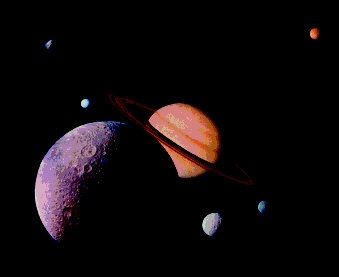
saturnandmoons.jpg Image Thumbnail

Figure 22: Saturn and Six of Its Moons. Saturn has 60 known moons. One of them, named Phoebe, has an orbit almost perpendicular to Saturn’s equator.  This is difficult for evolutionists to explain.

  • Previous Page
  • Next Page

This site is best viewed with a screen resolution of 1024 x 768 (XGA) or higher and a browser that supports cascading style sheets.
We have tested the site in Internet Explorer (Win), Netscape (Win), Safari (Mac), and Firefox (Mac and Win).
Please let us know if you have any suggestions or find any problems with the site.

Updated on Sunday, May 11
Copyright © 1995–2008
Center for Scientific Creation
http://www.creationscience.com

(602) 955-7663