What about the Dinosaurs?
This frequent question, asked in just this way, implies many questions related to dinosaurs, a word meaning “terrible lizards.” When did they live? What killed the dinosaurs? What were they like? What does the Bible say about them? Could the Ark have held so many large animals? Why are their bones and fossils found inside Antarctica and the Arctic Circle—unlivable places, too cold and lacking food?
There were about 500 different types of dinosaurs. Most were large; some even gigantic. One adult dinosaur was as tall as a five-story building. However, some adults were small, about the size of a chicken. [See page 464.] Most evolutionists now say that birds are dinosaurs.
Many questions will be answered if we focus on one question, “When did they live?” Two quite different answers are usually given. Evolutionists say that dinosaurs lived, died, and became extinct at least 60-million years before man evolved. Others believe God created all living things during the creation week, so man and dinosaurs lived at the same time. If we look at the evidence, sorting out these two very different answers should be easy.
Did dinosaurs become extinct at least 60-million years before man evolved? Almost all textbooks that address the subject say they did. Movies and television vividly portray this. One hears it even at Disney World and other amusement parks. Some will say that every educated person believes this. We frequently hear stories that begin with impressive-sounding phrases such as, “Two hundred million years ago, when dinosaurs ruled the earth, ...” But none of this is evidence; some of it is an appeal to authority. Evidence must be observable and verifiable.
Did man and dinosaurs live at the same time? Scientists in the former Soviet Union have reported a layer of rock containing more than 2,000 dinosaur footprints alongside tracks “resembling human footprints.”1 Obviously, both types of footprints were made in mud or sand that later hardened into rock. If some are human footprints, then man and dinosaurs lived at the same time. Similar discoveries have been made in Arizona.2 Were it not for the theory of evolution, few would doubt that these were human footprints.
Soft dinosaur tissue has now been recovered from several dinosaurs: three tyrannosaurs (T. Rex) and one hadrosaur. It is ridiculous to believe that soft tissue can be preserved for 60,000,000 years, but it could be preserved since the flood, about 5,000 years ago. [For details see “Old DNA, Bacteria, Proteins, and Soft Tissue?” on page 42.]
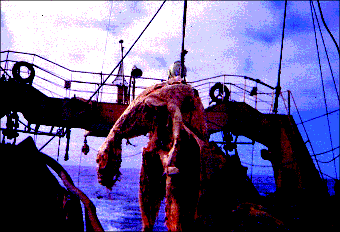
Figure 11: Probably Not a Plesiosaur. This 32-foot-long “monster,” caught by a Japanese fishing ship off the coast of New Zealand in 1977, was unfortunately thrown overboard soon after this picture was taken. The animal made front-page news for weeks in Japan. Several Japanese scientists felt that it was a plesiosaur, and a Japanese postage stamp seemed to commemorate the discovery of the first modern plesiosaur. In the 6th edition (1995) of this book, this animal was incorrectly labeled as a “possible plesiosaur.” Later, after reading English translations of opinions of other Japanese scientists and seeing similar pictures of decaying basking sharks, it is more likely that this was a large basking shark.3 Decay patterns near the shark’s head give the appearance of a neck. My apologies for the error.
The Book of Job is one of the oldest books ever written. In it, God tells of His greatness as Creator and describes an animal, called Behemoth, as follows:
Behold now, Behemoth, which I made as well as you; He eats grass like an ox. Behold now, his strength in his loins, And his power in the muscles of his belly. He bends his tail like a cedar; The sinews of his thighs are knit together. His bones are tubes of bronze; His limbs are like bars of iron. (Job 40:15–18)
Marginal notes in many Bibles speculate that Behemoth was probably an elephant or a hippopotamus, but those animals have tails like ropes. Behemoth had a “tail like a cedar.” Any animal with a tail as huge and strong as a cedar tree is probably a dinosaur. Also, Job 40:19–24 says this giant, difficult-to-capture animal was not alarmed by a raging river. If the writer of Job knew of a dinosaur, then the evolution position is wrong, and man saw dinosaurs.
The next chapter of Job describes another huge, fierce animal, a sea monster named Leviathan. It was not a whale or crocodile, because the Hebrew language had other words to describe such animals. Leviathan may be a plesiosaur (PLEE-see-uh-sore), a large seagoing reptile that evolutionists say became extinct 60-million years before man evolved. Other ancient writing describe Behemoth and Leviathan.4
For the past three centuries, reports have come from the Congo in western Africa that dinosaurs exist in remote swamps. These eyewitness stories are often from educated people who can quickly describe dinosaurs. Two expeditions to the Congo, led by biologist Dr. Roy Mackal of the University of Chicago, never saw dinosaurs, but interviewed many of these witnesses and concluded that their reports were about dinosaurs and were apparently true.5 If any of these accounts are correct, man and dinosaurs were contemporaries.
Consider the many dragon legends. Most ancient cultures have stories or artwork of dragons that strongly resemble dinosaurs.6 The World Book Encyclopedia states that:
The dragons of legend are strangely like actual creatures that have lived in the past. They are much like the great reptiles [dinosaurs] which inhabited the earth long before man is supposed to have appeared on earth. Dragons were generally evil and destructive. Every country had them in its mythology.7
The simplest and most obvious explanation for so many common descriptions of dragons from around the world is that man once knew the dinosaurs.
What caused the extinction of dinosaurs? Primarily, the flood. Because dinosaur bones are found among other fossils, dinosaurs must have been living when the flood began. Dozens of other dinosaur extinction theories exist, but all have recognized problems. [See pages 126– 128.] Most of the food chain was buried in the flood. Therefore, many large dinosaurs that survived the flood probably had difficulty feeding themselves and became extinct.
One of the least acknowledged dinosaur mysteries is the discovery of their fossils and bones inside the Arctic Circle and in Antarctica8—places where they shouldn’t have been able to live. That mystery is solved when one understands why the earth slowly rolled 34° – 57° after the flood. [See “Earth Roll” on page 141.]
Were dinosaurs on the Ark? Yes. God told Noah to put representatives of every kind of land animal on the Ark. (Some dinosaurs were semiaquatic and could have survived outside the Ark.) But why put adult dinosaurs on the Ark? Young dinosaurs would take up less room, eat less, and be easier to manage. Animals were on board so they could reproduce after the flood and repopulate the earth. Young dinosaurs would have more potential for reproduction than old dinosaurs.
Bones of certain dinosaurs show annual growth rings, as trees do. Those dinosaurs, early in life and late in life, grew very slowly. During mid-life, they had large growth spurts.9 Therefore, their juveniles, during the year they were on the Ark, probably weighed less than 60 pounds. (A 2-year-old T. Rex weighed 66 pounds. The largest known T. Rex lived to the age of 28 years.10 Dinosaurs did not become large because they lived long lives.)