How Old Do Evolutionists Say the Universe Is?
In the late 1920s, evolutionists believed that the universe was 2-billion years (b.y.) old. Later, radiometric dating techniques gave much older ages for certain rocks on Earth.1 Obviously, a part of the universe cannot be older than the universe itself. This contradiction was soon removed by devising a rationale for increasing the age of the universe.
Similar problems are now widely acknowledged. [See “Big Bang?” on page 36.] If a big bang occurred, it happened 13.7 b.y. ago. If stars evolved, some stars are 16 b.y. old, such as the stars in the globular cluster in Figure 13.2 Obviously, stars cannot be older than the universe. Also, the Hubble Space Telescope has found distant galaxies too old (based on big bang assumptions) to fit in a younger universe.3
Here is a similar, but less widely known, problem. Let’s suppose that the universe is 13.7 b.y. old. That is not enough time for stars containing heavy chemical elements to form and then transmit their light all the way to Earth. A big bang would have produced only hydrogen, helium, and lithium—the three lightest chemical elements. Light from some of the most distant stars and galaxies shows that they contain much heavier chemical elements, such as carbon, iron, and lead—elements that could not have been in the first generation of stars to form after the big bang. Evolutionists therefore believe that the hundred or so heavier chemical elements (97% of all chemical elements) were produced either deep inside stars or when some stars exploded as supernovas. Much later, a second generation of stars supposedly formed with the heavy elements from that exploded debris.
Big bang advocates and physicists have struggled to explain the origin of the heavier chemical elements (carbon, oxygen, iron, lead etc.). [See Endnote 33 on page 149.] To squeeze enough hydrogen nuclei together to form some other light elements supposedly requires the high temperatures inside stars. To form elements heavier than iron, they say, requires something even hotter—a supernova. But this too will not work. [See Endnotes 116– 118, beginning on page 425.]
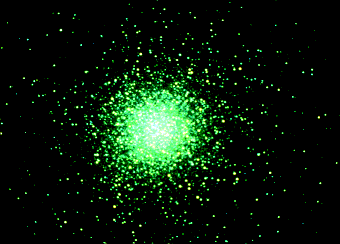
Figure 13: Globular Cluster. Globular clusters are tight, spherical concentrations of 10,000 –1,000,000 stars. This globular cluster, called M13, is about 22,000 light-years away. To see why all the stars in a globular cluster did not evolve but came into existence about the same time, see “Star Births? Stellar Evolution?” on page 34.
So, if a big bang happened, there would not be enough time afterward to complete all four of the following:
a. Form the first generation of stars out of hydrogen, helium, and lithium.
b. Have many of those stars quickly4 pass through their complete life cycles then finally explode as supernovas to produce the heavier chemical elements.
c. Recollect, somehow, enough of that exploded debris—presumably containing heavy elements—to form second generation stars. (Some were quasars which are powered by black holes, billions of times more massive than our Sun!) [See Endnote 23 on page 462.]
d. Transmit the light from these heavy elements to Earth, immense distances away.
Sophisticated light-gathering instruments have allowed astronomers to discover heavy elements in many extremely distant galaxies5 and quasars.6 If the speed of light has been constant, that quasar’s light has taken 95% of the age of the universe to reach us. This means that only the first 5% of the age of the universe (only 0.7 b.y.) was available for events a–c above. Few astronomers believe that such slow processes as a–c above, if they happened at all, could happen in 0.7 b.y.7
Evolutionists can undoubtedly resolve these time contradictions—but at the cost of rejecting some cherished belief. Perhaps they will accept the possibility that light traveled much faster in the past. More than 160 measurements collected over 300 years by dozens of researchers support this revolutionary idea. [See page 465.] Maybe they will conclude that the big bang never occurred, or that heavy elements were somehow in the first and only generation of stars, or that stars degrade, but new stars don’t evolve. Much evidence supports each of these ideas, and all are consistent with a recent creation.
Few evolutionists are aware of these contradictions. However, as more powerful telescopes begin peering even farther into space, these problems will worsen and more attention will be focused on them. If scientists find, as one might expect, even more distant stars and galaxies with heavy elements, problems with the claimed age of the universe will no longer be the secret of a few evolutionists.8