Galaxies Are Billions of Light-Years Away, So Isn’t the Universe Billions of Years Old?
The logic behind this common question has several hidden assumptions, two of which are addressed by the following italicized questions:
a. Was space, along with light emitted by stars, rapidly stretched out soon after creation began? If so, energy would have been added to the universe and starlight during that stretching. Pages 449–464 show that the scientific evidence clearly favors this stretching explanation over the big bang theory, which also claims that space expanded rapidly. Yet, the big bang theory says all this expansion energy, plus all the matter in the universe, was, at the beginning of time, inside a volume much smaller than a quadrillionth of an atom.
b. Has starlight always traveled at its present speed—about 186,000 miles per second or, more precisely, 300,000 kilometers per second?
If either (a) space and its starlight were stretched out, or (b) the speed of light was much faster in the past, then distant stars should be visible in a young universe. Pages 449–464 address possibility (a). Here, we will address possibility (b) by examining the historical measurements of the speed of light.
Historical Measurements. During the past 300 years, at least 164 separate measurements of the speed of light have been published. Sixteen different measurement techniques were used. Astronomer Barry Setterfield has studied these measurements, especially their precision and experimental errors.1 His results show that the speed of light has apparently decreased so rapidly that experimental error cannot explain it! Montgomery and Dolphin have critically reexamined all of Setterfield’s data, applied various statistical tests, and reached similar conclusions.2 In the seven instances where the same scientists remeasured the speed of light with the same equipment years later, a decrease was always reported. The decreases were often several times greater than the reported experimental errors. I have conducted other analyses that give weight (give significance) to each measurement according to its accuracy. Even after considering the wide range of accuracies, it is hard to see how one can claim, with any statistical rigor, that the speed of light has remained constant.3
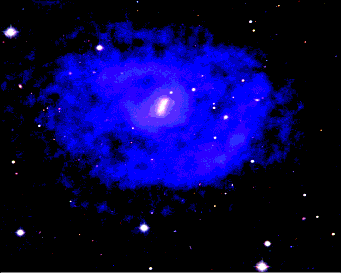
Figure 10: Spiral Galaxies. The arms in these six representative spiral galaxies have about the same amount of twist. Their distances from Earth are shown in light-years. (One light-year, the distance light travels in one year, equals about 5,879,000,000,000 miles.) For the light from all galaxies to arrive at Earth tonight, the more distant galaxies had to release their light long before the closer galaxies. Therefore, the more distant galaxies did not have as much time to rotate and twist their arms, so the farther galaxies should have less twist. But, if light traveled millions of times faster in the past—or if space and its light were stretched out during the creation week, as proposed on pages 449–464—the farthest galaxies did not have to send their light long before the nearest galaxies. Spiral galaxies should have similar twists. This turns out to be the case.6
The galaxies are: A) M33 or NGC 598; B) M101 or NGC 5457; C) M51 or NGC 5194; D) NGC 4559; E) M88 or NGC 4501; and F) NGC 772. All distances are taken from R. Brent Tully, Nearby Galaxies Catalog (New York: Cambridge University Press, 1988).
M. E. J. Gheury de Bray, in 1927, was probably the first to propose a decreasing speed of light.4 He based his conclusion on measurements spanning 75 years. Later, he became more convinced and twice published his results in Nature,5 possibly the most prestigious scientific journal in the world. He emphasized, “If the velocity of light is constant, how is it that, invariably, new determinations give values which are lower than the last one obtained ... There are twenty-two coincidences in favour of a decrease of the velocity of light, while there is not a single one against it.”7 [emphasis in original]
Although the measured speed of light has decreased only about 1% during the past three centuries, the decrease is statistically significant, because measurement techniques can detect changes thousands of times smaller. While the older measurements have greater errors, the trend of the data is startling. The farther back one looks in time, the more rapidly the speed of light seems to have been decreasing. Various mathematical curves fit these three centuries of data. When some of those curves are projected back in time, the speed of light becomes so fast that light from distant galaxies conceivably could have reached Earth in several thousand years.
Some people have arbitrarily defined the speed of light as a constant. However, no scientific law requires the speed of light to be constant.8 Many have simply assumed that it is constant, so changing old ways of thinking is sometimes difficult. Russian cosmologist, V. S. Troitskii, at the Radiophysical Research Institute in Gorky, also questioned some old beliefs. He concluded, independently of Setterfield, that most redshifts of distant starlight are the result of the slowing speed of light, and at the beginning, the speed of light was 10 billion times faster at time zero! 9 Furthermore, he attributed the cosmic microwave background radiation to this rapidly decreasing speed of light. Setterfield reached the same conclusion concerning redshifts by a different method. If either Setterfield or Troitskii is correct, the big bang theory will fall (with a big bang).
Other cosmologists are proposing an enormous decay in the speed of light.10 Several of their theoretical problems with the big bang theory are solved if light once traveled millions of times faster—or if the universe was initially more compact and was later stretched out as explained on pages 449–464. For example, “the horizon problem” recognizes that opposite extremes of the universe have the same temperature. Why should this be? The universe isn’t old enough for such vastly separated regions ever to have had contact with each other. Light doesn’t travel fast enough—at least not today.
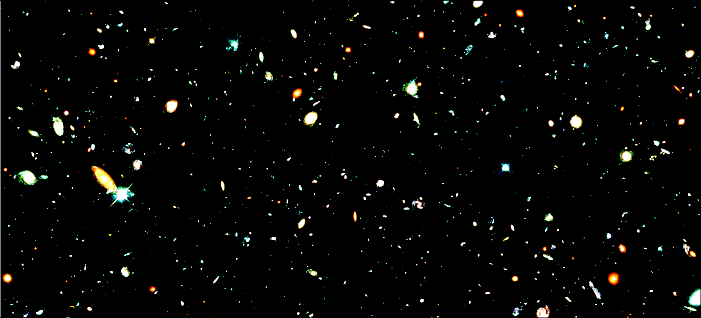
Figure 11: Hubble Deep Field North. There are about 2 trillion galaxies in the visible universe!12 The Hubble Space Telescope, searching for evolving galaxies in December 1995, focused for 10 continuous days on a tiny patch of sky, so small when viewed from Earth that a grain of sand held at arm’s length would cover that area. This picture of that tiny patch of sky is called Hubble Deep Field North. Most objects in it are not isolated stars, but galaxies, each containing billions of stars. Of the 3,000 galaxies photographed that emitted enough light to measure their redshifts, which presumably measure distance, all seemed surprisingly mature. As stated in Scientific American, “... the formation of ‘ordinary’ spiral and elliptical galaxies is apparently still out of reach of most redshift surveys.”13 Moreover, fully formed clusters of galaxies, not just galaxies, are seen at the greatest distances visible to the Hubble Space Telescope.14 In 1998 and 2004, similar pictures—with similar results—were taken.
Think about this: There is not enough time in the age of the universe (even as evolutionists imagine it, times a billion ) for gravity to pull together all the particles comprising clusters of galaxies.15 (As explained under “Galaxies” on page 36, clusters of galaxies cannot form, even granting all this time.) Because the most current studies show fully-formed galaxies even farther away than those shown above,16 creation becomes the logical and obvious alternative. We may be seeing galaxies as they looked months after they were created. Vast amounts of time are no longer needed. [See page 473.]
Atomic vs. Orbital Time. Why would the speed of light decrease? In 1981, T. C. Van Flandern, working at the U.S. Naval Observatory, showed that atomic clocks are probably slowing relative to orbital clocks.11 He wrote:
The number of atomic seconds in a dynamical interval (such as a revolution of the Earth about the Sun) is becoming fewer. Presumably, if the result has any generality to it, this means that atomic phenomena are slowing down with respect to dynamical phenomena. ... we cannot tell from existing data whether the changes are occurring on the atomic level or the dynamical level.17
Orbital clocks are based on orbiting astronomical bodies, especially Earth’s one-year period about the Sun. Before 1967, one second of time was defined by international agreement as 1/31,556,925.9747 of the average time it takes Earth to orbit the Sun. However, atomic clocks are based on the vibrational period of the cesium-133 atom. In 1967, a second was redefined as 9,192,631,770 oscillations of the cesium-133 atom. Van Flandern showed that if atomic clocks are “correct,” the orbital speeds of Mercury, Venus, and Mars are increasing, so the gravitational “constant” should be changing. He also noted that if orbital clocks are “correct,” the gravitational constant is truly constant, but atomic vibrations and the speed of light are decreasing. The drift between the two types of clocks is only several parts per billion per year. But again, the precision of the measurements is so good that the discrepancy is probably real.
For the following three reasons, orbital clocks seem to be correct and the frequencies of atomic vibrations are probably slowing very slightly.
- If Van Flandern’s studies are correct, the gravitational “constant” should be changing or else atomic vibrations are slowing slightly. Other studies have not detected variations in the gravitational constant.
- If a planet’s orbital speed increased (and all other orbital parameters remained the same), the planet’s energy would increase. That would violate the law of conservation of mass-energy.
- If atomic frequencies are decreasing, then five “properties” of the atom, such as Planck’s constant, should also be changing. Statistical studies of past measurements show that four of the five “constants” are changing—and in the right direction.2
So, orbital clocks seem to be more accurate than the extremely precise atomic clocks.18
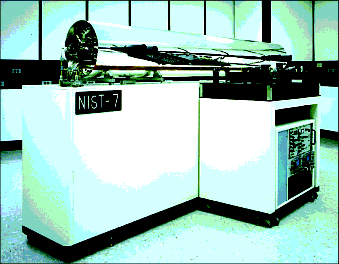
Figure 12: Atomic Clock. This is NIST-7, an atomic clock at the United States National Institute of Standards and Technology. If its time were compared with a similar clock 6-million years from now, they might differ by only one second! The latest development, called NIST-F2, achieves fifty times greater precision by cooling the vibrating atoms to nearly absolute zero. Despite the extreme precision of atomic clocks, we have no assurance that they are not all drifting relative to “true” time. In other words, we can marvel at the precision of atomic clocks, but we cannot be certain of their accuracy.
I initially doubted Setterfield’s claim, because the decrease in the speed-of-light measurements ceased in 1960. Large, one-time changes seldom occur in nature. The measurement techniques were precise enough to detect any decrease in the speed of light after 1960, if the trend of the prior three centuries had continued. Later, Setterfield realized that beginning in the 1960s, atomic clocks were used to measure the speed of light. If atomic frequencies are decreasing, then both the measured quantity (the speed of light) and the newly adopted measuring tool (atomic clocks) are changing at the same rate. Naturally, no relative change would be detected, and the speed of light would be constant in atomic time—but not orbital time.
Misconceptions. Does the decrease in the speed of light conflict with the statement frequently attributed to Albert Einstein that the speed of light is constant? Not really. Einstein said that the speed of light was not altered by the velocity of the light’s source. Setterfield says that the speed of light decreases over time.
Einstein’s statement that the speed of light is independent of the velocity of the light source, is called Einstein’s Second Postulate. (Many have misinterpreted it to mean that “Einstein said the speed of light is constant over time.”) Einstein’s Second Postulate is surprising, but probably true. Wouldn’t we expect a ball thrown from a fast train in the forward direction to travel faster than one thrown in the opposite direction, at least to an observer on the ground? While that is true for a thrown ball, some experimental evidence indicates it is not true for light.19 Light, launched from a fast-moving train, will travel at the same speed in all directions. This strange property of light led to the more extensive theory of special relativity.20
Some people give another explanation for why we see distant stars in a young universe. They believe that God created a beam of light between Earth and each star. Of course, a creation would immediately produce completed things. Instantly, they would look much older than they really are. This is called “creation with the appearance of age.” The concept is sound. However, for starlight, this presents two difficulties:
- Bright, exploding stars are called supernovas. If starlight, seemingly from a supernova, had been created less than 10,000 years ago on its path to Earth and did not originate at the surface of an exploding star millions of light years away, then what exploded? Only a relatively short beam (less than 10,000 light-years long) would have been created near Earth. If the image of an explosion was created on that short beam of light, then the star never existed and the explosion never happened. One finds this hard to accept.
- Every hot gas radiates a unique set of precise colors, called its emission spectrum. The gaseous envelope around each star also emits specific colors that identify the chemical composition of the gas. Because all starlight has emission spectra, this strongly suggests that a star’s light originated at the star—not in cold, empty space. Each beam of starlight also carries other information, such as the star’s spin rate, magnetic field, surface temperature, and the chemical composition of the cold gases between the star and Earth. Yes, God could have created this beam of light with all this information in it. However, the real question is not “Could God have done it?” but “Did He?”
Therefore, starlight seems to have originated at stellar surfaces, not in empty space.
Surprising Observations. Starlight from distant stars and galaxies is redshifted; that is, their light is redder than one might expect. Redshifted light is a wave effect, similar to the lower pitch of a train’s whistle when the train is going away from an observer. As the wave emitter (train or star) moves away from an observer, the waves are stretched, making them lower in pitch (for the train) or redder in color (for the star or galaxy). The greater a star’s or galaxy’s redshift, the faster it is supposedly moving away from us.
Since 1976, William Tifft, a University of Arizona astronomer, has found that distant stars and galaxies have redshifts that typically differ from each other by only a few fixed amounts.21 This is very strange if stars are actually moving away from us. It would be as if galaxies could travel only at specific speeds, jumping abruptly from one speed to another, without passing through intermediate speeds. Other astronomers, not initially believing Tifft’s results, did similar work and reached the same conclusion—one that undermines the foundations of cosmology.
All atoms give off tiny bundles of energy (called quanta) of fixed amounts—and nothing in between. So, Setterfield believes that the “quantization of redshifts,” as many describe it, is an atomic effect, not a strange recessional-velocity effect. If space slowly absorbs energy from all emitted light, it would do so in fixed increments, which would redshift starlight, with the farthest star’s light red-shifting the most. If the speed of light is decaying, we should soon see the redshifts of a few distant galaxies suddenly decrease. This may explain why two distinct redshifts have been seen in each of several well-studied galaxies;22 they are obviously not flying apart!
Another surprising observation is that most distant galaxies look remarkably similar to nearer galaxies. For example, galaxies are fully developed and show no signs of evolving. This puzzles astronomers.23 If the speed of light has decreased drastically—or if space and its light were stretched out during the creation week, as proposed on pages 449–464—these distant, yet mature, galaxies no longer need explaining. Also, the light from a distant galaxy would have reached Earth not too long after the light from nearby galaxies. This may be why spiral galaxies, both near and far, have similar twists. [See Figure 10.]
A Critical Test. If the speed of light has decreased a millionfold, we should observe events in outer space in extreme slow motion. Here is why.
Imagine a time in the distant past when the speed of light was a million times faster than it is today. On a hypothetical planet, billions of light-years from Earth, a light started flashing toward Earth every second. Each flash then began a very long trip to Earth. Because the speed of light was a million times greater than it is today, those initial flashes were spaced a million times farther apart than they would have been at today’s slower speed of light.
Now, thousands of years later, imagine that throughout the universe, the speed of light has slowed to today’s speed. The first of those light flashes —strung out like beads sliding down a long string—are approaching Earth. The large distances separating adjacent flashes have remained constant during those thousands of years, so the moving flashes slowed in unison. Because the first flashes to strike Earth are spaced so far apart, they will strike Earth every million seconds. We would see past events on that distant planet (the flashing of a light) in slow motion. If the speed of light has been decreasing since the creation, then the farther out in space we look, the more extreme this slow motion becomes.
About half the stars in our galaxy are binary; that is, each has a companion star. Both stars are in a tight orbit around their common center of mass. If the speed of light is decreasing, the “slow-motion effect,” should show the orbital periods of binaries decreasing with time and increasing with distance from Earth.