[ Technical Notes > How Much Dust and Meteoritic Debris Should the Moon Have If It Is 4,600,000,000 Years Old? > Discussion ]
Discussion
The lunar surface is composed of a powdery soil, an inch or so thick, below which are 4–10 meters of regolith.5 The Moon’s regolith consists of a range of particle sizes from fine dust up to blocks several meters wide. Meteoritic impacts overturn and mix this soil-regolith, each time coating the outer surfaces with very thin layers of condensed meteoritic material.
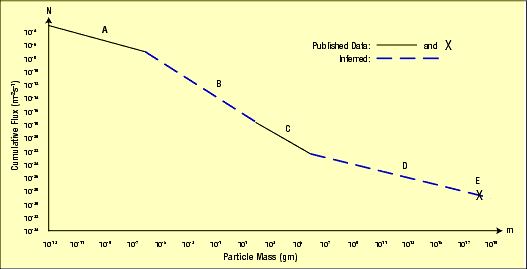
The expected thickness of the soil-regolith, as shown in Table 34, exceeds by about 50 times its actual thickness. (That table assumes that the Moon has been bombarded for 4.6-billion years at only today’s rate.) Most of this calculated thickness comes from Region D—meteorites larger than 106 grams but smaller than meteorites that can form craters 100 km in diameter. Why are the contributions from Regions A, B, and C so much smaller?
We made two incorrect assumptions. First, we assumed that the influx of meteoritic material, for Regions A, B, and C, has always been what it is today. Obviously, the influx decreases over time, because moons and planets sweep meteoritic material up or expel it beyond the Earth-Moon neighborhood. Stated simply, the influx of smaller dust particles in the past was much greater than satellite and moon-based seismometers have detected recently. Only Point E, which strongly influenced Region D, did not have that assumption. Point E is based on rocks that we know struck the Moon sometime in the past. Removing this assumption increases the expected thickness in all regions 6 and partly explains why Region D contributes so much to our total expected thickness.
Second, Table 34 assumes that the impactors fell steadily from outer space as they do today. However, Figure 175’s description on page 311 explains why most large lunar impactors probably originated from Earth and struck the Moon within a few years after the flood began. Heat flow measurements on the Moon are also consistent with a recent cratering event. [See “Hot Moon” on page 44 and the corresponding endnote on page 110.]
What if all lunar impactors were of two types: primary and secondary? The primary impactors were large, extremely high-velocity rocks launched from Earth by the fountains of the great deep. Those impacts, perhaps after a few years of orbiting the Sun, formed the Moon’s giant, multiringed basins. The resulting debris and other space debris were secondary impactors. Consequently, primary impactors account for Point E, and secondary impactors account for much smaller and slower impactors. Therefore, Region D received less impactor mass than our interpolation assumed.