Have Scientific Tools Detected Adam and Eve within Us?
Cells of every plant, animal, and human contain tiny strands of coded information called DNA.1 DNA directs the cell, telling it what to produce, when to produce it, and where it is to go. Therefore, much of your appearance and personality is determined by the DNA you inherited from your parents.
In human cells, the nucleus contains 99.5% of the DNA. Half of it came from the individual’s mother and half from the father. Because both halves are shuffled together, it is difficult to identify which parent contributed any tiny segment, so half of this DNA changes with each generation. However, outside the nucleus of each cell are thousands of little energy-producing components called mitochondria, each containing a circular strand of DNA. Mitochondrial DNA (mtDNA) comes only from the mother. Where did she get hers? From her mother—and so on. Unless there is a rare mutation, mtDNA does not change from generation to generation.
DNA is written with an alphabet of four letters: A, G, T, and C. One copy of a person’s mtDNA is 16,559 letters long. Sometimes a mutation changes one of the mtDNA letters that a mother passes on to her child. These rare and somewhat random changes allow geneticists to identify families. For example, if your grandmother experienced an early mutation in her mtDNA, her children and any daughters’ children would carry the same changed mtDNA. It would differ, in general, from that in the rest of the world’s population.2
In 1987, a team at the University of California at Berkeley published a ground-breaking study comparing the mtDNA of 147 people from five of the world’s geographic locations.3 The study concluded that all 147 had the same female ancestor. She is now called “Mitochondrial Eve.”
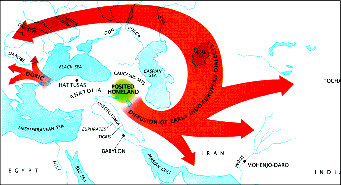
Figure 8: Language Divergence. Languages are related, as are genes. One of thousands of examples is the word for “from, of.” It exists in French (de ), Italian (di ), Spanish (de ), Portuguese (de ), and Romanian (de ). So, these languages, now spoken generally in southwestern Europe, are twigs on a tree branch called the Romance languages. (Romance refers to Rome.) This branch joins a larger branch that includes all languages derived primarily from Latin. They merge with other large branches (such as the Germanic branch that includes English) into a family called the Indo-European languages. When these and other languages are traced back in time, they appear to converge near Mount Ararat, a likely landing site of Noah’s Ark.8 [See pages 45– 47.] Linguists admit that they do not understand the origin of languages, only how languages spread.9
Where did Mitochondrial Eve live? Initial research concluded she probably lived in Africa. Later, after much debate, researchers realized that Asia and Europe were also possible origins for Mitochondrial Eve.4
From a biblical perspective, do we know where Eve lived? Because the flood was so destructive, no one knows where the Garden of Eden was.5 However, Noah’s three daughters-in-law, who lived only a dozen or so generations after Eve, probably began raising their families near Mount Ararat in eastern Turkey—very near the common boundary of Asia, Africa, and Europe. (Each of us can claim one of Noah’s daughters-in-law as our ever-so-great grandmother.) So, it is not surprising that Asia, Africa, and Europe are candidate homes for Mitochondrial Eve.
Also, when similar words, sounds, and grammar of the world’s most widely spoken languages are traced back in time, they also seem to originate near Ararat.6 Another convergence near eastern Turkey is found when one traces agriculture back in time.7
When did Mitochondrial Eve live? To answer this, one must know how frequently mutations occur in mtDNA. Initial estimates were based on the following faulty reasoning: “Humans diverged from chimpanzees about 6-million years ago. Because the mtDNA in humans and chimpanzees differ in 1,000 places, one mutation occurs about every 12,000 years.” Another incorrect approach began by assuming Australia was first populated 40,000 years ago. The average number of mitochondrial mutations among Australian aborigines divided by 40,000 years gave another extremely slow mutation rate for mtDNA. These estimated rates, based on evolution, led to the mistaken belief that Mitochondrial Eve lived 100,000 – 200,000 years ago.10 This surprised evolutionists who believe that the first human female lived 6-million years ago.
A greater surprise, even disbelief, occurred in 1997, when it was announced that mutations in mtDNA occur 20 times faster than had been estimated. Without assuming humans and chimpanzees had a common ancestor 6-million years ago or that Australia was populated 40,000 years ago, mutation rates can now be determined directly by comparing the mtDNA of many mother-child pairs. Using the new, more accurate rate, Mitochondrial Eve lived only about 6,500 years ago.11
Is there a “genetic Adam”? At conception, each man received from his father a segment of DNA which lies on the Y chromosome; this makes him a male. Where did your father receive his segment? From his father. If we all descended from one man, all males should have the same Y chromosome segment—except for rare mutations.
A 1995 study of a worldwide sample of 38 men showed no changes in this segment of the Y chromosome that is always inherited from fathers. Had humans evolved and all men descended from one male who lived 500,000 years ago, each should carry about 19 mutations. Had he lived 150,000 years ago, 5.5 mutations would be expected.12 Because no changes were found, our common father probably lived only thousands of years ago. While Adam was father of all, our most recent common male ancestor was Noah.
In 2010, a comprehensive comparison was made between the DNA on the male Y chromosome of humans and chimpanzees. The differences were more than 30 percent! 13
For completeness, we must consider another possibility. Even if we all descended from the same female, other women may have been living at the same time. Their chains of continuous female descendants may have ended; their mtDNA died out. This happens with family names. If Mary and John XYZ have no sons, their unusual last name dies out. Also, many other men may have lived at the same time as our “genetic Adam,” but had no continuous chain of male descendants down to today. How likely is it that other men lived a few thousand years ago but left no continuous male descendants, and other women lived 6,000 years ago but left no continuous female descendants, and we end up today with a world population of 7 billion people? Extremely remote!14
Yes, new discoveries show that we carry traces of Adam and Eve in our cells. Furthermore, our common “parents” are probably removed from us by only 200 – 300 generations. All humans have a common and recent bond—a family bond. We are all cousins.
Furthermore, the mitochondrial DNA in all life (animals and plants), carries a unique signature, called the DNA barcode, that uniquely identifies 5.5 million species, including humans. Each species only produces others of the same species, and the gaps between species are huge. [See “Distinct Types” on page 9.] Members of each species, including humans, can all trace their ancestry back to a common male and female of the same species, all of whom began giving birth at about the same time.15