10. Distinct Types
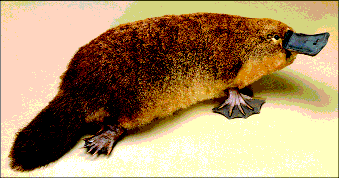
Figure 3: Duckbill Platypus. The duckbill platypus is found only in Tasmania and eastern Australia. European scientists who first studied platypus specimens thought that a clever taxidermist had stitched together parts of different animals—a logical conclusion if one believed that each animal must be very similar to other animals. In fact, the platypus is perfectly designed for its environment.
If evolution happened, one would expect to see gradual transitions among many living things. For example, variations of dogs might blend in with variations of cats. In fact, some animals, such as the duckbill platypus, have organs totally unrelated to their alleged evolutionary ancestors. The platypus has fur, is warm-blooded, and suckles its young as do mammals. It lays leathery eggs, has a single ventral opening (for elimination, mating, and birth), and has claws and a shoulder girdle as most reptiles do. The platypus can detect electrical currents (AC and DC) as some fish can, and has a bill similar to that of a duck—a bird. It has webbed forefeet like those of an otter and a flat tail like that of a beaver. The male platypus can inject poisonous venom like a pit viper. Such “patchwork” animals and plants, called mosaics, have no logical place on the so-called “evolutionary tree.”
One study by evolutionists of the mitochondrial DNA of 100,000 animal species (including humans) found that neutral mutations (slight changes in DNA that neither help nor hurt an organism’s survival) show so little variation within each species that almost all of those species must have come into existence at about the same time—and recently. Furthermore, the gaps between species are huge. In other words, lots of time produces many slight variations within a species; time does not produce new species. (Darwin was also perplexed by the absence of in-between species.)a
There is no direct evidence that any major group of animals or plants arose from any other major group.b Species are observed only going out of existence (extinctions), never coming into existence.c