4. Bounded Variations
Not only do Mendel’s laws give a theoretical explanation for why variations are limited, broad experimental verification also exists.a For example, if evolution happened, organisms (such as bacteria) that quickly produce the most offspring should have the most variations and mutations. Natural selection would then select the more favorable changes, allowing organisms with those traits to survive, reproduce, and pass on their beneficial genes. Therefore, organisms that have allegedly evolved the most should have short reproduction cycles and many offspring. We see the opposite. In general, more complex organisms, such as humans, have fewer offspring and longer reproduction cycles.b Again, variations within organisms appear to be bounded.
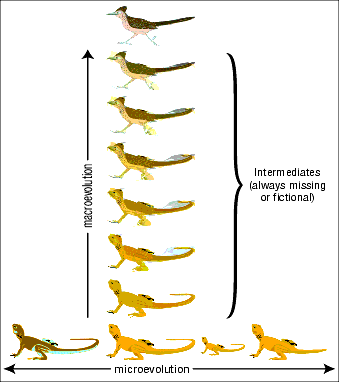
Figure 2: Microevolution vs. Macroevolution. Notice that macroevolution would require an upward change in the complexity of certain traits and organs. Microevolution involves only “horizontal” (or even downward) changes—no increasing complexity. Also note that all creationists agree that natural selection occurs. While natural selection does not result in macroevolution, it accounts for many variations within a very narrow range. Science must always base conclusions on what is seen and reproducible. So what is observed? We see variations in lizards, four of which are shown at the bottom. We also see birds, represented at the top. In-between forms (or intermediates), which should be vast in number if macroevolution occurred, are never seen as fossils or living species. A careful observer can usually see unbelievable discontinuities in these claimed upward changes, as well as in the drawing above.
Ever since Darwin, evolutionists have made excuses for why the world and our fossil museums are not overflowing with intermediates.
Organisms that occupy the most diverse environments in the greatest numbers for the longest times should also, according to macroevolution, have the greatest potential for evolving new features and species. Microbes falsify this prediction as well. Their numbers per species are astronomical, and they are dispersed throughout almost all the world’s environments. Even so, the number of microbial species is relatively few.c New features apparently don’t evolve.