Below is the online edition of In the Beginning: Compelling Evidence for Creation and the Flood,
by Dr. Walt Brown. Copyright © Center for Scientific Creation. All rights reserved.
Click here to order the hardbound 8th edition (2008) and other materials.
Life Science Conclusions
When Darwin published The Origin of Species in 1859, the “evolutionary tree” had only a few gaps. Believers in his new theory thought that these gaps would be filled as scientific knowledge increased. Just the opposite has happened. As science has progressed, these “missing links” have multiplied enormously, and the obstacles to “bridging” these gaps have become even more obvious. For example, in Darwin’s day, all life fell into two categories (or kingdoms): animals and plants. Today, it is generally accepted that life falls into five radically different kingdoms, of which animals and plants comprise only two. (None of the five include viruses, which are complex and unique in their own way.) In the 1800s, the animal kingdom was divided into four animal phyla; today there are about forty.
Darwin suggested that the first living creature evolved in a “warm little pond.” Today, almost all evolutionary biologists will privately admit that science has no explanation for how the first living cell evolved. We now know that is a gigantic leap, vastly more improbable than for bacteria to evolve into humans. In Darwin’s day, a cell was thought to be about as simple as a ping-pong ball. Even today, many evolutionists say that bacteria are simple and one of the first forms of life to evolve. However, bacteria are marvelously integrated and complex manufacturing facilities with many mysteries yet to be understood, such as bacterial motors and communication among bacteria. Furthermore, cells come in two radically different types—those with a nucleus and those without. The evolutionary leap from one to the other is staggering to imagine.
The more evolutionists learn about life, the greater complexity they find. A century ago there were no sophisticated microscopes. Consequently, gigantic leaps from single- to multiple-cell organisms were grossly underestimated. Each type of cell in a multicellular organism has a unique job that is controlled by only part of the organism’s DNA. If that organism evolved, its delicate controls (directing which of the myriad of DNA instructions to follow, which to ignore, and when) must also have evolved. Had it not evolved perfectly the first time, that organism would have been diseased. If that first unique cell could not reproduce, the new function would disappear. If just one reproducing cell is out of control, the organism would have one type of cancer.
Development of the computer has also given us a better appreciation of the brain’s intricate electronics, extreme miniaturization, and vast storage capabilities. The human eye, which Darwin admitted made him shudder, was only a single jump in complexity. [See Endnote 9b on page 59.] We now know there are at least a dozen radically different kinds of eyes, each requiring similar jumps if evolution happened. Likewise, the literal leap we call “flight” must have evolved not once, but on at least four different occasions: for birds, some insects, mammals (bats), and reptiles (pterosaurs). Fireflies produce light without heat, a phenomenon called bioluminescence. Other species, including certain fish, crustaceans, squids, plants, bacteria, and fungi, also have lighting systems. Did all these remarkable capabilities evolve independently?
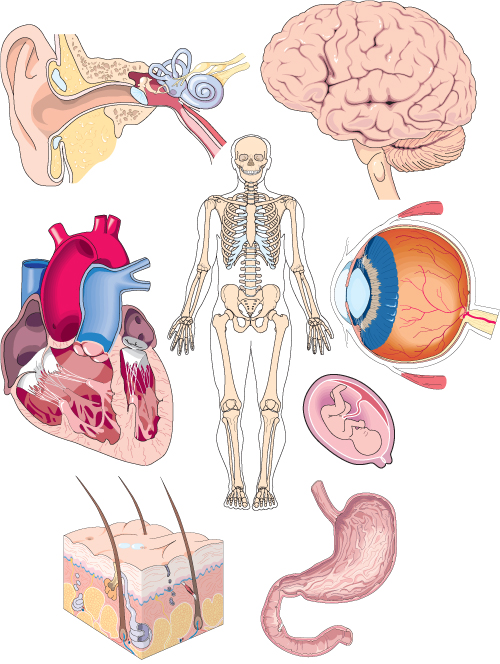
Figure 22: Integration and Compatibility. An organ is a complex structure of different types of tissues and cells, all of which work together to perform one or more functions, such as seeing, hearing, digesting, or pumping. (Shown are a few of the amazing human organs: eye, ear, stomach, heart, skin, and brain.) A system, such as the nervous system, circulatory system, skeletal system, or reproductive system, consists of related organs and other tissues and cells that have even broader functions. In a healthy body, all systems work properly. Life depends on a broad, compatible, and complex hierarchy: molecules --> cells --> tissues --> organs --> systems --> body --> other organisms --> the environment. All are carefully balanced and integrated.
Arbitrarily changing one component at any level will often be harmful at that level and to the vertical hierarchy. For example, change one type of molecule throughout a category of cells, and a diseased body or damaged cells may result. Environmentalists and ecologists are aware of this critical balance (regarding, say, the spotted owl and the environment), but often they fail to ask, “Who or what created this balance?” Some fail to see the incredible complexity, integration, and systems engineering that extends throughout the universe—from carbon atoms to galaxies to physical laws.
Humans are only one of millions of different types of organisms. To integrate all organisms into a living ecosystem requires stupendous design and balance. If evolution happened, time and natural processes alone must have maintained a livable environment for most forms of life as each new organism came into existence and proliferated. No global contaminants, plagues, predators, or famines could be allowed for billions of years. Imagine what would happen if a few organisms at the base of the food chain became extinct.
Who or what has the ability to design, construct, and harmoniously integrate and maintain all of life? Time, chance, and natural processes, as evolution states, or an infinitely intelligent Creator?
Before 1977, it was thought that sunlight provided the energy for all life. We now know that some organisms, living at widely separated locations on the dark ocean floor, use only chemical and thermal energy. For one energy-conversion system to evolve into another would be like changing, by thousands of rare accidents, the wood-burning heating systems of widely separated homes to electricity—but slowly, one accident each year. The occupants would risk freezing every winter. How such a system could evolve on different ocean floors, without solar energy, and in a cold, diluting environment, has yet to be explained.
If evolution happened, many other giant leaps must also have occurred: the first photosynthesis, cold-blooded to warm-blooded animals, floating marine plants to vascular plants, placental mammals to marsupials, egg-laying animals to animals that bear live young, insect metamorphosis, the transition of mammals to the sea (whales, dolphins, porpoises, seals, sea lions, and manatees), the transition of reptiles to the sea (plesiosaurs, ichthyosaurs), and on and on.
Gaps in the fossil record are well known. A century ago, evolutionists argued that these gaps would be filled as knowledge increased. The same gaps persist, and most paleontologists now admit that those predictions failed. Of course, the most famous “missing link” is between man and apes, but the term is deceiving. There is not merely one missing link, but thousands—a long chain—if the evolutionary tree were to connect man and apes (with their many linguistic, social, mental, and physical differences).
Scientific advancements have shown that evolution is an even more absurd theory than it seemed in Darwin’s day. It is a theory without a mechanism. Not even appeals to long periods of time will allow simple organisms to “jump gaps” and become more complex and viable. In fact, as the next section (Astronomical and physical Sciences) will show, long periods of time make such leaps even less likely. Later in this book, you will see that those unimaginably long, time periods in which evolution is claimed to have occurred were a result of a scientific blunder—failure to understand the origin of Earth’s radioactivity.
Breeding experiments that many had hoped would demonstrate macroevolution have failed. The arguments used by Darwin and his followers are now discredited or, at best, in dispute, even among evolutionists. Finally, research during the last several decades has shown that the requirements for life are incredibly complex. Just the design that most people can see around them obviously implies a designer. Oddly enough, evolutionists still argue against this design by using arguments which they spent a great deal of time designing. The theory of organic evolution is invalid.
As we leave the life sciences and examine the astronomical and physical sciences, we will see many other serious problems with evolutionary theories. If just one of the following could not have evolved:
(1) the Earth, (2) the solar system, (3) our galaxy, (4) the universe, or even (5) the heavier chemical elements
as now seems to be the case for each of the five, then organic evolution could not even have begun.