Evidence Requiring an Explanation
Summarized below are the hard-to-explain details which any satisfactory theory for the frozen mammoths should explain.
Abundant Food. A typical wild elephant requires about 330 pounds of food per day. Therefore, vast quantities of food were needed to support the estimated 5,000,000 mammoths that lived in just a small portion of northern Siberia. Adams’ mammoth, discovered in 1799, “was so fat ... that its belly hung below its knees.”109 How was abundant food available inside the Arctic Circle, especially during winter months when the Sun rarely shines?
Warm Climate. Abundant food requires a temperate climate, much warmer than northern Siberia today—or during the Ice Age. Little of the food found in Berezovka’s mouth and stomach grows near the Arctic Circle today. Furthermore, the flower fragments in its stomach show that it died during warm weather. Despite the popular misconception, the mammoth was a temperate—not an Arctic—animal.
Away From Rivers. Although most frozen remains are found along river banks where excavations naturally occur, some frozen remains are found far from rivers.
Yedomas and Loess. Frozen mammoths are frequently found in yedomas and loess. What accounts for this and the strange properties of yedomas and loess? What is the source of so much loess?
Elevated Burials. Mammoth and rhinoceros bodies are often found on the highest levels of generally flat, low plateaus.110 Examples include dense concentrations of mammoth and rhinoceros remains in yedomas and the interior of Arctic islands. Dima was discovered in a mountainous region.
Multi-Continental. Soft parts of large animals have been preserved over a 3,000-mile-wide zone involving three continents (Asia, Europe, and North America). It is unlikely that so many unrelated local events would produce such similar results over such a broad geographical area.
Rock Ice. Strange, granular, Type 3 ice containing clay, sand, and a large volume of air pockets is sometimes found near frozen mammoths. [See Table 10 on page 292.]
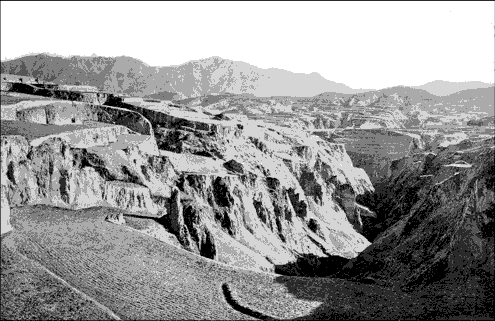
Figure 12: Extensive Loess Deposits. Another property of loess is its ability to maintain a vertical cliff. This is seen here in agricultural terraces in northern China, south of Huang Ho. Some historians maintain that the loess deposits helped establish early Chinese civilization, because the fertility of loess soil allows two or three crops a year—without fertilizers. Homes, even furniture, have been carved out of loess hillsides, sometimes 200 feet underground. Entire villages are cut into loess cliffs. Several million people have lived in loess dwellings. While such homes are cheap, insulated, militarily defensible, and may last for generations, they are unstable and dangerous. For example, 180,000 died in the 1920 Kansu earthquake, primarily from the collapse of loess dwellings.112
Frozen Muck. Mammoth carcasses are almost exclusively encased in frozen muck.111 Also buried in muck are huge deposits of trees and other animal and vegetable matter. The origin of muck is a mystery.
Sudden Freezing. Some frozen mammoths and rhinoceroses had food preserved in their mouths, stomachs, or intestines.113
Suffocation. At least three mammoths and two rhinoceroses suffocated. No other cause of death has been established for the remaining frozen giants.
Dirty Lungs. Dima’s respiratory and digestive tract contained silt, clay, and small particles of gravel. Just before he died, Dima breathed air and/or ate food containing such matter.
Peppered Tusks. Why, over wide geographical areas, did millimeter-size particles (rich in iron and nickel) become embedded in one side of some mammoth tusks?
-150°F. Temperatures surrounding some mammoths must have plunged below -150°F.
Large Animals. Most frozen remains are from the larger, stronger animals, such as mammoths and rhinoceroses.
Summer-Fall Death. Vegetation in the stomachs and intestines of preserved mammoths implies that they died in late summer or early fall,114 perhaps in August115 or even late July.116
Animal Mixes. Bones of many types of animals, friends and foes, are frequently found near the mammoths.
Upright. Several frozen mammoths, and even mammoth skeletons,117 were found upright. Despite this posture, the Berezovka mammoth had a broken pelvis and shoulder blade, and a crushed leg. Surprisingly, he was not lying on his side in a position of agony.
Vertical Compression. Berezovka’s crushed leg bone and horizontally flattened penis show severe vertical compression before or soon after death. Dima was also compressed and flattened.
Eighteen pieces of the problem are now before us. Fitting this centuries-old jigsaw puzzle together will be our final task. As you will see, clever and imaginative proposals have been made, but most address only a few pieces of the puzzle.