63. Radiometric Dating
To date an event or thing that preceded written records, one must assume that the dating clock has operated at a known rate, that the clock’s initial setting is known, and that the clock has not been disturbed. These three assumptions are almost always unstated, overlooked, or invalid.
For the past century, a major (but incorrect) assumption underlying all radioactive dating techniques has been that decay rates, which have been essentially constant over the past 100 years, have also been constant over the past 4,600,000,000 years. Unfortunately, few have questioned this huge and critical assumption.a
It is also critical that one understands how dating clocks work. For radiometric dating clocks on Earth, this is explained in the chapter “The Origin of Earth’s Radioactivity” on pages
391–
429. After studying that chapter, you will see that Earth’s radioactivity—and the many daughter products that so many misinterpreted to mean that the Earth was billions of years old—are a result of powerful electrical activity during the flood, only about 5,000 years ago.
Figure 7: 70,000,00FigureNumberTi0-Year-Old Fish? Thought to have been extinct for 70,000,000 years, the coelacanth (SEE-la-kanth) was first caught in 1938, deep in the Indian Ocean, northwest of Madagascar. Rewards were then offered for coelacanths, so hundreds were caught and sold. In 1998, they were also found off the coast of Indonesia.c How could the ancestors of these coelacanths leave no fossils for 70,000,000 years? (Endnotes here are under “Index Fossils” on pages
97–
99.)
Before coelacanths were caught, evolutionists incorrectly believed that the coelacanth had lungs, a large brain, and four bottom fins about to evolve into legs.d Evolutionists reasoned that the coelacanth, or a similar fish, crawled out of a shallow sea and filled its lungs with air, becoming the first four-legged land animal. Millions of students have been incorrectly taught that this fish was the ancestor of all amphibians, reptiles, dinosaurs, birds, and mammals, including people. (Was your ancestor a fish?)
J. L. B. Smith, a well-known fish expert from South Africa, studied the first two captured coelacanths (nicknamed the coelacanth “Old Fourlegs”) and wrote a book by that title in 1956. When dissected, did they have lungs and a large brain? Not at all.e Furthermore, in 1987, a German team filmed six coelacanths in their natural habitat. They were not crawling on all fours!f
Before living coelacanths were found in 1938, evolutionists dated any rock containing a coelacanth fossil as at least 70,000,000 years old. It was an index fossil. Today, evolutionists frequently express amazement that coelacanth fossils look so much like captured coelacanths—despite more than 70,000,000 years of evolution.g If that age is correct, billions of coelacanths would have lived and died. Some should have been fossilized in younger rock and should be displayed in museums. Their absence implies that coelacanths have not lived for 70,000,000 years.
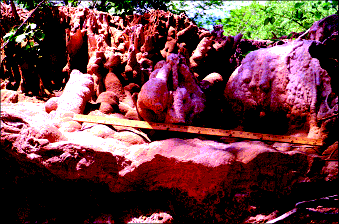
Figure 8: Stalagmites. Water from an underground spring was channeled to this spot on a river bank for only one year. In that time, limestone built up around sticks lying on the bank. Limestone deposits can form rapidly if the groundwater’s chemistry is favorable. Just because stalactites and stalagmites are growing slowly today does not mean they must be millions of years old. As we will see in Part II, conditions after the flood provided the ideal chemistry for rapidly forming such features.