50. Faint Young Sun
If, as evolutionists teach, the solar system evolved from a spinning cloud of dust and gas 4.6-billion years ago, the slowly condensing Sun would have radiated 25–30% less heat during its first 600-million years than it radiates today.a (A drop in the Sun’s radiation of only a few percent would freeze all our oceans.) Had this happened anytime in the past, let alone for 600-million years, the ice’s mirrorlike surfaces would have reflected more of the Sun’s radiation into outer space, cooling Earth even more in a permanent, runaway deep-freeze. If it had, all agree that life could not have evolved.
Evolutionists first tried to solve this “faint young Sun” problem by assuming Earth’s atmosphere once had up to a thousand times more heat-trapping carbon dioxide than today. No evidence supports this, and much opposes it.b Actually, large amounts of carbon dioxide on a cool Earth would have produced “carbon dioxide ice clouds high in the atmosphere, reflecting the Sun’s radiation into outer space and locking Earth into a permanent ice age.”c
A second approach assumes that Earth’s atmosphere had a thousand times more ammonia and methane, other heat-trapping gases. Unfortunately, sunlight quickly destroys both gases, and at high concentrations methane produces a haze that would have cooled Earth’s surface instead of warming it.d Besides, ammonia would readily dissolve in water, making oceans toxic.e
A third approach assumes that Earth had no continents, had much more carbon dioxide in its atmosphere, and rotated once every 14 hours, so most clouds were concentrated at the equator. With liquid water covering the entire Earth, more of the Sun’s radiation would be absorbed, raising Earth’s temperature slightly. All three assumptions are questionable.f
Evolutionists have never explained in any of these approaches how such drastic changes could occur in almost perfect step with the slow increase in the Sun’s radiation. Until some evidence supports such “special pleadings,” it does not appear that the Sun evolved.g
If the Sun, a typical and well-studied star, did not evolve, then why presume that all other stars did?
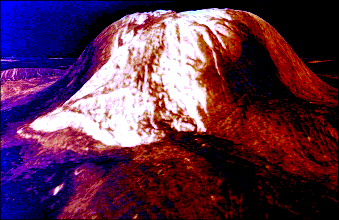
Figure 4: Maat Mons on Venus. If Venus’ mountains were composed of lighter material, they would “float” in the denser rock below, similar to an iceberg floating in denser liquid water. (Mountains on Earth are buoyed up, because they have a density of about 2.7 gm/cm3 and “float” in rock that is about 3.3 gm/cm3.) Data from the Magellan spacecraft that orbited and mapped Venus for several years showed that Venus’ mountains are composed of rock that is too dense to “float.” So, what supports them? It must be Venus’ strong crust—despite Venus’ extremely hot atmosphere. This implies Venus is not old and did not evolve.